 Blog
Blog
Across the European Union, farmers face a common challenge: optimising their operations with efficient, durable, and legally compliant infrastructure. Whether it's for grain storage, housing livestock, or protecting valuable machinery, a well-planned agricultural hangar is a cornerstone of modern farming. But navigating the permits, certifications, and legal frameworks can be as complex as any harvest.
Consider Piotr from Poland, who needed a new facility for his expanding potato and onion storage. He initially considered a budget solution from an uncertified supplier, lured by a low upfront cost. However, his local authorities in Wielkopolska quickly flagged the lack of proper CE EN 1090-2 certification, halting his project before it even began. Meanwhile, Anna in rural Sweden, aiming to build a modern cattle shed, found that EU animal welfare directives and specific ventilation requirements were non-negotiable for securing her CAP funding. Both farmers, like many others, soon realised that a successful build demands more than just steel; it requires an unwavering commitment to European standards and expert guidance.
At Swed-Trac, based in Klaipėda, Lithuania, we don't just manufacture steel structures; we provide the engineering expertise to ensure your agricultural hangar stands legally, safely, and solidly for decades. Our standard-width wide steel hangar is specifically designed as the universal and optimal choice for most farmers across the EU, balancing generous clear-span space with cost-effectiveness and ease of permitting.
This guide delves into the essential legal framework for constructing an agricultural hangar anywhere in Europe, with a strong focus on the highly versatile standard width width. We cover planning permission nuances, mandatory structural certificates, relevant EU regulations, and insurance demands. By understanding these critical elements, you can avoid costly mistakes and ensure your investment provides total peace of mind.
CORE FACTS: SPECIFICATIONS AND MATERIALS
Defining the physical structure is the first step. While we offer a range of widths, our hangar provides an ideal balance of capacity and structural simplicity for most agricultural needs. Its clear span design maximises usable internal space without internal support pillars, making it perfect for manoeuvring large machinery, storing bulk goods, or housing livestock comfortably.
| Specification | Details |
|---|---|
| Product Code | agr-standard width |
| Dimensions (Primary) | 12 m width (universal recommendation), variable length |
| Alternative Widths | 8m (small farms), 10m (medium farms), 15m (wider), 18m (large farms), 20m (industrial) |
| Building Class | Standard Agricultural Structure (typically EXC2, simpler than very wide spans) |
| Steel Grade | S355 (high-strength structural steel) |
| Snow Load | Calculated per region (e.g., Baltic vs. Mediterranean Europe) |
| Certification | CE marking, EN 1090-2 (EXC2 / EXC3) |
FULL PRICE BREAKDOWN: WHAT DOES LEGALITY AND QUALITY COST?
The cost of a new agricultural hangar is a significant investment. While the market is flooded with offers, it's crucial to understand that quality, certification, and compliance come at a price. Our prices reflect European steel market realities and the precision engineering required for a durable structure. Below are three real-world estimate scenarios for a agricultural hangar (e.g., standard width x 30m, 360 m²) in the 2026 European market.
| Configuration | What Do You Get? | Estimated Price (EUR ex. VAT) |
|---|---|---|
| Basic (Cold) | Uninsulated hangar. Steel frame, heavy-duty PVC membrane roof, profiled steel sheet walls, natural ventilation. Ideal for machinery storage or seasonal grain. | ~ 45,000 EUR |
| Optimal (Anti-Drip) | Cold steel building with anti-condensation roof system. Superior natural lighting via transparent roof sections, reinforced airflow. Excellent for grain storage or general purpose. | ~ 60,000 EUR |
| Premium (Warm) | Fully insulated standard width agricultural hangar. Walls and roof from high-grade PIR sandwich panels. Automated doors, mechanical ventilation, smart LED lighting. Perfect for livestock or temperature-sensitive crops. | ~ 95,000 EUR |
Note: Prices are baseline estimates for the 2026 European market for a standard width x 30m structure. We calculate every project individually based on your specific local wind and snow loads, whether you build in the windy Dutch plains or the snowy Austrian Alps. Prices for other widths (8m, 10m, 15m, 18m, 20m) will vary based on material usage and structural complexity.
WHAT IS INCLUDED IN THE ESTIMATE AND WHAT YOU NEED TO BUY EXTRA
Transparency is key to a smooth project. We clearly define our scope of work so you know exactly where our responsibility ends and yours begins for your new hangar.
| Included in the Swed-Trac Price | Not Included (Client Responsibility) |
|---|---|
| Structural design (manufacturing drawings) | Geotechnical soil surveys |
| Steel fabrication | Foundation works (we supply the specs) |
| Wall and roof cladding materials | Bringing utilities (water, electricity) to the site |
| All structural fasteners (bolts, heavy anchors) | Specialised internal fittings (e.g., grain walls, livestock stalls) |
| Delivery of all components to your European site | Architectural planning and securing building permits |
| Professional assembly by our certified crews | Internal fit-out (e.g., office space, feed systems) |
LAWS, CERTIFICATES, AND BUREAUCRACY: HOW TO HANDLE THE STATE BUREAUCRATS
Navigating regulations is crucial for any construction project in the EU. While a steel building is less complex than a 30m clear-span structure, adherence to legal requirements remains paramount.
The Building Permit Process: Navigating Permits
For agricultural buildings, permits are almost always required. In many EU countries, agricultural structures below certain size thresholds or on farms exceeding 5 hectares may benefit from "permitted development rights" or simplified procedures. However, a hangar is a substantial structure that typically requires local authority approval. You can expand or create new agricultural buildings up to 1,500 sq m on units of 5 hectares or more. The normal maximum height for such buildings is standard width.
What does this mean for your timeline? You will need a certified local architect or planner to prepare and submit your application. While a wide span is not classified as a "complex structure" in the same way a 30m span is (which faces intense scrutiny), it still demands precise load calculations based on Eurocode standards (EN 1993-1-1). Securing planning permission usually takes several months, depending on your local municipality. Our Swed-Trac engineers provide all the necessary manufacturing and structural drawings, which your architect can integrate into the master planning application, streamlining the process.
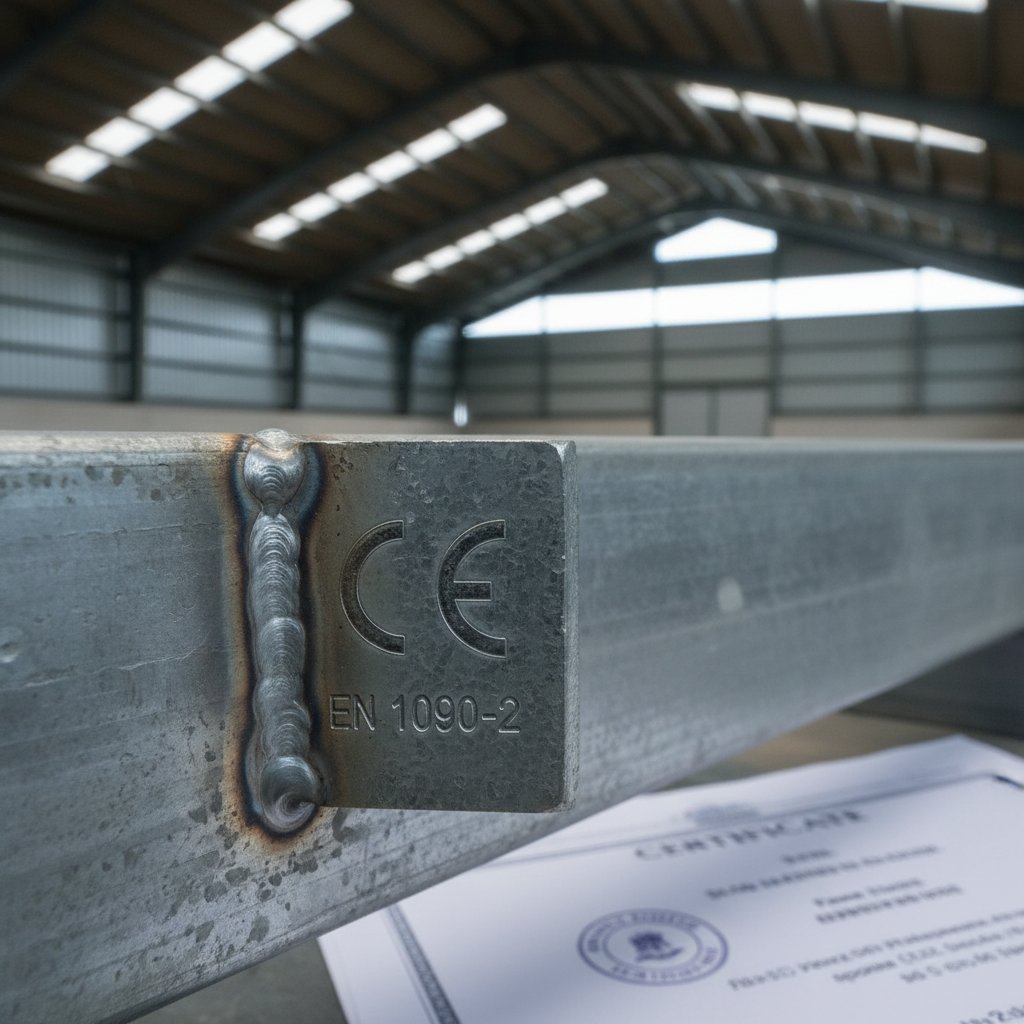
CE EN 1090-2 Certificate: Your Insurance Guarantee
Since 2014, all load-bearing steel structures sold and erected in the EU must carry the CE mark under the EN 1090 standard. For agricultural buildings, including your standard width agricultural hangar, authorities typically demand Execution Class EXC1 or EXC2. EXC1 covers simple designs with low risk, including small agricultural halls, while EXC2 is the most common class for typical building structures.
Purchasing a steel building from an uncertified supplier is a significant risk. Without proper CE EN 1090-2 certification, your local building inspector can halt construction, and major insurers may reject your policy. If a structural failure occurs, the legal and financial liability falls squarely on you. At Swed-Trac, we issue a full Declaration of Performance for every steel component, guaranteeing full traceability and compliance from our factory to your site.
EU Agricultural Regulations (e.g., Animal Welfare, Storage)
If your hangar is intended for livestock, national veterinary services (such as the Veterinäramt in Germany or NVWA in the Netherlands) will enforce EU animal welfare directives (e.g., Directive 98/58/EC). These mandate proper ventilation to prevent ammonia buildup and sufficient natural lighting for animal well-being. Our designs incorporate custom-engineered ridge ventilation systems and transparent roof panels to ensure optimal air circulation and daylight, creating a healthy environment for your animals.
For grain storage, regulations often focus on humidity control and pest prevention. Our optimal and premium standard width grain storage hangars are designed to maintain stable internal conditions, crucial for preserving crop quality.
Insurance Policy Nuances
European underwriters remain cautious after several high-profile agricultural roof collapses due to heavy snow. To secure favourable premiums from insurers like Generali or BNP Paribas for your wide-span universal hangar, you must demonstrate that the building is engineered to withstand local weather extremes. Snow loads in Europe vary significantly. Our engineers design every Swed-Trac frame with a high safety margin, ensuring our buildings are classified as low-risk assets, potentially leading to better insurance rates.
EU CAP & EAFRD Funding in 2026: Financing Opportunities
If you operate a registered agricultural business, you can often tap into EU Common Agricultural Policy (CAP) and EAFRD rural development funds. These funds frequently support investments in modern agricultural infrastructure, including standard width agricultural hangars. The 2026 funding windows usually open in early autumn, and funding bodies demand flawless paperwork. To secure grants, you almost always need full planning permission in hand before applying. This means initiating the design phase with us in the spring is essential to meet autumn funding deadlines.
COMPETITOR COMPARISON: WHAT IS THE MARKET OFFERING?
The European market for agricultural steel buildings is diverse. Here's an objective look at how Swed-Trac's hangar solutions compare, stripping away marketing jargon.
| Manufacturer | Steel Origin & Production | Certification (EN 1090) | Warranty | Strengths / Weaknesses |
|---|---|---|---|---|
| Swed-Trac | Lithuania (Šilutė) | Full EXC2/EXC3 CE | Long-term | In-house manufacturing, rapid EU delivery, highly engineered for extreme weather, hangar expertise. |
| Röwer & Rüb | Germany | Full CE | Standard | Premium heritage brand, excellent quality, but significantly higher prices and longer wait times. |
| LLENTAB | Sweden | Full CE | Standard | Strong track record, but often over-engineered for simple agricultural needs, driving up base costs. |
| Gooiermeer | Netherlands | Basic / Limited | Minimal | Cheap initial price, but frequent issues with local planning due to missing structural documentation. |
THE PROCESS FROM INQUIRY TO HANDOVER
Building a new steel building might seem daunting, but our streamlined process makes it straightforward. Here are nine clear, actionable steps:
- First Contact: You call us to discuss your vision, specific agricultural needs (grain, machinery, livestock), and the exact site location.
- Preliminary Offer: We provide a realistic budget outline for your chosen hangar configuration within a few days.
- Contract Signing: You sign the agreement, we lock in the steel prices (which can fluctuate, especially with ongoing EU steel market regulations) and commence work.
- Design Phase: Our engineers prepare the detailed structural drawings for your local architect or planner.
- Planning Permission: Your architect secures the necessary permits (patience is essential here).
- Manufacturing in Šilutė: We cut and weld the steel for your wide hangar. This typically takes about six weeks.
- Foundation Work: Your local groundworkers pour the concrete foundations using our exact specifications.
- Delivery and Assembly: We ship the structure across Europe, and our certified crews typically build a hangar in two to three weeks.
- Handover: We provide all CE certificates and warranties for final building control sign-off.
TECHNICAL REQUIREMENTS: FOUNDATIONS AND LOADS
Even a hangar must be designed to withstand significant forces. Wind acts like a massive sail, and snow can impose immense loads. Our engineering ensures your building is robust.
Foundations: For a steel building, simple strip or pad foundations are often sufficient, depending on your geotechnical soil surveys. We provide detailed foundation specifications tailored to your site's soil conditions and the calculated loads. Fasteners and Joints: We use only the highest-strength bolts and anchors. Our advanced engineering software calculates every joint, simulating the extreme weather conditions increasingly common across Europe to ensure maximum safety and durability.
REAL CLIENT CASES: THREE DIFFERENT STORIES
Theory is one thing; real-world application is another. Here are three examples of how Swed-Trac's standard width hangars have met diverse agricultural needs across the EU.
1. Henrik's Grain Storage in Denmark
Henrik, a grain farmer in Jutland, needed a cost-effective, yet robust, standard width grain storage hangar. He opted for our Optimal (Anti-Drip) solution, a standard width x 40m structure. The challenge was the high humidity and strong coastal winds. Our engineers reinforced the wind bracing and ensured the anti-condensation roof system was highly effective. The transparent roof sections also provided ample natural light, reducing electricity costs. Henrik successfully secured partial funding through Danish rural development programmes, thanks to our transparent documentation and CE certification.
2. Maria's Machinery Shed in Portugal
Maria, a vineyard owner in the Douro Valley, required a secure standard width machinery shed to protect her expensive tractors and harvesting equipment from the intense sun and occasional heavy rains. She chose a Basic (Cold) standard width x 25m hangar, focusing on durability and ease of access. We incorporated large, custom-sized sliding doors to accommodate her widest machinery. The quick assembly meant minimal disruption to her harvest schedule.
3. Jan's Livestock Barn in the Netherlands
Jan, a dairy farmer in Friesland, needed a new standard width agricultural hangar for young cattle. His primary concerns were animal welfare, ventilation, and future expandability. He selected our Premium (Warm) insulated standard width x 50m hangar. We designed a bespoke natural ventilation system combined with transparent roof sections for optimal daylight and air quality, meeting strict Dutch animal welfare standards. The insulated sandwich panels maintain a stable internal temperature, reducing stress on the calves and cutting heating costs, proving the value of a wide-span universal hangar for livestock.
DECISION TREE: WHICH OPTION TO CHOOSE?
Feeling overwhelmed by choices? Ask yourself these three simple questions to guide your decision for a hangar or alternative width:
- What is the primary use of your hangar? * Machinery/General Storage: Basic or Optimal cold steel building is typically sufficient. * Grain/Feed Storage: Optimal (Anti-Drip) standard width grain storage hangar is highly recommended for climate control. * Livestock/Temperature-Sensitive Crops: Premium insulated standard width agricultural hangar is the best choice for animal welfare and climate stability.
- Do you plan to apply for EU CAP or EAFRD funding? * Yes: Start the design phase with us today. The bureaucratic paperwork for grants often requires approved plans and takes several months before submission.
- Is your budget strictly capped right now, but you foresee future upgrades? * Yes: Build a cold wide hangar now. Our heavy-duty structural frames allow you to add PIR insulation panels and other features later when cash flow improves, making it a truly wide-span universal hangar that adapts to your needs.
GENERAL TIPS AND WARNINGS: DO NOT REPEAT THESE MISTAKES
As structural engineers, we've witnessed numerous pitfalls. Avoid these common and costly mistakes when planning your hangar:
- Never ignore ventilation, especially for livestock. Inadequate airflow in a sealed structure leads to condensation, which can damage stored goods or, worse, cause respiratory issues for animals due to ammonia buildup.
- Do not buy from uncertified suppliers. A steel building, even a hangar, is a significant structure. Without proper engineering, certified materials, and full EN 1090-2 documentation, you risk structural failure, legal penalties, and insurance rejection. It's not worth saving a few euros upfront.
- Plan your access and internal layout carefully. Consider the largest machinery you'll use, the flow of goods (e.g., grain delivery and extraction), or animal movement within the standard width machinery shed or livestock barn. Ensure gates are appropriately sized and positioned for optimal efficiency.
Want a quote on a hangar? Call +370 645 18595 or email sales@swedhall.se - we will prepare an individual quote within 24 hours.
FREQUENTLY ASKED QUESTIONS (FAQ)
Does a agricultural hangar require planning permission in Europe?
Yes, almost always. While specific rules vary by country and farm size, a structure of this size is a permanent agricultural building and typically requires local authority approval.
How long does it take to get a permit for a standard width agricultural hangar?
The approval process can range from two to six months, depending on your local municipality, the complexity of your application, and whether you qualify for simplified "permitted development" procedures.
Can a hangar be built on designated agricultural land?
Yes, provided you operate a registered agricultural business or farm. You will, however, need to ensure the building is for agricultural purposes and may require a rural development plan approved by local planning officers.
What exactly is the CE EN 1090-2 certificate, and why is it important for a steel building?
It is a mandatory European Union standard proving that the steel structures are manufactured correctly, are traceable, will withstand designated loads, and are safe. Without it, your hangar may not pass inspection, be insurable, or be legal.
Is a wide span considered a "complex structure" under Eurocodes?
No, not in the same way a 30m or wider span is. While all steel structures require proper engineering under Eurocode 3 (EN 1993-1-1), a standard width clear span typically falls into Execution Class EXC1 or EXC2, indicating a standard level of complexity and risk, making the permitting process generally more straightforward than for very large spans.