 Blog
Blog
Picture Lars, a grain farmer based in Jutland, Denmark. A few years ago, his farm operated with limited storage, forcing him to sell his harvest at suboptimal times. His machinery was left exposed to the harsh Nordic weather, leading to premature wear and costly repairs. Every autumn, the struggle to protect his valuable assets from rain, snow, and wind was an absolute nightmare. His profits suffered, and worse, he was losing his passion for farming efficiently.
One day, he decided enough was enough and contacted our Swed-Trac team. We proposed the most efficient solution for his diverse needs: a versatile wide steel hangar. This universal width is perfectly suited for everything from grain storage and machinery sheds to livestock housing and feed storage, making it the optimal choice for most European farmers. A few weeks later, after manufacturing at our Šilutė factory in Lithuania and rapid assembly on his Danish property, a robust, bright, and spacious steel building stood in Lars's yard. His first reaction was pure relief. His second question, however, was highly practical: "What exactly do I need to do to make sure this standard width agricultural hangar stands here without any issues for the next fifty years?"
That exact question inspired us to write this comprehensive, expert guide. An agricultural hangar is never just a random collection of steel and cladding. It is a highly engineered structure. Its longevity depends entirely on correct operation and regular upkeep. In this deep dive, we will break down the exact agricultural hangar maintenance and longevity requirements, reveal what a project like this actually costs across Europe in 2026, explain how to secure EU CAP (Common Agricultural Policy) funding, and show you how to avoid costly mistakes.
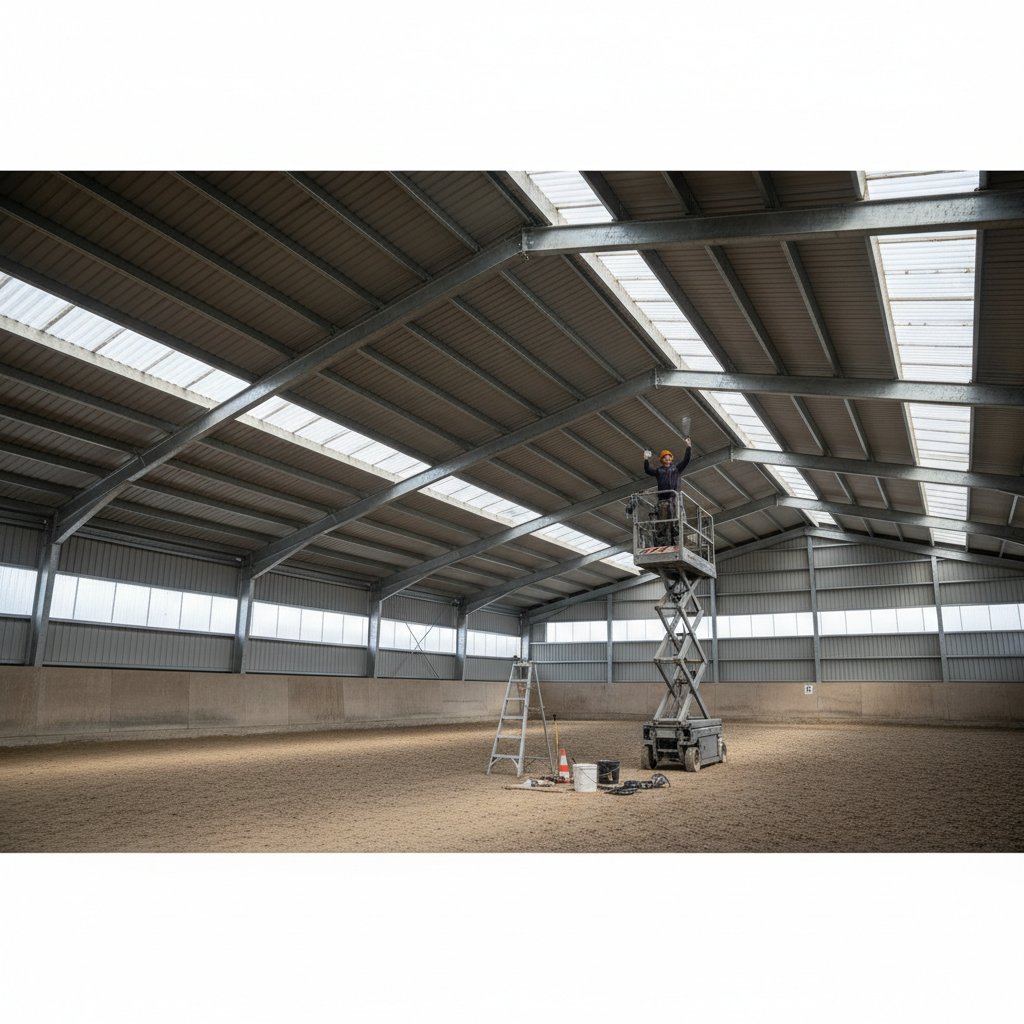
Core Facts About the "20x40m Dressage Arena"
Before we look at the finer details of maintenance, you need to understand exactly what kind of structure we are dealing with. Swed-Trac agricultural hangars are engineered to handle the most brutal European climates-from the punishing coastal winds of Normandy to the crushing snow loads of the Austrian Tyrol. While this article focuses on our highly recommended hangar, Swed-Trac offers a versatile range of widths to suit every farm size and requirement:
- 8m width: Ideal for small farms, compact machinery, or basic storage.
- 10m width: Suitable for medium-sized operations, offering more flexibility.
- standard width width (UNIVERSAL - RECOMMENDED): Our flagship wide hangar, offering unparalleled versatility for grain, feed, machinery, livestock, and general storage. This wide-span universal hangar is the most cost-effective solution for the majority of farmers.
- 15m width: For wider machinery or larger storage volumes.
- 18m width: Tailored for large farms and substantial storage needs.
- 20m width: Our largest option, perfect for industrial-scale agricultural operations or specialist facilities.
Here are the core specifications for our highly popular hangar:
| Parameter | Specification |
|---|---|
| Product Code | hgr-agri-standard width |
| Dimensions | 12 m (width) × Variable Length (typically 20m, 30m, 40m, etc.) |
| Typical Area (e.g., 12x40m) | 480 square metres |
| Primary Use | Grain storage, machinery shed, livestock housing, feed storage, general agricultural storage |
| Framework | Steel, strictly CE EN 1090-2 certified |
| Cladding Options | High-grammage PVC tensioned membrane, profiled steel, or insulated PIR panels |
| Snow Load Capacity | Engineered to withstand up to 2.5 kN/m² (compliant with Alpine and Nordic regions) |
| Wind Load Capacity | Withstands severe gusts up to 32 m/s |
| Manufacturing Hub | Šilutė, Lithuania (100% European production) |
These specifications tell a very clear story. You are not buying a temporary cover. You are investing in a permanent, architecturally calculated steel building that will serve generations of farmers if you treat it right.
Full Price Breakdown: What Does an Arena Actually Cost?
The most common question we hear from farmers across Germany, Poland, and the Benelux region is simple: what is the final bill for a standard width agricultural hangar? The internet is flooded with misleading advertisements offering agricultural buildings for suspiciously low prices. They conveniently hide what is excluded from the quote. We prefer total transparency. Here are three realistic pricing scenarios for a standard width x 40m wide hangar for the European market in 2026 (prices exclude VAT and remain estimates based on specific site conditions).
| Component | Base Class (Cold, PVC Membrane) | Mid-Range (Steel Cladding + Anti-Condensation) | Premium Class (Fully Insulated PIR Panels) |
|---|---|---|---|
| Steel Framework (12x40m) | 35,000 EUR | 38,000 EUR | 45,000 EUR |
| Roof and Wall Cladding | 19,000 EUR | 28,000 EUR | 70,000 EUR |
| Gates (Two Standard) | 4,000 EUR | 4,500 EUR | 7,500 EUR |
| Pan-European Delivery | 3,500 EUR | 3,500 EUR | 4,500 EUR |
| Professional Assembly | 13,000 EUR | 17,000 EUR | 24,000 EUR |
| Total Estimated Investment | ~74,500 EUR | ~91,000 EUR | ~151,000 EUR |
Here's the thing: upgrading to a fully insulated steel building with PIR panels requires a significantly higher initial investment. However, it is absolutely worth the money if you need to guarantee optimal conditions for sensitive crops like potatoes or onions, or maintain a comfortable environment for livestock even when it is minus fifteen degrees outside in Bavaria. For a standard width grain storage hangar, insulation can be critical for preventing spoilage.
What Is Included in the Price and What You Handle Yourself
Honesty is the foundation of our business model. When you sign a contract with Swed-Trac, you know exactly what is landing on your desk and what remains on your to-do list for your new hangar.
| Included in the Swed-Trac Package | Excluded (Client Responsibility) |
|---|---|
| Full technical working project for the steel structure | Geological soil surveys and ground testing |
| Framework manufacturing at our CE-certified Šilutė plant | Pouring concrete foundations and earthworks |
| All heavy-duty fasteners, bolts, and tensioning systems | Local planning permission fees (though we supply the structural drawings for your standard width agricultural hangar) |
| Your chosen cladding (PVC, steel, or insulated panels) | Internal flooring (concrete slab, gravel, etc.) |
| Professional assembly on your property by our crews | Internal lighting and electrical installations |
| Comprehensive, long-term structural warranty | External perimeter drainage systems |
We never hide extra costs. A successful build requires meticulous budget planning, often involving financing through institutions like ING, Crédit Agricole, or Deutsche Bank. Knowing your exact outgoings prevents nasty surprises down the line for your steel building.
Maintenance Schedule: Daily, Monthly, Yearly
Let us tackle the core subject: agricultural hangar maintenance and longevity. The truth is, prevention is always cheaper than a cure. Our steel structures are incredibly resilient, but like any premium facility, they demand respect and routine care.
Daily Maintenance
- Ventilation Management: For livestock housing or grain storage, proper ventilation is crucial. EU regulations often mandate specific air exchange rates to prevent ammonia, dust, or moisture buildup, which can harm animal health or spoil crops. Open your ventilation louvres or gates daily, especially in standard width livestock hangars.
- Gate Track Sweeping: Agricultural operations often involve heavy machinery and vehicles, which track in a massive amount of dirt and debris. Sweep the sliding gate tracks every single day. If you skip this, the rollers will jam, grind, and eventually snap, impacting your standard width machinery shed access.
- Visual Inspections: Before starting your day, cast a quick eye over the structure. Check for any obvious damage to cladding, gates, or anything unusual.
Monthly Maintenance
- Membrane Tension Checks: If you opted for the PVC membrane roof on your hangar, inspect the tension after severe autumn storms. A loose membrane flaps in the wind, which can cause material degradation and unnecessary wear.
- Gutter Cleaning: Across Europe, autumn means falling leaves. Blocked gutters mean rainwater will overflow, wash away your perimeter foundations, and potentially cause water ingress. This is particularly critical for a standard width grain storage hangar where moisture control is paramount.
- Condensation Monitoring: If you own a cold steel building with a steel roof, keep an eye on the anti-condensation fleece. It needs to dry out completely during the day. If it remains permanently sodden, your ventilation is inadequate and needs immediate adjustment to protect stored goods or livestock.
Yearly Maintenance
- Cladding Washdown: Every spring, wash the exterior of your standard width agricultural hangar. If your facility sits near dense woodland, algae, moss, and pollen will accumulate on the roof. A clean surface looks professional and extends the lifespan of the materials.
- Fastener and Bolt Inspection: We use high-grade, vibration-resistant bolts. Even so, once a year, visually inspect the primary structural joints of your hangar.
- Foundation Settling Checks: Ground shifts slightly during the first few years after construction. Walk the perimeter and ensure no hairline cracks have appeared in the concrete around the anchor columns.
Every Five Years
- Detailed Engineering Audit: We highly recommend calling in specialists (you can book our Swed-Trac maintenance team) for a comprehensive audit. They will check the structural geometry, recalibrate the tensioning ratchets, grease all heavy moving mechanisms, and replace any perishing weather seals on your steel building.
Common Problems and Swed-Trac Solutions
Even the most premium agricultural buildings face environmental challenges. Recognising them early makes them incredibly easy to manage for your hangar.
-
Condensation Dripping on Stored Goods or Livestock The Problem: High humidity from stored grain or livestock respiration, combined with cold external temperatures, leads to moisture condensing on uninsulated or poorly ventilated roof surfaces. This can spoil grain, create damp conditions for animals, and lead to structural corrosion. The Solution: For any standard width grain storage hangar or livestock facility, we always integrate a factory-applied anti-condensation fleece or recommend insulated PIR panels. This absorbs moisture or prevents condensation entirely. We also mandate ridge ventilation to ensure continuous airflow.
-
Wind Noise and Damage to Cladding The Problem: A poorly tensioned PVC cover or inadequately secured steel sheets can flap and rattle in strong winds, causing stress to the structure and potential damage. This can also disturb sensitive livestock. The Solution: Swed-Trac uses a proprietary dual-tensioning system featuring industrial-grade straps and ratchets for PVC membranes, pulling them as tight as a drum snare. For steel cladding on our steel building, we use robust fasteners and a precise installation method to eliminate wind flutter and rattle.
-
Debris Clogging Doors and Mechanisms The Problem: Agricultural environments are inherently dusty and muddy. Dirt, straw, and other debris can clog traditional floor-mounted door hinges and locks, making access difficult for machinery. The Solution: We engineer our standard width machinery sheds with top-hung sliding gates or heavy-duty roller shutters. The bottom edge floats above the ground, meaning there are zero complex mechanisms sitting in the debris zone, ensuring smooth operation.
The Swed-Trac Warranty - What It Covers and How It Works
We build these structures to last, and our warranty conditions reflect that confidence. European insurers like Allianz, AXA, and Agria love our buildings because of our strict compliance with CE EN 1090-2 standards.
- The Steel Framework of your standard width agricultural hangar carries a structural warranty of up to fifty years, depending on the environmental aggressiveness of your site (facilities built right on the North Sea coast require specific maintenance schedules due to salt spray).
- The PVC Membrane comes with a standard ten-year warranty, though real-world data proves that a well-maintained cover easily lasts fifteen to twenty years for a wide hangar.
- Steel Cladding and PIR Insulated Panels carry manufacturer warranties typically ranging from twenty to thirty years.
The process is entirely frictionless. If you spot a manufacturing defect or structural anomaly in your steel building, you call our European support desk. Our engineers travel to your site, assess the situation, and if it falls under warranty, we fix it completely free of charge. No hidden clauses, no aggressive pushback.
Competitor Comparison: Swed-Trac vs. Röwer & Rüb, LLENTAB, and Gooiermeer
When tendering for your new hangar, you will inevitably cross paths with several well-known European brands. Here is an objective look at the 2026 market landscape.
| Criteria | Swed-Trac | Röwer & Rüb (DE) | LLENTAB (SE) | Gooiermeer (NL) |
|---|---|---|---|---|
| Core Specialisation | Universal Agricultural Hangars (8m-20m), expert in standard width width | Ultra-luxury equestrian estates | Heavy industrial and commercial steel | Universal agricultural and budget storage |
| Manufacturing Base | Šilutė, Lithuania (EU) | Germany | Sweden / Europe | Netherlands / Outsourced |
| Price Bracket | Mid / High | Ultra-Premium | High | Budget / Mid |
| Framework Warranty | Up to 50 years | Long-term | Long-term | Standard |
| Assembly Control | In-house Swed-Trac crews | Highly controlled | In-house / Certified partners | Often relies on local subcontractors |
| CE EN 1090-2 | Strictly Enforced | Strictly Enforced | Strictly Enforced | Varies by product line |
Röwer & Rüb is a spectacular choice if you have a limitless budget and want architectural luxury, but their pricing is astronomical and their focus is not on agricultural practicality. LLENTAB builds phenomenal, indestructible steel halls, but their focus leans heavily toward industrial warehousing rather than the specific nuances of a versatile standard width agricultural hangar. Gooiermeer offers great value if you just need a basic tractor shed, but their lighter structures may struggle with extreme snow loads or the demands of a standard width grain storage hangar. Swed-Trac occupies the perfect middle ground: flawless engineering, deep agricultural expertise with a special focus on the optimal wide hangar, and highly competitive pricing thanks to our consolidated manufacturing base in Lithuania.
The Process From Inquiry to Handover
What exactly happens when you decide to pull the trigger on a new hangar? We have stripped the chaos out of the process, breaking it down into ten predictable steps.
- Initial Consultation (1-2 days). You contact us. We discuss your site layout, local weather conditions, and budget for your steel building.
- Preliminary Quotation (2-3 days). We deliver a crystal-clear, itemised proposal for your chosen hangar.
- Contract and Deposit (1 week). Once you are happy, we sign the paperwork. Your price is locked in.
- Technical Design (2-3 weeks). Our structural engineers draft the exact blueprints your local planning authority and groundworkers will need for your standard width agricultural hangar.
- Planning Permission (4-12 weeks). You handle this locally with your architect, using our certified drawings to speed up the approval.
- Manufacturing in Šilutė (3-5 weeks). We cut and weld your steel framework.
- Foundation Work (Concurrent). Your local contractors pour the concrete pads based on our exact specifications.
- Site Delivery (1-3 days). The steel, cladding, and components for your hangar arrive at your yard via heavy goods transport.
- Construction (2-4 weeks). Our specialist assembly crews arrive and build the hangar safely and efficiently.
- Final Handover. We walk the site together, inspect every bolt, sign the handover protocol, and your new hangar is ready for use.
From the first phone call to the first use, the entire journey usually takes three to six months, heavily dependent on how fast your local municipality processes planning permits.
Technical and Legal Requirements in 2026
Building an agricultural facility requires navigating a web of European regulations. The landscape in 2026 is stricter than ever.
EAFRD and EU CAP Funding: If you plan to subsidise your build using the European Agricultural Fund for Rural Development (EAFRD) or local CAP grants, timing is everything. In many EU states, the application windows for sustainable rural business expansion open in September. You must have your planning permissions and official Swed-Trac commercial quotes ready long before the deadline for your standard width agricultural hangar. Missing the window means waiting another year.
Agricultural Building Standards: All Swed-Trac standard width steel buildings are designed to comply with relevant European structural standards (e.g., Eurocodes) for snow and wind loads. For livestock housing, specific directives regarding ventilation, natural light, and animal welfare (e.g., Council Directive 2008/120/EC for pigs, 2007/43/EC for chickens) must be considered. Our white PVC roof membranes allow brilliant, diffused natural daylight to flood the interior, while our steel-clad buildings incorporate massive polycarbonate light ridges to ensure compliance with natural light requirements for animal welfare or a pleasant working environment in your standard width machinery shed.
Grain Storage Regulations: For a standard width grain storage hangar, specific regulations regarding ventilation, pest control, and moisture management are paramount to prevent spoilage and ensure food safety. Our insulated options and integrated ventilation solutions are designed with these critical factors in mind.
Real Customer Cases: How Arenas Perform Across European Regions
Theory is fantastic, but real-world performance is what actually matters. Here is how Swed-Trac's standard width wide hangars are currently performing in three very different European climates.
1. Sophie from Normandy, France - Battling the Coastal Gales with a standard width Machinery Shed Sophie runs a mixed farm just a few miles from the English Channel. The autumn winds here regularly rip the roofs off old barns. She chose a base-class PVC tensioned standard width machinery shed because she needed natural light for maintenance work and a cost-effective solution, but she was terrified of wind damage. By employing our dual-tensioning system and upgrading her ground anchors, her wide hangar has withstood 30 m/s gusts without a single flutter. She sweeps her gate tracks daily to keep the coastal sand out, and the structure looks as good as the day we built it.
2. Hans from Bavaria, Germany - The Heavy Snow Load Challenge for a standard width Grain Storage Hangar Hans operates a large arable farm in the foothills of the Alps. His previous wooden grain store collapsed under a freak snowstorm in 2023. When he rebuilt with Swed-Trac, we engineered his steel building to handle a massive 2.5 kN/m² snow load. He opted for the mid-range steel cladding with anti-condensation fleece for his standard width grain storage hangar. During the brutal winter of 2025, while neighbouring facilities were paying crews to shovel snow off their roofs, Hans's grain remained perfectly dry and safe inside his Swed-Trac structure.
3. Martijn from North Holland, Netherlands - Managing Relentless Rain for a standard width Livestock Hangar Martijn operates a busy dairy farm in a region famous for its endless winter drizzle and high humidity. Condensation was his biggest enemy in his previous livestock shelters, leading to respiratory issues for his calves. He invested in our premium PIR-insulated standard width livestock hangar. Because the panels create a thermal break, condensation simply does not form on the ceiling, regardless of how many animals are housed inside. Combined with strict daily ventilation routines, his calves remain healthy and comfortable all winter long. He considers the premium upgrade for his wide-span universal hangar the best financial decision he ever made for his business.
Want a quote on a hangar? Call +370 645 18595 or email sales@swedhall.se - we will prepare an individual quote within 24 hours.
Frequently asked questions
What is the optimal arena size?
Training: 20×40 m (small showjumping). Competition: 20×60 m (Olympic dressage). Hobby: 15×30 m can be sufficient. Ceiling height minimum 4.5 m at centre.
How much does an insulated arena cost?
An insulated 20×40 m arena in Europe: €120,000-€220,000. Uninsulated: €70,000-€130,000. Insulation pays off if used year-round.
Which footing is best?
Most popular: quartz sand with geotextile (all-purpose), sand with rubber granules (drainage), polymer EuroDressage-type (pro level). Thickness 12-18 cm.
Is ventilation needed?
Yes - natural ventilation via ridge vent + gable doors. With >15 horses simultaneously, mechanical ventilation is recommended (CO₂
How long does an arena build take?
Typically 3-5 months: design + permits (1.5 mo), manufacturing (4-6 wks), installation (2-4 wks), footing installation (1 wk).