 Blog
Blog
Let us take a real example. Klaus, a farmer in Mecklenburg-Vorpommern, Germany, faced a common dilemma. His existing storage was overflowing, leaving expensive machinery exposed to the harsh Baltic winters and newly harvested grain vulnerable to moisture and pests. Every year, he calculated the damage - thousands of euros in machinery repairs due to rust, spoiled grain, and lost income from inefficient operations. He needed a robust, versatile, and cost-effective solution that could adapt to his farm's diverse needs, from sheltering tractors to storing feed or even housing young livestock. He needed a structure that would last, required minimal upkeep, and fit a strict budget.
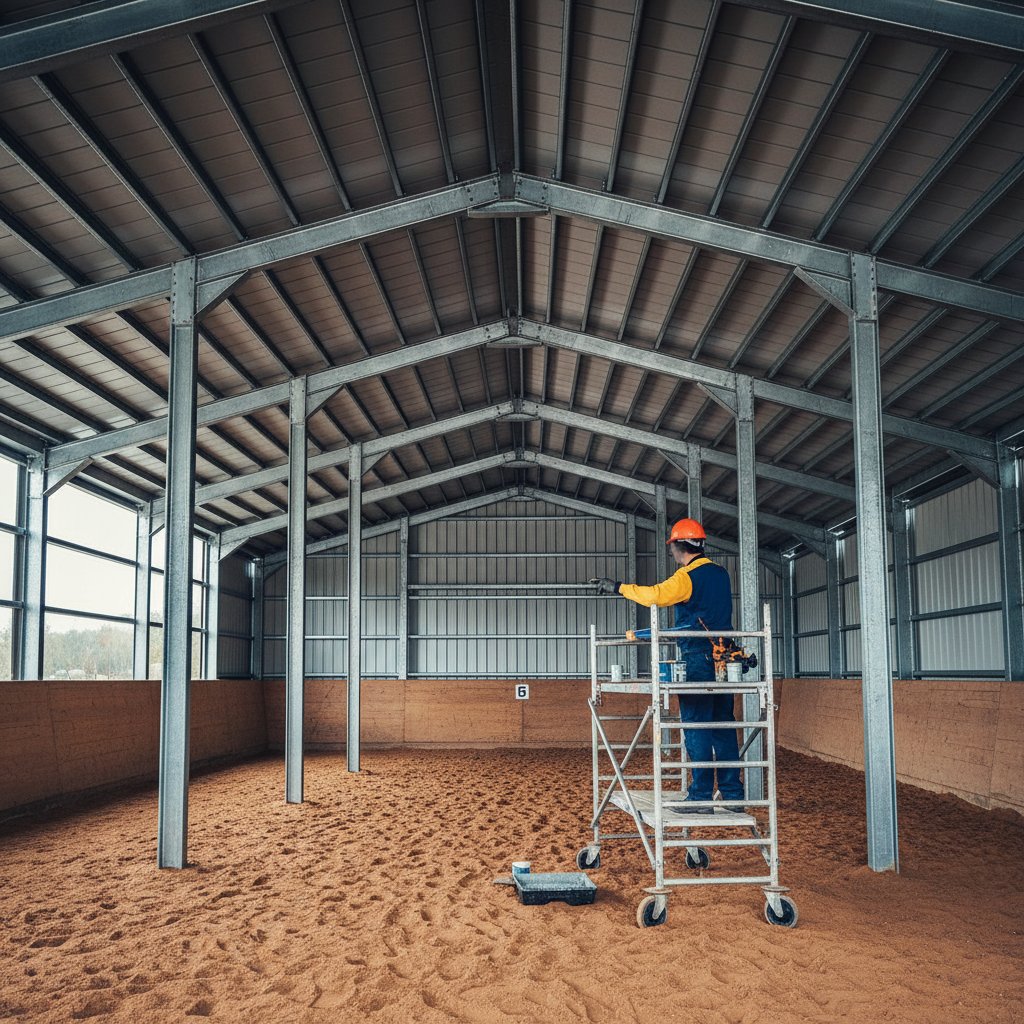
That is exactly when he contacted our team. At Swed-Trac, we engineer and manufacture heavy-duty steel structures in our Šilutė factory in Lithuania. We offered him a way out: a wide hangar, perfectly suited for a wide range of agricultural applications. This isn't just a basic shed; it's a highly engineered steel building designed to withstand severe European weather, from heavy snowfalls in the Nordics to strong coastal winds in the Netherlands. Klaus initially had doubts about the investment. Would it be truly versatile? Would the steel frame rust? The truth is, several years down the line, he has absolutely no regrets. His standard width agricultural hangar stands as solid as the day we installed it, providing crucial protection and flexibility for his farm.
If you, like Klaus, are looking for a reliable, multi-purpose solution for your farm, this expert guide is for you. Here we break down exactly what selecting, costing, and ensuring the longevity of a hangar looks like in the real world. We will look at what it actually costs, the problems you might face, and how to avoid them entirely. A modern farm demands efficient, protected spaces, and a hangar offers precisely that peace of mind and solid guarantees.
The core facts about the standard width wide universal agricultural hangar
Before we dive into pricing and maintenance schedules, let us look at what makes the hangar the optimal choice for most European farms. This width (product code: STR-AG12) is truly universal, providing ample space for everything from large combine harvesters to bulk grain storage, or even flexible livestock housing.
| Specification | Details |
|---|---|
| Length and width | Twelve metres wide (universal) and customisable length (e.g., 20m, 30m, 40m+) |
| Total area | From 120 m² (for a 12x10m unit) upwards, offering scalable solutions |
| Structure type | Steel frame (CE EN 1090-2 certified) |
| Cover options | High-density PVC (UV resistant) or robust sandwich panels (PIR) |
| Snow load | Engineered for diverse European climates (e.g., up to 2.5 kN/m² for heavy snow regions) |
| Wind load | Withstands coastal storms and strong inland winds (customisable by location) |
| Manufacturing site | Šilutė, Lithuania |
| Expected lifespan | Steel frame - over fifty years, PVC cover - fifteen to twenty years, Sandwich panels - thirty to fifty years |
The structures we manufacture stand out because we only use premium structural steel. Longevity is hardcoded into the very first stage of our production line. This ensures your steel building is a long-term asset.
Full cost breakdown: Investing in your farm's future
One of the most frequent questions we hear from European farmers is simple: "What will a hangar actually cost, without the hidden fees?" Prices depend directly on your specific requirements and the chosen dimensions. While we offer a range of widths - from 8m for small farms, 10m for medium operations, standard width as the universal and recommended choice, 15m for wider needs, 18m for large farms, up to 20m for industrial applications - the hangar consistently proves to be the most versatile and cost-effective for the majority.
We created three distinct scenarios focusing on the standard width width to help you plan your budget. These figures are estimates and fluctuate slightly based on global steel market rates, but they accurately reflect the reality of the European market in 2026.
| Scenario | Description | Estimated price (EUR excl. VAT) |
|---|---|---|
| Basic (PVC) | standard width x 20m (240m²), single-layer PVC cover, standard sliding doors, no forced ventilation. Ideal for machinery storage or hay. | From thirty-two thousand euros |
| Medium (PVC Pro) | standard width x 30m (360m²), double-layer PVC roof (reduces condensation), reinforced sliding doors, natural ridge ventilation. Excellent for standard width grain storage hangar or feed. | From forty-eight thousand euros |
| Premium (Insulated) | standard width x 40m (480m²), sandwich panels (PIR) for walls and roof, automatic roll-up doors, full climate control. Perfect for livestock, workshops, or high-value standard width machinery shed. | From seventy-eight thousand euros |
For context, if you just want a basic storage shed, a standard steel structure (say, eight by ten metres, totalling eighty square metres) from suppliers like LLENTAB or Gooiermeer might cost you around eleven thousand euros. However, a Swed-Trac standard width agricultural hangar is engineered for specific agricultural demands, offering superior protection, longevity, and versatility. The investment is higher, but it is entirely justified by the increased efficiency, reduced losses, and extended lifespan of your farm assets.
What is included in the price, and what is not?
Transparency drives our business. When you sign a contract with Swed-Trac for your hangar, you know exactly what is landing on your yard. Here is the clear breakdown:
| Included in the standard quote | Not included (Client responsibility or optional extra) |
|---|---|
| Complete steel frame | Foundation works (concrete pads or screw piles) |
| Selected cladding (PVC or PIR panels) | Internal fit-out (e.g., grain walls, livestock pens, shelving) |
| Standard access doors (e.g., sliding or roll-up) | Lighting systems and electrical wiring |
| Engineering drawings and CE documentation | Ground levelling and site preparation |
| Delivery across mainland Europe | VAT (applied according to national laws) |
| Installation manuals | Specialised ventilation or climate control systems (beyond natural) |
If you want to know how to properly prepare the base for your new steel building, we highly recommend reading our dedicated guide on the subject.
Maintenance and longevity: Ensuring your hangar stands the test of time
Here is the crux of the matter. The longevity of your standard width agricultural hangar depends entirely on how seriously you take regular inspections. Our buildings are incredibly tough, but a tiny bit of routine attention guarantees they will serve you for decades, protecting your investments and streamlining your operations.
Daily maintenance (Takes five minutes)
Your daily routine should never feel like a chore. You only need to: - Visually inspect the main access doors and ensure the tracks are clear of mud, stones, or feed debris. Debris quickly jams sliding or roll-up mechanisms. - Check the perimeter for any obvious damage to the cladding or signs of impact.
Monthly maintenance (Takes half an hour)
Once a month, carry out a slightly closer inspection: - PVC tension check: If your hangar has a PVC cover, inspect all tensioning straps and buckles. Temperature fluctuations cause the PVC to contract and expand. If the cover flaps violently in the wind, you must tighten it. Flapping eventually wears the material down. - Condensation check: In single-layer PVC structures, condensation can occur. Ensure any moisture runs cleanly down the edges and doesn't accumulate on stored items or drip onto machinery. - Bolt inspection: Quickly check visible structural bolts for any signs of loosening.
Yearly maintenance (Before the winter season)
This is a more thorough check. Set aside half a day: - Washing the cladding: Use mild soapy water. Never use aggressive chemical cleaners. Washing away dust, bird droppings, and algae extends the life of PVC and improves natural light. For sandwich panels, a simple rinse is often sufficient. - Tightening bolts: Wind loads and daily vibrations can loosen structural bolts over a twelve-month period. Walk through the main structural nodes with a spanner and tighten everything up. - Lubricating hinges and bearings: Well-oiled door tracks and hinges guarantee smooth operation even when temperatures drop below freezing. - Seal inspection: Check all seals around doors and openings for integrity, ensuring your standard width grain storage hangar remains airtight and pest-free.
Every five years: General inspection
After half a decade, we recommend a complete structural audit: - Inspect the entire steel frame. Mechanical damage (like hitting a pillar with a tractor) can compromise the protective layer, so touch up any scratched areas. - Evaluate the foundation. Has the ground settled? Are the screw piles or concrete pads still perfectly level? - Read more about the long-term differences in our PVC vs. sandwich panels comparison on our blog.
Common problems and their solutions
- Condensation dripping inside: This is basic physics in single-layer structures. The solution is to ensure constant airflow through natural ventilation (ridge vents, gable openings) or to opt for a double-layer PVC roof or insulated sandwich panels from day one.
- Algae/Moss on PVC roof: Yards located near dense forests often see moss or algae build-up on PVC. The solution is an annual pressure wash (keeping the nozzle at a safe distance to avoid damaging the fabric). This is less common with sandwich panels.
- Stiff or jammed doors: This usually means debris in the tracks or a slight shift in the foundation after heavy frost. The solution is regular cleaning of tracks and adjusting hinges or rollers to compensate.
Warranty conditions
We back the products we build in Šilutė. We provide ironclad guarantees: - Twenty-five years on the steel frame against structural manufacturing defects. - Five to ten years on the PVC cover (depending on the chosen fabric density). - Five years on the installation work (if our teams assemble the structure).
Competitor comparison: Why Swed-Trac is your best choice for agricultural hangars
The European market is full of companies selling hangars and agricultural buildings. When deciding where to spend your money, you need the hard facts. Let us compare Swed-Trac with a few familiar names across the continent.
| Criterion | Swed-Trac | LLENTAB (SE) | Gooiermeer (NL) |
|---|---|---|---|
| Specialisation | Agricultural hangars (standard width universal width), industrial buildings | Universal steel halls, industrial | Budget storage solutions |
| Manufacturing | Lithuania (Šilutė) | Sweden / EU | Netherlands / EU |
| Price level | Medium | Medium-High | Low |
| CE certification | Yes, strict EN 1090-2 | Yes | Varies by model |
| Warranty service | Direct, rapid response | Regional teams | Can be slow |
LLENTAB is a brilliant choice if you need a massive industrial warehouse. Gooiermeer will sell you a cheap eighty-square-metre shed for around eleven thousand euros. Swed-Trac occupies a different space. We understand the precise mechanics of agricultural operations. We know exactly what clearance heights are needed for modern farm machinery, how to manage airflow for grain storage, and how to create healthy environments for livestock. Our hangar is specifically designed to meet these diverse needs efficiently and cost-effectively.
The process from enquiry to handover
How does it actually work when you decide to build a standard width agricultural hangar with us? We have refined the process down to a fine art.
- Enquiry and consultation (One day): You call us. We discuss your needs, your location, and the specific agricultural purposes for your hangar (e.g., standard width grain storage hangar, standard width machinery shed, livestock housing).
- Preliminary quote (Two days): We provide a detailed cost breakdown for three different scenarios, focusing on the standard width width and suitable lengths.
- Contract signing (One week): We finalise the details and clarify the warranties. You sign the paperwork.
- Engineering design (Two weeks): Our structural engineers draft blueprints tailored to the specific wind and snow loads of your region, ensuring your steel building is compliant and safe.
- Manufacturing in Šilutė (Four weeks): The steel is cut and welded.
- Foundation works (One week): While we manufacture, you (or your local groundworkers) install the foundations.
- Delivery (Two to four days): The entire structure arrives on a lorry at your yard.
- Installation (Two weeks): Our professional assembly crew builds your hangar.
- Handover and briefing (One day): We inspect every bolt, hand over the compliance documents, and walk you through the maintenance routine.
Technical requirements and standards for modern agricultural buildings
Building an agricultural hangar is not just about putting a roof over an area. You must comply with strict European and national regulations, especially when dealing with grain, machinery, or livestock.
EU Directives & National Regulations for Agricultural Holdings: Modern agricultural buildings must meet rigorous standards for safety, environmental protection, and, if applicable, animal welfare. For instance, a standard width grain storage hangar needs to ensure proper ventilation to prevent spoilage and mould, while a standard width machinery shed must offer secure, dry conditions to prolong equipment life. If your wide-span universal hangar is used for livestock, national bodies (like the Veterinäramt in Germany or DGAL in France) enforce EU directives on animal housing, requiring adequate space, light, and ventilation to prevent disease and stress. Our standard width steel buildings are engineered to exceed these requirements, providing optimal conditions for all agricultural uses.
EU CAP Funding & Farm Modernisation: The Common Agricultural Policy (CAP) continues to offer significant funding opportunities for farm modernisation and diversification across the EU. Investing in a high-quality standard width agricultural hangar often qualifies for grants under schemes like the European Agricultural Fund for Rural Development (EAFRD). These funds can significantly offset the initial investment, making a robust hangar even more accessible. We provide all the necessary technical blueprints, formal commercial quotes, and CE certificates required for grant applications.
Real case studies from European clients
Theory is fine, but practice proves the point. Here are three detailed case studies from different corners of Europe, highlighting the versatility of our hangar.
Case 1: Klaus’s farm in Bavaria (Germany) As mentioned earlier, Klaus needed to protect his valuable farm machinery and store hay efficiently. He chose a basic PVC model. - Investment: Around thirty-five thousand euros for a standard width x 25m hangar. - Challenge: Protecting expensive machinery from heavy snow and rain, needing easy access for large vehicles. - Solution: A hangar with robust, reinforced steel roof trusses and large sliding doors, designed for heavy snow loads typical of Bavaria. - Result after three years: Klaus reports significantly reduced machinery repair costs and zero weather-related damage. The standard width machinery shed allows him to store all his essential equipment under one roof, extending their lifespan and ensuring readiness.
Case 2: Sophie’s arable farm in Normandy (France) Sophie needed a reliable solution for storing her harvested grain and mixing animal feed, contending with high humidity and strong Atlantic winds. - Investment: Around fifty-five thousand euros for a standard width x 35m hangar (Medium tier, double-layer PVC). - Challenge: Maintaining a dry, stable environment for grain, preventing spoilage, and withstanding wind gusts exceeding thirty metres per second. - Solution: A standard width grain storage hangar with extra wind-bracing cables installed in the frame and a double-layer PVC fabric for superior condensation control. - Result: Her grain is stored safely, with minimal spoilage, even during humid periods. The standard width width allows for easy manoeuvring of loading equipment and flexible partitioning for different grain types or feed mixing areas.
Case 3: Lars’s mixed farm in Jutland (Denmark) Lars aimed for a premium, multi-purpose solution: housing young calves during winter, a workshop space, and general storage. - Investment: Around eighty-five thousand euros for a standard width x 40m hangar (Premium tier, insulated PIR). - Challenge: Maintaining a stable, warm, and draft-free environment for young livestock, while also providing a comfortable workshop and flexible storage. - Solution: A hangar clad entirely in PIR sandwich panels for excellent insulation, fitted with mechanical ventilation for optimal air quality, and designed with flexible internal partitioning. - Result: Healthy calves with reduced veterinary bills, a comfortable year-round workshop, and the versatility of the hangar allows for easy reconfiguration to meet evolving farm needs.
Decision tree: Choosing the right hangar for your farm
Still unsure which hangar is right for you? Use this simple decision tree to find your path, with the hangar as our primary recommendation due to its unparalleled versatility.
-
What is your main priority for the hangar? - Basic protection from rain/snow for machinery/hay -> Consider an 8m or 10m wide hangar for smaller needs, or a basic PVC standard width machinery shed for more versatility. - Grain storage, feed processing, or a multi-purpose space needing condensation control -> The standard width grain storage hangar with double-layer PVC is your optimal choice. - Livestock housing, workshop, or climate-sensitive storage requiring year-round comfort -> An insulated steel building with sandwich panels is ideal.
-
What is your budget and expected lifespan? - Under forty thousand euros -> A basic PVC hangar (e.g., 12x20m) offers excellent value and longevity. - Over seventy thousand euros -> A fully insulated standard width agricultural hangar provides the best long-term return on investment and comfort.
-
Where are you located and what are the environmental conditions? - Coastal areas (e.g., North Holland, Brittany) -> You must invest in heavy wind bracing. Our standard width hangars are designed with this in mind. - Alpine or Nordic regions (e.g., Tyrol, Lapland) -> Prioritise heavy-duty roof trusses for snow loads. All our standard width steel buildings are engineered to local snow load requirements.
General advice and warnings
Before you sign anything, keep a few crucial things in mind.
First, never cut corners on groundworks. If your foundation is uneven, the entire steel frame will warp over time, your doors will jam, and your cladding will be under uneven tension, compromising the integrity of your hangar. Second, actively look into agricultural subsidies. How to secure EU CAP funding is a massive topic, but highly relevant. In 2026, the Common Agricultural Policy and EAFRD rural development funds continue to back farm modernisation. If your farm is registered, you can often claim back a significant percentage of the build cost for a standard width agricultural hangar. Just be aware that the paperwork takes months to process.
Finally, insure your investment. Major rural insurers like Agria, Allianz, and AXA look very favourably on CE-certified structures like our standard width steel buildings. Your annual premium will be entirely reasonable, and you will sleep soundly during the worst winter storms, knowing your assets are protected.
Want a quote on a hangar? Call +370 645 18595 or email sales@swedhall.se - we will prepare an individual quote within 24 hours.
Frequently asked questions (FAQs)
How long does it take to build a agricultural hangar?
From signing the contract to handing over the keys, the whole process usually takes about eight weeks. The physical assembly on your yard typically takes one to two weeks, depending on the size of your hangar and weather conditions.
Do I need planning permission for a standard width agricultural hangar?
Planning regulations vary significantly across EU jurisdictions and even regionally. While many agricultural buildings benefit from simplified planning routes, especially for structures like a steel building on a farm, you must always check with your local municipal planning office first.
Can I extend my hangar later?
Yes. Our modular steel frame system allows you to easily bolt on extra bays in the future if your farm business expands and you need more covered space for machinery, grain, or livestock.
How do I stop condensation in a PVC hangar?
The most effective method is ensuring constant airflow through ridge vents and gable openings. Upgrading to a double-layer PVC roof or opting for insulated sandwich panels provides the ultimate fix, especially for a standard width grain storage hangar or livestock housing.
Will the cover survive severe hailstorms?
The industrial-grade PVC we use for our standard width hangars is highly resistant to mechanical impact. It handles standard European hailstorms without breaking a sweat. Sandwich panels offer even greater impact resistance.
What foundations do you recommend for a steel building?
The fastest and most cost-effective method is often using steel screw piles. However, if your ground conditions are particularly challenging (e.g., very soft or peaty), you will need deep concrete pads. We provide detailed foundation plans.
Do you help with EU CAP funding paperwork for a standard width agricultural hangar?
We provide all the technical blueprints, formal commercial quotes, and CE certificates that the agricultural funding assessors require, significantly assisting your application process.
What happens if the cladding of my hangar gets damaged?
PVC is incredibly easy to repair on-site. We simply heat-weld a heavy-duty patch over the tear. It takes minutes and costs very little. Damaged sandwich panels can also be replaced individually.
Will my standard width machinery shed be too hot inside during the summer?
A white roof reflects a massive amount of solar radiation, and opening large gable doors creates a cooling cross-breeze. Even so, during peak European summer heatwaves, we advise good ventilation and strategic use during the hottest parts of the day.
What is the warranty on the frame of a steel building?
We give a two-year warranty on the steel frame against any structural failures caused by manufacturing defects.
Do you install standard width hangars during the winter?
Yes, our crews work through the winter, provided you installed the foundations before the ground froze solid.
How much is delivery to remote areas like rural West Cork or northern Finland?
Delivery costs anywhere in mainland Europe and Ireland are usually factored straight into your final project quote for your hangar . There are no nasty surprises on the final invoice.
Can I choose the colour of my standard width agricultural hangar?
Yes, we offer a wide colour palette. The most popular combination is a white roof (for maximum natural light) with green or grey walls to blend into the rural landscape.
Do I need to shovel snow off the roof of my hangar?
The roof pitch is designed so that the vast majority of snow slides off naturally. You only need to intervene during extreme, once-in-a-decade blizzards if the snow depth exceeds the engineered safety limits for your region.
How long do internal fittings for a standard width grain storage hangar last?
Internal fit-outs like grain walls, livestock pens, or workshop benches, if properly installed and maintained, are designed for decades of use, matching the lifespan of your steel building .
We hope this guide has cleared up the realities of selecting, costing, and maintaining a agricultural hangar. Investing in a top-tier, versatile structure from Swed-Trac is a direct investment in the efficiency, protection, and long-term success of your farm. Do not let another season pass with unprotected assets.
📞 Call us today: +370 645 18595 and let us discuss exactly what your farm needs!