 Blog
Blog
Picture the scene. You are Marta, based in rural Poland. You run a thriving mixed farm - a modern fleet of machinery, a growing herd of cattle, and a significant grain harvest each year. You desperately need more covered space to protect your valuable assets from the harsh European weather, but also to comply with increasing regulations for feed storage and machinery maintenance. Marta decided she needed a new agricultural building. She scoured the internet, found a cheap, non-EU imported tent structure, erected it in her field, and breathed a massive sigh of relief. After all, it’s just a simple cover, right? What kind of permits could you possibly need for a sheet of canvas and some metal tubes?
The reality hit harder and faster than Marta could harvest her spring wheat. First, the local Urząd Gminy (municipal office) paid a visit, deciding that a four-hundred-square-metre footprint was hardly a temporary garden shed. Then came the inspectors from the Inspekcja Weterynaryjna, enforcing EU Directive 98/58/EC on animal welfare, or the Państwowa Inspekcja Sanitarna for feed storage. They took one look at the total lack of ventilation and the dangerous, exposed metal walls, and immediately issued a formal warning. Finally, after a brutal winter storm tore a massive section of the roof away, her insurer-PZU-coldly refused the claim. Why? The structure lacked a valid CE EN 1090-2 certificate. Marta was left with shredded PVC, crippling local fines, and a massive headache.
We hear these horror stories constantly at Swed-Trac. With our European headquarters in Klaipėda and our state-of-the-art manufacturing hub humming away in Šilutė, we see the fallout of bad decisions across the continent. That is exactly why we do things differently. We do not just manufacture top-tier agricultural hangars. We solve your regulatory nightmares before they even begin. In this comprehensive guide, we strip away the legal jargon and lay bare the exact requirements for a wide hangar framework in the European market. You will learn how to build legally, how to satisfy the bureaucrats, and, crucially, how to sleep soundly knowing your farm assets and your financial investment are completely secure.
Core Facts and Technical Specifications: The Universal hangar
Before we wade into the regulatory swamp, we need to establish exactly what we are talking about. An agricultural hangar, especially our recommended steel building, is not merely a large tarpaulin. It is a serious piece of engineering designed to withstand brutal Alpine snowfalls and vicious North Sea gales. The structural integrity of any agricultural building dictates its legal standing. If the steel is weak, the building fails. If the PVC is flammable, the building is a hazard.
Swed-Trac offers a range of widths to suit diverse farm needs: 8m (ideal for small farms or specialist storage), 10m (suitable for medium farms), standard width (the universal, highly recommended width for most agricultural applications), 15m (for wider machinery or larger livestock groups), 18m (catering to large farms and more extensive operations), and 20m (industrial scale solutions).
The hangar stands out as the optimal choice for most European farmers. Its wide-span universal hangar design perfectly accommodates modern agricultural machinery, offers ample space for grain storage, provides excellent conditions for livestock housing, and serves as versatile general storage. This standard width agricultural hangar strikes the perfect balance between cost-efficiency, usability, and regulatory compliance.
Below is the baseline specification for a typical standard width wide Swed-Trac hangar, which sets the standard for compliance across the European Union.
| Parameter | Specification / Value |
|---|---|
| Recommended Width | 12 m (Universal for Agriculture) |
| Alternative Widths | 8m, 10m, 15m, 18m, 20m |
| Typical Length (example) | 30 m |
| Total Footprint (12x30m) | 360 m² |
| Eaves Height | From 3.5 m to 4.5 m |
| Ridge Height | Approx. 6.0 m (depending on roof pitch) |
| Steel Framework | Steel, S355 grade |
| Manufacturing Standard | CE certified, EN 1090-2, EXC2 class |
| Membrane Material | Flame-retardant PVC, 900 g/m² (B-s2, d0 class) |
| Snow Load Capacity | 1.5 kN/m² (engineered for European climate zones) |
| Wind Load Capacity | Up to 28 m/s |
These figures are not pulled out of thin air. Every square metre and every millimetre of steel is calculated by certified structural engineers to meet uncompromising EU directives. When a local planning inspector asks for proof of stability for your steel building, you hand them the paperwork matching these exact specifications.
Full Price Breakdown: What Does Peace of Mind Cost for a hangar?
Clients always ask the same question right out of the gate: "What is the bottom line?" The truth is, the final price depends entirely on your site conditions and specific needs. To give you absolute clarity, we have broken down the costs for a hangar into three realistic scenarios. The figures below are baseline estimates in Euros (excluding VAT), reflecting the reality of the European agricultural market in 2026.
| Component | Basic Scenario (EUR) | Standard Scenario (EUR) | Premium Scenario (EUR) |
|---|---|---|---|
| standard width Structure & Membrane | 28,800 | 30,700 | 36,500 |
| Foundations (Blocks / Screws) | 3,000 | 5,500 | 8,500 |
| Gates and Doors | 1,200 | 2,600 | 4,600 |
| Lighting System | None | 1,800 | 4,200 |
| Internal Partitioning / Walls | None | 3,400 | 5,500 |
| Documentation (Engineering Plans) | 1,800 | 2,400 | 4,200 |
| Estimated Total for hangar | 37,800 | 46,400 | 63,500 |
The Basic Scenario works for private farmers erecting a steel building on an existing hardstanding, using it primarily for machinery storage during daylight hours with no extra frills. The Standard Scenario represents the sweet spot for most commercial farms. It includes a robust foundation system, essential internal partitioning or low walls for feed/grain separation, and basic LED lighting for dark winter evenings. This option is ideal for a standard width grain storage hangar or a versatile standard width machinery shed. The Premium Scenario is the ultimate setup. It features a double-layer roof membrane to eliminate condensation (crucial for grain or livestock), professional-grade shadow-free lighting, and heavy-duty internal divisions suitable for specific agricultural uses.
What is Included in the Swed-Trac Package (And What is Not)
Transparency is our calling card. We refuse to leave you in the dark, only to discover mid-build that you need to source your own anchor bolts or hire a telehandler at the last minute. Here is exactly where our responsibility ends and yours begins.
| INCLUDED in our standard package | NOT INCLUDED (Client responsibility) |
|---|---|
| Complete steel frame | Ground levelling and site preparation |
| High-density PVC membrane with tensioning system | Concrete floor or other internal surfacing |
| Standard sliding access doors | Bringing mains electricity to the structure |
| Certified structural engineering drawings | Architect fees for local planning permission |
| All assembly bolts and ground anchors | Rainwater guttering systems (unless specified) |
| Factory CE EN 1090-2 certificate and declaration | Daily hangar maintenance and cleaning |
Legalities and Certificates: What You Must Know Before Building Your hangar
We have reached the crux of the matter. This is where we answer the question of why some farms thrive while others end up bogged down in endless litigation. Let us dissect the four main bureaucratic pillars you must navigate in the European market for your standard width agricultural hangar.
The Building Permit Process: Myths and Reality for Your steel Building
There is a persistent, dangerous myth circulating in the agricultural world that a fabric-covered structure does not require planning permission. This is categorically false. Across Germany, France, the Netherlands, and Scandinavia, any structure with a footprint of several hundred square metres (like our standard width wide hangars) is classified as a significant building. Therefore, a formal building permit (or planning permission) is absolutely mandatory.
Here's the thing: the process follows a strict rhythm. First, you need a topographical survey of your land. Next, you hire a local architect who takes our certified structural drawings and submits a formal application to your local planning authority (such as the Bauamt in Germany or the Kommun in Sweden). The planners will scrutinize the boundaries, environmental impact, and visual aesthetics. Usually, you must maintain a setback of at least three metres from any property line.
There is a rare exception. If you register the hangar as a temporary structure (say, for a maximum of three years) using screw piles instead of concrete, some municipalities might grant a simplified consent. We always advise taking the official, permanent route. It takes a few months of paperwork, but it guarantees decades of uninterrupted, legal use. Trying to fly under the radar is simply not worth the hassle.
The CE EN 1090-2 Standard: Why It Is a Matter of Life and Death for Your hangar
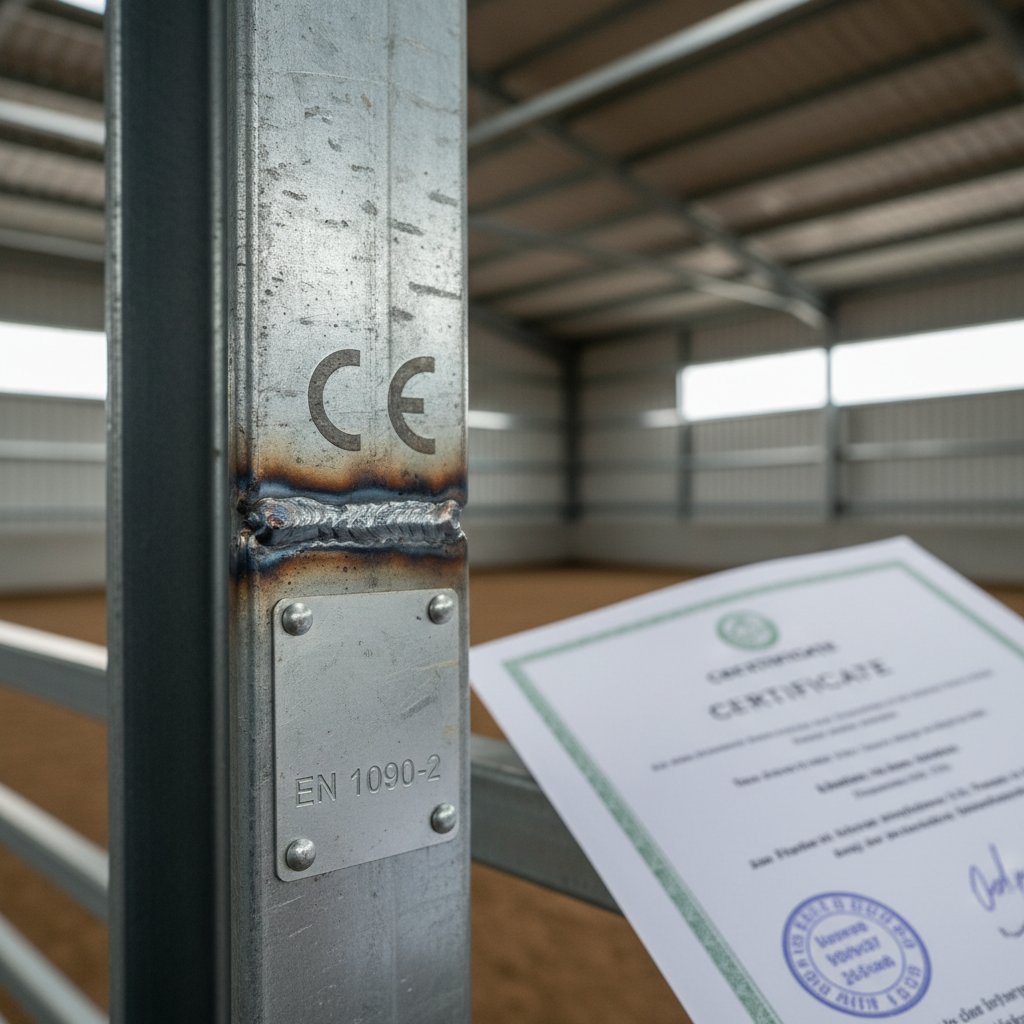
The second pillar is manufacturing certification. Under European law, all load-bearing steel structures must carry a CE mark and comply with the EN 1090-2 standard. What does this actually mean on the ground? It means every batch of steel for your steel building is traceable, every weld is executed by a certified professional, and the entire skeleton is mathematically proven to handle the loads we claim it can.
Our manufacturing facility in Šilutė operates under strict EXC2 (Execution Class 2) compliance, the mandatory legal baseline for this type of public-access or commercial building. If you buy a cheap, imported shed from a rogue supplier lacking this certificate, you are not just risking the safety of your machinery, crops, or livestock. You are instantly voiding any chance of getting the building signed off by local authorities or securing an insurance policy.
Agricultural Building Suitability and Safety Regulations (EU Context)
Agricultural buildings, whether for machinery, grain, or livestock, must meet specific suitability and safety standards. While EU Directive 98/58/EC specifically covers animal welfare, the principles of good practice extend to all agricultural uses. Inspectors-whether from national agricultural ministries, food safety agencies, or local health departments-will enforce rules rooted in ensuring a safe and appropriate environment. Fabric hangars actually offer a massive advantage here, provided they are engineered correctly.
First, consider ventilation. Proper airflow is crucial to prevent moisture buildup in standard width grain storage hangars, reduce ammonia levels in livestock housing, and ensure a comfortable working environment in a standard width machinery shed. Our structures feature specialised ventilation nets in the ridge and along the eaves, ensuring continuous, draft-free airflow. Second, lighting. The translucent PVC roof membrane floods the hangar with natural daylight. This is beneficial for worker safety, reduces the need for artificial lighting during the day (saving energy), and creates a more natural environment for livestock if housed within. Third, safety. The design must prevent hazards. Exposed sharp edges or unstable components are unacceptable. Swed-Trac hangars are designed with safety in mind, and any internal fittings (like feed barriers or machinery guards) must be installed according to local safety regulations.
Navigating Insurance Policies for Your standard width Agricultural Hangar
Insurance brokers despise surprises. When you attempt to insure your new standard width agricultural hangar, they will demand two pieces of paper: your building permit and your CE declaration of conformity. Hand those over, and the process is seamless.
When insuring a fabric structure, pay close attention to the fine print. Ensure your policy covers snow load damage. Our hangars handle one point five kilonewtons per square metre, which keeps underwriters very happy. You also need coverage for storm damage, specifically wind speeds up to twenty-eight metres per second. Without official Swed-Trac documentation, massive companies like Allianz, AXA, or Agria will flatly refuse to underwrite an unverified structure.
Competitor Comparison: Where Does the True Value Lie for Your Agricultural Hangar?
We are not the only players in the European market. We welcome the competition because it highlights exactly where our strengths lie. Here is an objective look at how Swed-Trac stacks up against three common alternatives you will likely encounter when looking for a steel building.
| Criteria | Swed-Trac (Us) | Gooiermeer (NL) | LLENTAB (SE) | Local Builder (e.g., DE) |
|---|---|---|---|---|
| Manufacturing Base | Lithuania (Šilutė) | Netherlands / Import | Sweden / International | Local / Regional |
| Core Specialisation | Fabric agricultural hangars | Basic agri-tents, storage | Heavy steel industrial halls | Traditional timber/steel buildings |
| CE EN 1090-2 Cert | Yes (EXC2) | Varies (often EXC1) | Yes (High spec) | Varies (often custom) |
| Agricultural Suitability | Maximum (translucent roof, ventilation) | Low (dark, poor airflow) | High (but solid roof) | High (but higher cost) |
| Price Point (hangar) | Mid-Range / Optimal Value | Very Low | Very High | Premium |
| Warranty & Support | Direct, fast response | Limited | Excellent but slow | Varies greatly |
As you can see, if you just need the absolute cheapest cover to park a combine harvester temporarily, a basic Dutch agricultural tunnel might suffice. If you have an unlimited budget and want a massive steel warehouse, LLENTAB builds incredible structures. If you want a traditional, permanent building, a local builder can construct one. But if you are looking for the perfect intersection of price, agricultural-specific functionality (like a standard width grain storage hangar or standard width machinery shed), and total legal compliance, Swed-Trac is the logical choice for your hangar.
The Process: From Initial Enquiry to First Use of Your hangar
Our workflow is refined to a razor's edge. Here is the exact roadmap from the moment you pick up the phone to the day you use your new standard width agricultural hangar:
- Initial Consultation (1 Day): We dissect your needs, analyse your specific site conditions, and discuss your budget for a hangar.
- Detailed Quotation (2 Days): You receive a comprehensive, line-by-line commercial offer. No hidden fees.
- Contract and Deposit (1 Week): We sign a legally binding agreement. You know exactly what you are paying for.
- Handover of Structural Plans (1 Week): We send the certified engineering drawings to your local architect to kickstart the planning permission process for your steel building.
- Manufacturing in Šilutė (4-6 Weeks): Our team cuts and welds the steel, while the PVC membrane is high-frequency welded.
- Foundation Preparation (2 Weeks): While we build the frame, your local groundworkers prepare the footings.
- Delivery to Site (1-3 Days): The complete kit arrives at your farm via articulated lorry.
- Assembly (1-2 Weeks): Our specialised crew erects the steel skeleton and tensions the membrane over the top.
- Finishing Touches (A Few Days): We install the sliding doors, any requested internal partitions, and accessories.
- Final Handover (1 Day): We hand over the keys, the CE certificates, the warranties, and shake hands.
Depending on your local planning department's speed, the entire journey for your hangar takes between two and four months.
Technical Requirements for Foundations and Anchoring Your hangar
A fabric agricultural hangar is significantly lighter than a brick building, but you cannot simply drop it onto loose topsoil. A properly engineered foundation is critical for structural stability and absolutely mandatory for securing insurance.
We offer three distinct foundation solutions for your standard width agricultural hangar: - Bored Concrete Piles: The most permanent and reliable method. Deep concrete pillars are cast into the ground, and our steel columns are bolted directly to them. This is perfect for soft, unpredictable soil. - Ground Screws (Screw Piles): Fast, clean, and highly effective. Massive steel screws are driven deep into the earth using specialised machinery. This is the ultimate solution if you are erecting the hangar as a temporary structure, as the screws can be removed later without leaving a trace. - Interlocking Concrete Blocks (Lego-style): Used strictly when ground excavation is banned (for instance, on rented land, asphalt, or highly protected nature reserves). The hangar is anchored to massive concrete ballast blocks resting directly on the surface.
Real Customer Success Stories Across Europe with Swed-Trac Hangars
Theory is fine, but real-world application proves the point. Here are three distinct cases where Swed-Trac solved major problems for European farm owners with our versatile hangars.
Case 1: Optimising Grain Storage in France with EU CAP Funding Sophie, a farmer in Normandy, France, needed to expand her grain storage capacity to take advantage of better market prices post-harvest. She applied for rural development funding through the EU CAP (using EAFRD funds). Because public money was involved, the bureaucratic scrutiny was intense. The French agricultural ministry demanded flawless documentation. We provided the complete CE EN 1090-2 dossier for her new standard width grain storage hangar, and her funding was approved without a single hitch. The hangar has been standing for three years, protecting her harvest from violent Atlantic gales, and Sophie’s farm profitability has significantly increased.
Case 2: Navigating Nature Reserves in Jutland for a standard width Machinery Shed Lars, a progressive farmer, bought a stunning property in Jutland, Denmark. The catch? The land sat squarely inside a protected coastal buffer zone, meaning permanent new buildings were strictly forbidden. His architect suggested a brilliant loophole: apply for a temporary structure using ground screws. Because our standard width machinery shed was fully certified yet easily dismantled, the local municipality granted the permit. Lars now protects his valuable combine harvesters and tractors in perfect conditions, completely respecting local environmental laws.
Case 3: Rescuing a Business in North Holland with a standard width Livestock Hangar A busy dairy farm in North Holland suffered a catastrophe when heavy, wet snow collapsed the roof of their cheap, uncertified imported livestock shelter. Thankfully, the animals were moved in time. Their insurer, AXA, flatly refused the claim because the building lacked structural certification. Facing financial ruin, the farm contacted us. Within eight weeks, we designed, manufactured, and installed a fully compliant standard width agricultural hangar suitable for livestock. This time, the building was officially insured, and the farm owners regained both their peace of mind and their herd's well-being.
Decision Tree: Which Route Should You Take for Your Agricultural Hangar?
If you are still weighing your options for a new agricultural building, use this straightforward logic to find your path:
- Do you need covered space for machinery, grain, feed, or livestock protection year-round?
- No: An open-sided shed or tarp might be enough.
- Yes: Move to the next question.
- Do you have a budget exceeding €150,000 for a traditional steel or brick agricultural building?
- Yes: Hire a traditional commercial construction firm.
- No, I need an optimal, cost-effective solution: A fabric agricultural hangar, especially our hangar, is exactly what you need.
- Are you willing to secure planning permission and insure the building properly?
- No, I want to build illegally in the woods and hope nobody notices: We cannot help you. It is not worth the risk.
- Yes, I want everything done by the book: Choose Swed-Trac for a fully certified, stress-free build of your standard width agricultural hangar.
General Advice and Warnings from the Experts
Having seen every conceivable mistake in the agricultural construction industry, we want to leave you with three critical warnings.
First, never underestimate local snow loads. European winters are unpredictable, and wet snow is incredibly heavy. If a manufacturer will not guarantee a minimum roof load capacity of one point five kilonewtons per square metre for your steel building, walk away immediately. Second, do not cut corners on farm safety. Whether it's for machinery, feed, or livestock, ensure proper internal layouts and secure any potential hazards. A well-designed wide-span universal hangar provides the necessary space for safe operation. Third, never start groundworks before your planning permission is officially granted. The local authority might force you to move the building line by two metres, rendering your expensive new concrete foundations completely useless.
Want a quote on a hangar? Call +370 645 18595 or email sales@swedhall.se - we will prepare an individual quote within 24 hours.
Frequently Asked Questions (FAQ)
Does a agricultural hangar really need planning permission?
Yes. With a footprint typically exceeding three hundred square metres, a standard width agricultural hangar is classed as a significant structure across Europe and requires formal planning permission or a temporary building permit.
How long does the planning permission process take for a steel building?
Depending on your local authority and the efficiency of your architect, expect the process to take anywhere from two to four months.
What exactly is a CE EN 1090-2 certificate?
It is a mandatory European standard proving that a load-bearing steel structure, like our hangar , has been manufactured to strict engineering and safety tolerances. Without it, your building is legally invalid.
Can I use EU CAP rural development funds to buy a hangar in 2026?
Yes, provided the steel building holds all necessary CE certifications and your business meets the specific criteria of your national rural development or young farmer support programmes.
What wind speeds can this hangar survive?
Our standard frames for a standard width agricultural hangar are engineered to withstand wind speeds up to twenty-eight metres per second, which comfortably covers severe European winter storms.
Does a fabric hangar meet EU agricultural suitability standards?
Absolutely. When fitted with proper ridge ventilation, translucent roofing for natural light, and designed for its specific use (e.g., standard width grain storage hangar or standard width machinery shed ), it perfectly aligns with general agricultural building requirements and safety directives.
How do I insure a agricultural hangar?
Contact a specialist agricultural broker, and provide them with our CE declaration of conformity alongside your local building permit. Most major European insurers will underwrite it without issue.
Can the hangar be extended in the future?
Yes. The design is completely modular. If you need more space later, we simply remove the end gable and bolt on additional steel bays, transforming your hangar into an even larger facility.
How long does the PVC roof membrane actually last on a steel building?
A premium, nine-hundred-gram-per-square-metre PVC membrane will comfortably last fifteen to twenty years if maintained correctly. After that, we can easily swap it for a new one while retaining the original steel frame.
Will condensation drip from the roof in winter in my standard width grain storage hangar?
A single-layer membrane can suffer from condensation during rapid temperature swings. To eliminate this entirely, especially crucial for standard width grain storage hangars or livestock housing, we highly recommend upgrading to our double-layer anti-condensation roof system.
What kind of warranty do you provide for a standard width agricultural hangar?
We provide a comprehensive two-year warranty on the steel structure, a manufacturer's warranty on the PVC membrane (typically three to five years), and a two-year guarantee on our assembly work.
Can you install the hangar during the winter?
Yes. As long as the foundations are prepared before the ground freezes solid, our crews can erect the steel and tension the membrane even in sub-zero temperatures.
How much does delivery cost for a hangar across Europe?
Delivery costs depend entirely on the distance from our factory in Šilutė to your farm, but typically range from one thousand five hundred to three thousand five hundred euros for a standard articulated lorry load.
Do I need to manually clear snow off the roof of my steel building?
Because of the steep roof pitch and the slick PVC surface, snow usually slides off naturally. However, during extreme, unprecedented blizzards with heavy ice buildup, manual clearing may be required.
Who handles the electrical installation for the lighting in a standard width machinery shed?
We can supply and mount the LED lighting fixtures, but the final connection to your site's mains power must be completed and certified by a locally registered electrician.
By choosing Swed-Trac for your standard width agricultural hangar, you are not just buying steel and PVC. You are buying total peace of mind, absolute legal compliance, and the guarantee that your farm assets are safe regardless of what the weather throws at you. Our engineering team in Klaipėda and our master fabricators in Šilutė are ready to make your dream agricultural building a reality, completely free of bureaucratic nasty surprises. Worth the money? We certainly think so.
Call us today to discuss your project and secure a detailed quotation.