 Blog
Blog
Building a new agricultural hangar in Europe, whether for grain storage, machinery, livestock, or general storage, is a significant investment and an exciting prospect. However, it's rarely as simple as just pouring concrete and erecting steel. You're stepping into a complex landscape of regulations, from pan-European construction directives to highly specific national and even local building codes. Getting it right from the start, especially by choosing the optimal structure like a wide hangar, can save you a world of headaches, costly delays, and potential fines.
Consider Marek, a progressive farmer in central Poland. He planned to expand his operations with a new standard width grain storage hangar (12x50m) and a separate standard width machinery shed (12x30m). Initially, he approached a local Polish builder, who quoted him around €280,000 for the full complex. The cost was substantial, but the thought of navigating the Polish Prawo Budowlane and dealing with the Starostwo Powiatowe on his own felt even more overwhelming. Marek was about to scale back his plans when he discovered Swed-Trac.
He was surprised to learn that Swed-Trac, a Lithuanian manufacturer with over 2,630 delivered projects across Europe, could provide a CE-certified (EN 1090-2 EXC2) steel hangar solution for his farm for roughly €195,000 - a significant saving of over €85,000 compared to his initial quote. Crucially, Swed-Trac also supplied all the necessary structural documentation, making the permit application process with his local authorities much smoother. Marek's project is now underway, proving that premium quality and compliance for a wide-span universal hangar don't have to come with a premium price tag, especially when you have the right partner and choose the right dimensions. The hangar proved to be the perfect balance of space, cost-efficiency, and versatility for his needs.
The Permit Maze: Why it's More Than Just Paperwork
Across Europe, the journey from an idea for a new agricultural hangar to a fully operational facility is paved with permits. These aren't just bureaucratic hurdles; they're in place to ensure structural safety, environmental protection, and public health. Every country, and sometimes even every municipality, has its own interpretation and additional layers of requirements.
Understanding these layers is critical. You’ll need to consider everything from the footprint of your steel building to the depth of your foundations, the impact your new building will have on local drainage, and specific regulations for storing grain, housing livestock, or maintaining machinery. Ignoring any of these steps is simply not worth the hassle. The costs of rectifying non-compliant structures far outweigh the effort of proper planning.
EU Directives: The Foundation of Agricultural Construction
At the heart of European agricultural construction lie several key EU directives that influence national regulations and building standards. While there isn't one single "agricultural building directive," several overarching frameworks ensure safety, environmental protection, and quality.
- Construction Products Regulation (CPR - EU 305/2011): This directive mandates CE marking for construction products placed on the EU market, ensuring they meet essential requirements for safety, health, and the environment. This directly impacts the steel structures we provide, requiring compliance with standards like EN 1090-2.
- Environmental Impact Assessment (EIA) Directive (2014/52/EU amending 2011/92/EU): For larger agricultural projects, especially those involving significant land use change or potential environmental impact (e.g., large-scale livestock operations, extensive grain storage facilities), an EIA may be mandatory. This ensures environmental considerations are integrated into the planning and decision-making process.
- Water Framework Directive (2000/60/EC) and Nitrates Directive (91/676/EEC): These are particularly relevant if your standard width agricultural hangar will be used for livestock or involves manure storage, as they set standards for water quality and pollution prevention.
- Energy Performance of Buildings Directive (EPBD - 2010/31/EU): While often associated with residential or commercial buildings, this directive can influence insulation requirements for heated agricultural structures, promoting energy efficiency.
These EU-level guidelines provide a baseline, but the real complexity emerges when you delve into national laws.
National Nuances: Germany, France, Netherlands, Denmark
While the EU provides an umbrella, it's the national authorities that issue the actual permits and carry out inspections. Each country has its own approach, regulators, and sometimes, regional variations.
Germany
In Germany, the Bauamt (building authority) handles the primary building permit. Depending on the use of your hangar, other authorities might be involved. For a standard width grain storage hangar, environmental agencies might scrutinize dust emissions and pest control measures. For a standard width livestock hangar, the Veterinäramt (veterinary office) and environmental agencies will assess animal welfare, manure management plans, and potential odour emissions. Expect detailed plans, often including an environmental impact assessment, especially for larger facilities or those near residential areas.
France
France's Direction Départementale des Territoires (DDT) handles planning permits, while local Mairies (town halls) process applications. You'll need to submit a Déclaration Préalable for smaller changes or a Permis de Construire for new builds, accompanied by architectural plans, site maps, and often a notice descriptive detailing how environmental and safety standards are met. For a standard width agricultural hangar, particular attention will be paid to zoning, integration into the landscape, and potential impacts on water resources or biodiversity.
Netherlands
The gemeenten (municipalities) are responsible for granting building permits in the Netherlands. The Omgevingswet (Environmental Law) simplifies some procedures, but you'll still need to demonstrate compliance with environmental regulations, zoning plans, and specific agricultural building standards. For a steel building used for livestock, expect a strong focus on odour emissions, manure storage, and ammonia reduction measures.
Denmark
In Denmark, building permits are issued by the local kommuner (municipalities). You'll need to submit detailed drawings and descriptions, ensuring they adhere to the Bygningsreglement (Building Regulations) and any specific local plans. Environmental permits are often required alongside the building permit, particularly concerning groundwater protection, nutrient management (for livestock or fertilizer storage), and landscape integration for your hangar.
The table below offers a simplified overview of key considerations for agricultural hangars:
| Country | Primary Building Authority | Key Agricultural Regulator | Specific Local Considerations |
|---|---|---|---|
| Germany | Bauamt (local) | Environmental/Veterinary | Zoning, Manure Mgmt Plan, Environmental Impact, Odour Control |
| France | Mairie / DDT (local) | DDT / Environmental | Permis de Construire, Landscape Integration, Water Protection |
| Netherlands | Gemeente (local) | Environmental | Omgevingswet, Odour Emissions, Manure Storage, Ammonia Reduction |
| Denmark | Kommune (local) | Environmental | Bygningsreglement, Groundwater Protection, Nutrient Mgmt, Landscape |
Technical Standards That Matter
Beyond regulatory compliance, the structural integrity and safety of your agricultural hangar are paramount. This is where technical standards like EN 1090-2 come into play. This European standard specifies requirements for the execution of steel structures.
- Execution Classes:
- EXC1: Minor structures.
- EXC2: Standard structures, which includes most agricultural buildings like a standard width grain storage hangar or a standard width machinery shed. Swed-Trac delivers all its projects to this class, ensuring robust, safe constructions.
- EXC3: More complex structures or those with higher safety requirements (e.g., public buildings). Swed-Trac can deliver to EXC3 on request.
- EXC4: Critical infrastructure.
Choosing a manufacturer like Swed-Trac, which is CE certified per EN 1090-2 (notified body 1487), means you're investing in structures built to rigorous EU standards. This certification is often a non-negotiable requirement for building permits, especially for steel structures.
Other technical details that frequently appear in permit discussions for agricultural hangars include:
- Insulation (U-value): While uninsulated hangars are common, insulated structures (0.25-0.35 W/m²K) offer better climate control and energy efficiency, which might be a permit requirement in some regions for energy conservation, especially for temperature-sensitive grain storage or livestock housing.
- Foundation Depth: Frost lines vary across Europe. In Lithuania or Sweden, a 1.2m concrete foundation depth is typical, while in central EU, 0.8m might suffice. Local geological surveys are often required to determine the appropriate depth for your standard width agricultural hangar.
Funding Your Dream: Grants and Support
Navigating the permit process can also open doors to funding opportunities. The EU Common Agricultural Policy (CAP) and associated rural development funds (like the EAFRD) often provide grants for agricultural businesses, including new hangars that contribute to farm modernization, efficiency, and environmental sustainability.
A well-prepared permit application, demonstrating full compliance with all relevant regulations and a robust business plan, is essential for securing these grants. Banks like Deutsche Bank, Sparkasse, Crédit Agricole, ING, BNP Paribas, Danske, and Nordea are also familiar with such projects and may offer financing, often requiring proof of permit approval. Having structures that meet CE standards and national regulations significantly strengthens your application for both grants and loans for your hangar project.
The Swed-Trac Advantage: Quality, Compliance, Value
When you're building a new agricultural hangar, you want quality that lasts, compliance that gives you peace of mind, and a price that makes sense. Swed-Trac, a Lithuanian manufacturer founded in 2015, offers just that. With 35 employees and a factory in Šilutė/Kaunas, we've delivered over 2,630 projects across Europe.
We are CE certified (EN 1090-2, execution class EXC2, EXC3 on request) by notified body 1487, meaning our steel structures meet stringent EU safety and quality standards. We offer a 2-year structural warranty and a 2-year interior warranty.
Our competitive edge is clear: our turnkey solutions are typically 30-50% cheaper than Western premium competitors like LLENTAB, and 10-20% more than Polish alternatives. But here's the kicker: we provide full CE certification and EU-standard quality that many cheaper options simply cannot match. This makes Swed-Trac an incredibly cost-effective choice for premium, compliant agricultural facilities.
We offer a range of standard widths to suit various farm sizes and needs: * 8m wide: Ideal for small farms, covering smaller machinery, feed, or utility storage. * 10m wide: Suitable for medium-sized farms, offering more space for equipment or a small livestock section. * standard width wide (UNIVERSAL - RECOMMENDED): This is our expert recommendation for most farmers. A wide hangar provides optimal versatility and cost-efficiency. It's perfect for a standard width grain storage hangar, a spacious standard width machinery shed, a comfortable standard width livestock hangar, or general storage. Its wide-span design allows for excellent internal manoeuvrability and efficient use of space, making it a truly wide-span universal hangar. For example, a 12x40m standard width agricultural hangar from Swed-Trac might cost between €100,000-€140,000, while premium alternatives could easily push past €200,000. That's real savings, without compromising on quality or regulatory compliance. * 15m wide: For wider machinery or larger storage requirements. * 18m wide: Suited for large farms needing significant capacity for machinery fleets or bulk storage. * 20m wide: Our largest standard width, often used for industrial-scale agricultural operations or very large machinery.
We understand the permit process. We provide comprehensive documentation for our structures, which significantly aids your application to local authorities like the Bauamt, DDT, or gemeente. This support is invaluable in navigating what can often feel like a bureaucratic labyrinth, especially when planning your optimal steel building.
Navigating the Process: A Step-by-Step Approach
Successfully obtaining a permit for your agricultural hangar, particularly a hangar, involves several key steps:
- Initial Consultation & Needs Assessment: Define the purpose and size of your hangar. Swed-Trac can advise on the optimal dimensions, emphasizing the versatility of the hangar for various uses.
- Preliminary Design & Quotation: We provide a detailed design and quote, including specifications for your standard width agricultural hangar, ensuring it meets your operational needs and budget.
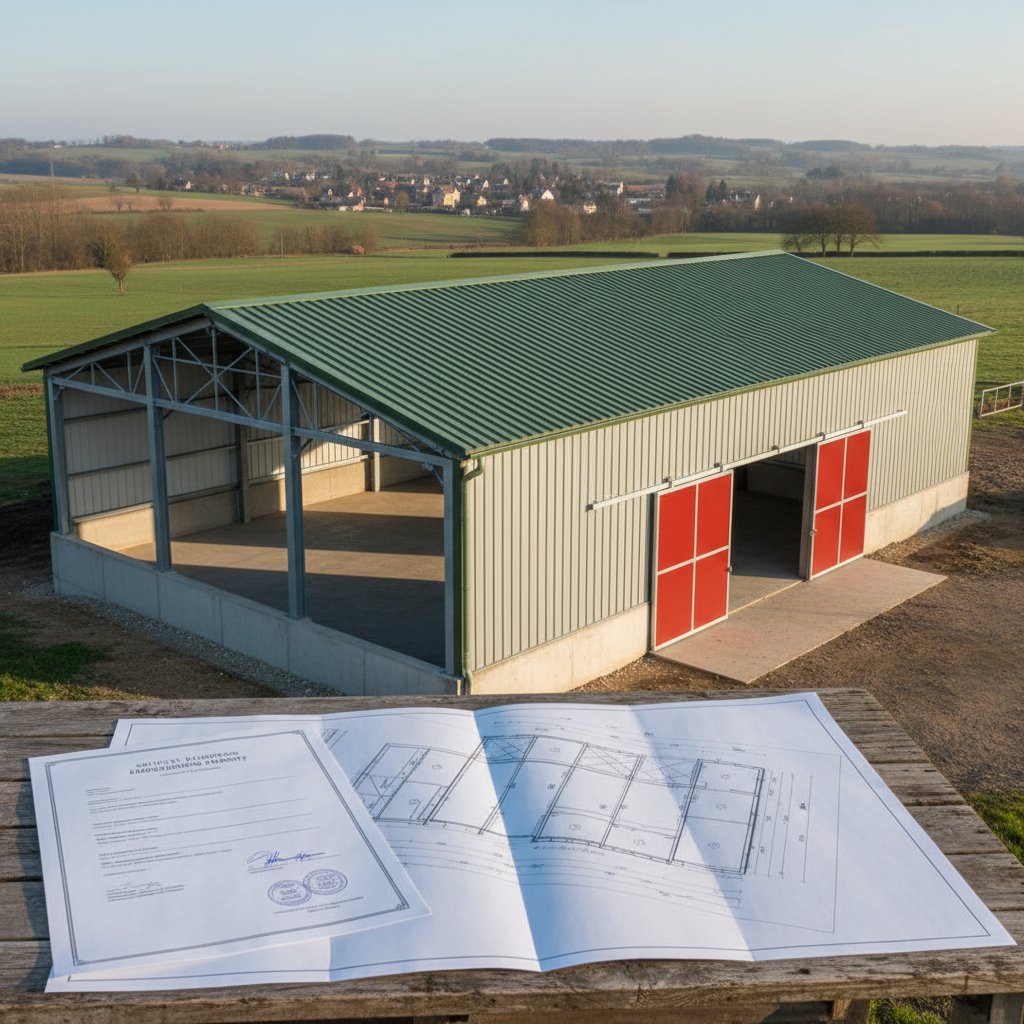
- Documentation Preparation: Swed-Trac supplies all necessary structural documentation, including CE certification (EN 1090-2), structural calculations, and technical drawings, which are crucial for your permit application.
- Local Authority Engagement: Submit your application to the relevant local and national authorities. Be prepared for potential consultations with environmental agencies, planning departments, and possibly veterinary offices if livestock is involved.
- Permit Approval & Construction: Once approval is granted, construction can commence. Our prefabricated steel structures ensure a quick and efficient build process.
Want a quote on a hangar? Call +370 645 18595 or email sales@swedhall.se - we will prepare an individual quote within 24 hours.
FAQ
What are the most common widths for agricultural hangars in Europe?
Agricultural hangars in Europe come in various widths to suit different farm sizes and needs. Common widths include 8m, 10m, standard width , 15m, 18m, and 20m. The hangar is particularly popular due to its excellent balance of versatility, cost-efficiency, and suitability for most agricultural applications.
Why is the hangar recommended for most farmers?
The hangar is often recommended as the optimal choice for most farmers because it provides ample space for a wide range of uses, including standard width grain storage hangar , standard width machinery shed , or standard width livestock hangar . Its dimensions allow for easy manoeuvrability of modern farm equipment, efficient storage layouts, and effective ventilation, making it a truly wide-span universal hangar that offers significant value for money.
What permits do I need for an agricultural hangar in the EU?
Permit requirements vary significantly by country and even municipality. Generally, you will need a primary building permit from your local planning authority ( Bauamt in Germany, Mairie in France, Gemeente in Netherlands). Depending on the hangar's use (e.g., livestock, large-scale grain storage) and size, additional permits related to environmental impact, water protection, or specific agricultural regulations may be required. Swed-Trac provides documentation to support these applications.
How does Swed-Trac help with the permit process for a hangar?
Swed-Trac supports your permit application by providing comprehensive, CE-certified structural documentation for your steel building . This includes detailed technical drawings, structural calculations, and proof of compliance with EU standards like EN 1090-2 (EXC2). This documentation is essential for demonstrating the safety and quality of your standard width agricultural hangar to local authorities, simplifying the approval process.
What is the typical cost of a standard width agricultural hangar?
The cost of a standard width agricultural hangar can vary based on length, specifications (e.g., insulation, cladding), and location. However, a typical 12x40m steel building from Swed-Trac, including full CE certification and high-quality materials, can range from €100,000 to €140,000. This offers significant savings compared to many Western European premium suppliers, while still providing robust, compliant structures.