 Blog
Blog
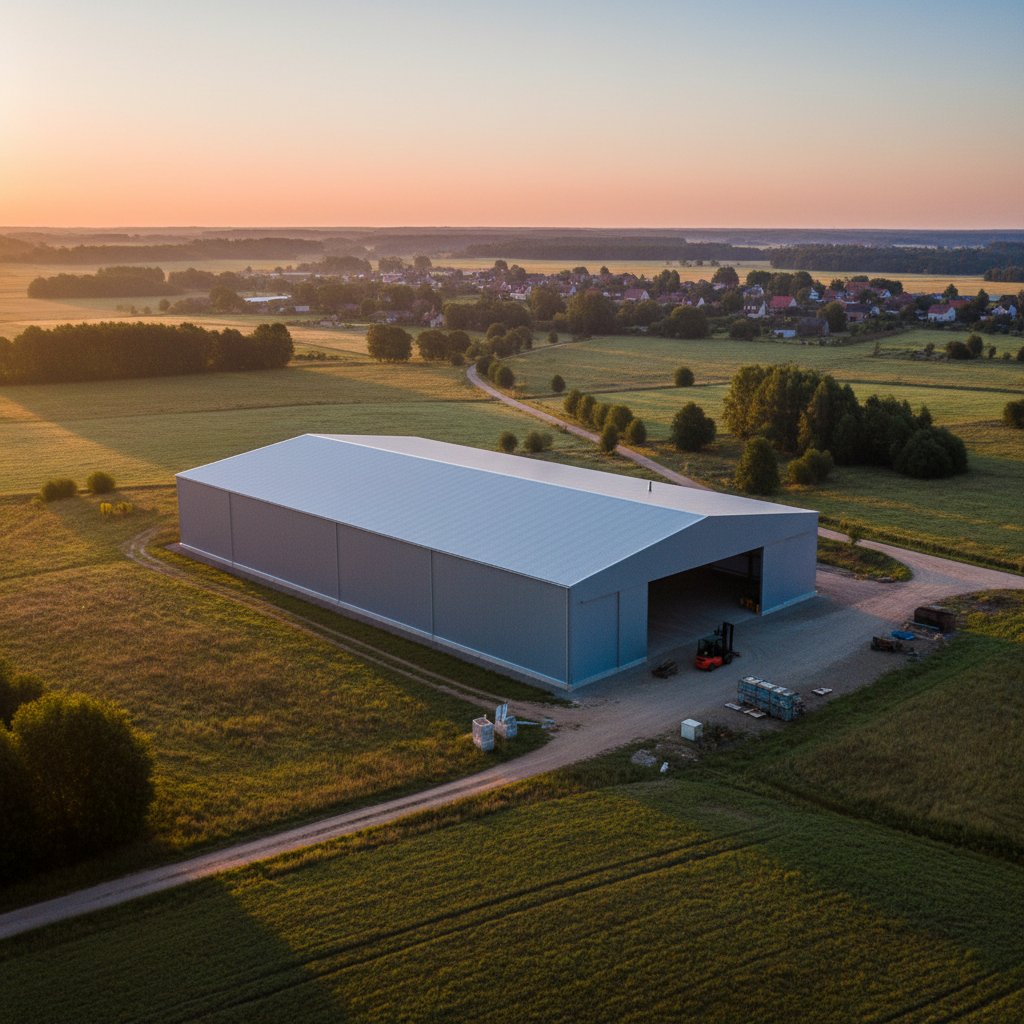
Imagine a common scenario for many European farmers. Anna, a farmer from Wielkopolska, Poland, cultivates a medium-sized farm focusing on grain and livestock. Every harvest season, she faces the same dilemma: where to store her grain securely without incurring exorbitant commercial silo fees, and how to protect her valuable machinery from the harsh Polish winters. She considered various options, from smaller sheds to massive industrial structures. After careful calculation, Anna decided on a hangar from Swed-Trac, built right on her land.
The outcome? She efficiently stored her entire grain harvest until market prices improved significantly in winter, securing a substantial additional profit. Her tractors and combine harvesters were safely sheltered, reducing wear and tear and costly repairs. This standard width agricultural hangar, a versatile steel building, proved to be the perfect balance of capacity, cost-effectiveness, and operational flexibility. It's not just a marketing claim; it's a proven mathematical and practical advantage that countless European farmers and business owners experience daily.
This article will explain why the hangar is consistently the optimal choice for most agricultural operations across Germany, France, the Netherlands, and Scandinavia. We will provide precise figures, real Return on Investment (ROI) calculations, current 2026 European market data, and detailed customer stories from various regions. If you are looking for a solution that genuinely saves money, protects your assets, and adapts to diverse farming needs, keep reading.
CORE FACTS: Your Optimal Hangar Width - The Versatility of the hangar
Before diving into costs, let's understand the range of structures available and why the hangar stands out. Swed-Trac offers a spectrum of widths to suit every farm size and requirement, from smallholdings to large industrial operations:
- 8m wide hangar: Ideal for small farms, hobbyists, or specialized storage like small machinery, tools, or firewood.
- 10m wide hangar: Suitable for medium-sized farms, offering more space for feed, smaller tractors, or seasonal storage.
- hangar (UNIVERSAL - RECOMMENDED): This is our flagship recommendation for most European farms. A agricultural hangar provides an unparalleled balance of internal space, construction efficiency, and cost-effectiveness. It's perfectly suited for standard width grain storage hangar needs, a standard width machinery shed, or a wide-span universal hangar for livestock or general storage. Its width allows for easy manoeuvring of most modern agricultural equipment.
- 15m wide hangar: Offers increased capacity for larger farms or businesses requiring more expansive storage or workspace.
- 18m wide hangar: Designed for large-scale agricultural enterprises or industrial applications with substantial machinery fleets or bulk storage needs.
- 20m wide hangar: Our largest standard width, ideal for industrial operations, very large farms, or complex logistics centres requiring vast, clear-span areas.
Our Swed-Trac hangars, particularly the steel building, are engineered to withstand heavy Alpine snow loads and brutal North Sea winds. We use thick-walled structural steel for the framework, produced entirely in our factory in Šilutė, Lithuania, and managed from our central office in Klaipėda. This ensures strict European quality control directly from the source, without waiting for components from unknown overseas factories.
Let's look at the specifications for a typical agricultural hangar (e.g., 12x40m for a 480 sqm footprint):
| Specification | Detailed Description |
|---|---|
| Length | Flexible (e.g., 40 metres for a 480 sqm footprint) |
| Width | standard width (completely clear span, no internal support columns) |
| Total Area | Varies by length (e.g., 480 square metres for 40m length) |
| Ridge Height | 4.5-5.5 metres (depending on specific project requirements) |
| Wall Height | 3.5-4.5 metres |
| Framework | Steel (Certified to CE EN 1090-2 standard) |
| Roof Cladding | Heavy-duty reinforced PVC fabric (900 g/sqm), highly UV resistant |
| Wall Cladding | Optional: PVC canvas, profiled steel sheeting, or insulated sandwich panels |
| Production Site | Šilutė, Lithuania (Central Office - Klaipėda) |
A standard-width clear span without any internal columns is a key advantage. It allows you to manoeuvre most agricultural machinery, including tractors and smaller combine harvesters, articulated lorries, or telehandlers freely. You utilize every single square metre of the footprint without navigating around annoying steel pillars, making your standard width machinery shed incredibly efficient.
FULL PRICE BREAKDOWN: What Does a hangar Actually Cost?
The most common question from clients across Europe is simple: "What will a hangar cost me?" Because every project is tailored to specific regional wind and snow loads, we've outlined three realistic scenarios for a 12x40m (480 sqm) steel building for 2026. These prices exclude Value Added Tax (VAT) and can fluctuate slightly depending on global steel exchange rates.
| Project Type | Cladding Solution | Estimated Price (EUR ex. VAT) | Best Suited For? |
|---|---|---|---|
| Economic (Cold) | Roof and walls made of heavy-duty PVC canvas | ~40,000 EUR | standard width machinery shed, hay bales, temporary logistics storage. |
| Medium (Hybrid) | PVC roof + profiled steel walls | ~46,000 EUR | standard width grain storage hangar, bulk fertilizers, secure logistics depots. |
| Premium (Warm) | Insulated sandwich panels (100 mm) | ~75,000 EUR | Workshops, heated garages, animal housing, manufacturing facilities. |
These sums might appear substantial initially. However, divide them by 480 square metres. For the economic option, you are paying roughly eighty-three euros per square metre. Try building a traditional brick, block, or concrete warehouse of this size for that money today. With current European labour and material costs, you would struggle to cover the foundations and the first layer of blockwork. A standard width agricultural hangar offers immediate shelter and significant functionality at a fraction of traditional construction costs.
WHAT IS INCLUDED / WHAT IS EXCLUDED FROM THE BASE PRICE
To avoid any misunderstandings, we play with our cards on the table. We see how some market players offer tempting low prices, only to hit the client with dozens of hidden fees later. A Swed-Trac estimate is entirely transparent.
| INCLUDED in the Base Estimate | EXCLUDED from the Base Estimate |
|---|---|
| Full metal structural frame kit | Groundworks, site levelling, and foundation pouring |
| Selected roof and wall cladding materials | Local building permit acquisition procedures |
| All required fasteners, structural bolts, and tensioners | Internal electrical wiring and lighting fixtures |
| One standard industrial roller door | Active ventilation systems and extractor fans |
| Structural engineering working project (drawings) | Transport costs (vairies based on distance from Šilutė) |
| Professional installation (if booked as a service) | Security alarms, cameras, and fire safety systems |
In short, we manufacture, deliver, and erect the steel building itself. Site preparation and local council bureaucracy remain your responsibility. We do, naturally, supply the exact structural drawings your local architect needs to push the paperwork through for your agricultural hangar.
CASES AND ROI: How We Calculate Return on Investment for Your hangar
ROI (Return on Investment) is a straightforward metric. It shows exactly how long it takes for your spent capital to return to your pocket through saved expenses or generated extra profit.
The calculation is simple: ROI = (Annual Saved Costs + Additional Profit) / Total Hangar Cost
Let's consider a commercial warehousing example, perhaps for a small distribution hub. Suppose you need 480 square metres to store palletised goods. Across major European hubs-whether in rural Germany, Belgium, or the Netherlands-renting an unheated commercial warehouse averages around six to eight euros per square metre per month.
Using a conservative six euros per square metre, you spend 2,880 EUR per month on rent for 480 sqm. Over a single year, this balloons to 34,560 EUR.
If you build a Swed-Trac hybrid hangar (PVC roof and steel walls) for approximately 46,000 EUR on your own land, your investment pays off in just over fifteen months compared to renting. After a little over a year, you stop feeding a landlord. The agricultural hangar starts generating pure savings, and the physical asset remains firmly on your company's balance sheet. That is an undeniable financial advantage.
REAL CUSTOMER CASES (European Market)
Theory is fine, but practice speaks louder. Here are three real cases from our European clients that perfectly illustrate the financial power and versatility of a Swed-Trac hangar, often highlighting why the hangar is such a popular choice.
Case 1: Farmer Lars from Jutland, Denmark (Grain Storage with a hangar)
The Problem: Lars, a farmer from Jutland, Denmark, managed three hundred hectares of winter wheat. He faced the annual headache of harvest time coinciding with low market prices and high commercial silo storage fees. The Solution: Lars opted for a hybrid standard width grain storage hangar (12x40m, 480 sqm). This steel building featured tough profiled steel walls designed to withstand the immense outward pressure of bulk grain, topped with a translucent PVC roof that floods the space with natural daylight. This specific agricultural hangar was ideal for his operation, providing ample storage without being excessively large. The Result and ROI: The local Danish authorities, adhering to EU Directive 98/58/EC, require strict standards for food and feed storage. The Swed-Trac hangar passed these inspections immediately, proving airtight enough for standard fumigation procedures. By storing his grain safely until January, Lars secured an extra forty euros per tonne on two thousand tonnes. His additional profit hit eighty thousand euros. The hangar, costing significantly less than this profit, paid for itself entirely within its first operational season. Lars stated, "My standard width agricultural hangar was the smartest investment I've made. It gave me control over my harvest and my profits."
Case 2: Agricultural Cooperative in Normandy, France (Machinery Shed)
The Problem: An agricultural cooperative in Normandy owned a fleet of five combine harvesters, self-propelled sprayers, and heavy tractors, representing an investment of over two million euros. Due to a lack of proper shelter, this valuable machinery wintered outdoors. The salty Atlantic air and winter rain accelerated rust, damaged sensitive electronics, and led to skyrocketing spring maintenance costs. The Solution: They erected a standard width machinery shed (12x50m, 600 sqm) specifically for machinery parking. The standard-width clear span allowed their drivers to park even their widest combine harvesters (with headers detached, if necessary) side-by-side with ease. The wide-span universal hangar proved ideal for protecting their valuable assets. The Result and ROI: While calculating direct profit from parking is trickier, the cooperative's head mechanic confirmed that spare parts and spring repair bills dropped by nearly forty percent. The operational lifespan of their machinery extended by several years. The steel building ensured their expensive equipment was always protected, ready for the next season.
Case 3: Small-to-Medium Logistics Hub in Lithuania (General Storage)
The Problem: A growing logistics firm in rural Lithuania needed affordable, quick-to-deploy storage for palletized goods and occasional vehicle parking. Traditional brick warehouses were too expensive and slow to build. The Solution: The company chose an economic hangar (12x30m, 360 sqm) with full PVC cladding. This provided a fast, cost-effective solution. The Swed-Trac team manufactured, delivered, and installed the entire structure in just four weeks. The Result and ROI: The firm saved significant capital they would have otherwise spent leasing commercial space. Goods remained dry and secure, and the translucent PVC fabric eliminated the need for daytime electric lighting, slashing energy bills. The entire investment saw a full ROI in under eighteen months, demonstrating the rapid payback of a well-chosen agricultural hangar.
COMPETITOR COMPARISON: Why Choose Our Manufacturing for Your hangar?
The European market is flooded with hangar suppliers. Let's look at the hard facts and 2026 market data, comparing Swed-Trac with other well-known options like LLENTAB (Sweden), Röwer & Rüb (Germany), and Gooiermeer (Netherlands).
| Criteria | Swed-Trac (Lithuania) | LLENTAB (Sweden) | Röwer & Rüb (Germany) | Gooiermeer (Netherlands) |
|---|---|---|---|---|
| Price Level 2026 (e.g., 12x40m) | Highly competitive (~40,000 EUR for 480 sqm) | Premium pricing | Premium (equestrian/agri focus) | Mid-range, varying focus |
| Structure | Massive, thick-walled steel | High-quality steel | Specialized heavy profiles | Standard profiles, sometimes lighter |
| Production Site | Šilutė, Lithuania | Sweden / Various | Germany | Netherlands / Outsourced |
| Large Span Suitability | Excellent (up to 20m clear span, with standard width being optimal value) | Great, but prices scale up fast | Good for specific niches | Limited for heavy industrial spans |
| Certification | Strict CE EN 1090-2 | CE EN 1090 | CE EN 1090 | Varies by project |
LLENTAB offers brilliant, high-quality Swedish steel solutions, but their pricing for massive industrial spans often runs significantly higher. Röwer & Rüb excel in their specific equestrian and premium agricultural niches, but you pay a heavy premium for the brand. Gooiermeer handles standard structures well, but when you push into larger clear spans, you need serious structural integrity.
Here's the thing: when you need a robust, reliable steel building that delivers exceptional value, you require heavyweight engineering without the inflated Western European price tag. Our factory in Šilutė specializes in these durable, wide-span structures. We leverage efficient Lithuanian manufacturing to deliver the absolute best price-to-quality ratio for major European farms and industrial parks, while strictly adhering to EU safety standards for every agricultural hangar we produce.
THE PROCESS FROM INQUIRY TO HANDOVER
Our workflow is refined down to the smallest detail. No delays, no nasty surprises.
- Inquiry and Analysis (Day 1): You contact us. We figure out exactly what you need-what you will store, your local soil type, and your specific expectations for your hangar.
- Quotation (Day 2): We provide a preliminary commercial offer containing exact figures.
- Contract Signing (Days 3-5): We iron out the technical details, sign the contract, and you pay the initial deposit.
- Design and Permits (1-4 weeks): We prepare the structural engineering project. Your local architect uses our precise drawings to secure your building permit for the standard width agricultural hangar.
- Production in Šilutė (4-6 weeks): We cut and weld the steel. While we do this, you pour the foundations (usually drilled concrete piles) at your site.
- Delivery to Site (Day X): We transport all components directly to your yard, anywhere in Europe.
- Installation (1-3 weeks): Our professional crew assembles the steel frame, tensions the PVC canvas, or screws in the steel sheeting.
- Handover and Warranty: We sign the final acceptance protocol. Your two-year structural warranty begins immediately.
TECHNICAL REQUIREMENTS AND STANDARDS
When building a structure like a hangar, there is zero room for improvisation.
Foundations: Although a steel and PVC hangar is lighter than a brick building, a standard-width wide roof acts like a massive sail in the wind and collects tons of snow. Solid foundations are mandatory. We almost always recommend drilled concrete piles fitted with heavy-duty anchor bolts.
Veterinary and Food Standards: If you plan to use your standard width grain storage hangar for grain or animal feed, it must comply with EU Directive 98/58/EC and your national veterinary services (such as the Veterinäramt in Germany, DGAL in France, or NVWA in the Netherlands). This requires absolute roof tightness, heavy netting over ventilation gaps to stop birds and rodents, and smooth surfaces that sweep clean easily before a new harvest. We can also install internal steel partition walls to ensure your high-grade milling wheat never mixes with chemically treated seed grain.
CE EN 1090-2 Standard: This is the mandatory European Union standard defining the manufacturing quality of structural steelwork. Swed-Trac holds this exact certification. Because our steel is fully traceable and certified, major European insurers like Allianz, AXA, and Generali will insure your new steel building without raising an eyebrow.
EU CAP FUNDING AND FINANCING IN 2026
If you operate a farm, 2026 opens excellent avenues to secure partial funding for your standard width agricultural hangar construction. The EU Common Agricultural Policy (CAP) and the European Agricultural Fund for Rural Development (EAFRD) have clear application schedules managed by your national agricultural agencies.
Key funding streams to watch this year include: - Sustainable Agricultural Investments: Usually opening in late summer or early autumn across most member states. This is the primary vehicle for funding standard width grain storage hangar and standard width machinery shed projects. - Small-to-Medium Farm Expansion: Simplified application processes often launch in September. - Young Farmer Establishment: Grants and subsidized loans typically have deadlines in late May and a second round in the winter.
To secure this funding, you must attach official commercial quotes to your application. The Swed-Trac team will quickly and freely prepare an official, detailed quote for your agricultural hangar that meets all the strict bureaucratic requirements of your local agricultural agency.
Beyond EU CAP grants, we cooperate smoothly with major European banks. Because our structures carry full CE certification, institutions like Deutsche Bank, ING, Crédit Agricole, and BNP Paribas gladly provide financing or leasing options, valuing the hangar as a highly liquid, durable asset.
DECISION TREE: Which Product Fits Your Needs?
Unsure which hangar variant suits your operation? Use this simple decision tree to determine the optimal width and cladding for your needs:
- What is the maximum width of machinery you need to store or operate? * Up to 6-7m: An 8m or 10m wide hangar might suffice. * Up to 10-11m (most modern tractors/combines): The agricultural hangar is your optimal choice. * More than 11m (very large industrial equipment): Consider 15m, 18m, or 20m widths.
Once you've determined the optimal width, proceed to cladding:
-
Will people work inside the hangar daily during the winter? * YES -> You need the Premium Warm hangar with insulated sandwich panels (available for all widths, including your hangar). * NO -> Move to the next question.
-
Will you store loose grain, potatoes, or bulk materials that push directly against the walls? * YES -> Choose the Medium (Hybrid) hangar. The steel or concrete retaining walls handle the outward pressure, while the PVC roof provides natural light. This is ideal for a standard width grain storage hangar. * NO -> Move to the third question.
-
Do you just need to protect heavy machinery, hay, or palletised goods from rain and snow at the lowest possible cost? * YES -> Your ideal choice is the Economic fully PVC-clad hangar. It is fast, affordable, and highly reliable, perfect for a standard width machinery shed.
GENERAL TIPS AND WARNINGS
From years of building across the continent, we can highlight a few common mistakes buyers make: - Ignoring Condensation: In cold hangars with steel sheet roofs, condensation drips heavily during autumn and spring. If you choose a steel roof, you absolutely must order an anti-condensation membrane. If you choose a PVC roof, this problem is drastically reduced, but sensitive goods still benefit from passive ventilation louvres. - Underestimating Snow Loads: Snow loads vary wildly. A hangar built for southern Spain will collapse under the first heavy snowfall in the Austrian Tyrol or the Bavarian Alps, where loads easily hit 1.5 to 2.5 kN/sqm. Do not buy cheap, uncertified imports. Our structures are engineered specifically for your exact local climate zone, whether it's an 8m or a hangar. - Delaying Paperwork: A new steel building almost everywhere in Europe requires a local building permit. Do not pour a single drop of concrete until you hold the official stamped paper. Otherwise, the local council will halt your project and hand you a massive fine. It is simply not worth the hassle.
Want a quote on a hangar? Call +370 645 18595 or email sales@swedhall.se - we will prepare an individual quote within 24 hours.
FAQ: Frequently Asked Questions
How long does a hangar take to build from start to finish?
From the moment you sign the contract, expect about four to six weeks for manufacturing in our Šilutė factory. Once the materials arrive at your site, our professional assembly crew usually erects a hangar (e.g., 12x40m) in one to two weeks, depending on the weather and the chosen cladding type. Total turnaround is generally five to eight weeks.
Can I install the hangar myself to save money?
While we provide detailed assembly manuals and it is technically possible for a highly skilled local crew to erect the economic PVC version, we strongly advise against it for any clear span over 10 metres. The massive steel trusses require professional cranes, precise tensioning, and strict safety protocols. Using our certified installers ensures your two-year warranty remains fully intact.
Do I need to pour a full solid concrete slab foundation?
No. One of the great financial advantages of our hangars is that they do not require a full concrete slab. We mount the steel columns onto individual drilled concrete piles (point foundations). You can leave the interior floor as compacted gravel, asphalt, or add a concrete slab later if your operational needs change.
What happens if the PVC roof gets damaged by debris or an accident?
The 900 g/sqm reinforced PVC we use is incredibly tough and resists tearing. However, if a sharp object does puncture it, you do not need to replace the entire roof. PVC can be hot-air welded on-site. A technician can apply a permanent, watertight patch in a matter of minutes, much like repairing a heavy-duty truck tarpaulin.
How does the EU CAP funding process work with your quotes?
When you plan to apply for EAFRD or national agricultural grants, let us know immediately. We will format our commercial proposal for your standard width agricultural hangar to match the exact line-item requirements demanded by your national paying agency. This ensures your application moves smoothly through the bureaucracy without being rejected for missing technical specifications.