 Blog
Blog
Picture this real-world scenario. Anna, a progressive farmer from Poland's Wielkopolska region, is looking to expand her operations. Her machinery fleet is growing, the grain harvest no longer fits in the old barns, and she needs a robust, long-lasting building that offers maximum versatility. After careful consideration, she calculates that a wide hangar, perhaps 30 metres long (360 square metres), hits the sweet spot for her needs - perfect for grain storage, machinery, or even a mixed-use livestock and feed facility. She finds some local "handymen" who promise to build it quickly, with zero paperwork, and, naturally, dirt cheap. Everything looks great until the local building authority drives into the yard six months later. Worse still, when the roof caves in after heavy winter snow, her insurance provider flatly refuses the payout because the steel structures lack a CE EN 1090-2 certificate. Anna is left with no hangar and thousands of euros in fines.
This is where Swed-Trac enters the picture. Our headquarters sit in Klaipėda, while our modern manufacturing hub operates in Šilutė, Lithuania. We do not build castles in the sky, we do not offer illegal shortcuts, and, to be clear, we do not sell tractors. We manufacture and construct steel hangars engineered to withstand both harsh European winters and the strictest bureaucratic machinery. Our approach is simple: build it right, so that ten years down the line you can say, "Worth the money."
In this detailed expert guide, we dissect everything you must know about the legal framework for a wide hangar. We will cover the necessary permits, explain why a building without a CE certificate is just an expensive pile of scrap metal, outline the requirements set by EU Directive 98/58/EC and national veterinary services, and show you how to smoothly secure EU Common Agricultural Policy (CAP) funding in 2026 for your new steel building.
Choosing the Right Width: Why the hangar is the Farmer's Universal Choice
Before diving into the legal nuances, we need absolute clarity on the structure we are discussing. A steel hangar is not just a large tent; it is a serious engineering project that demands precise calculations and premium materials. Swed-Trac offers a range of standard widths to suit diverse agricultural and industrial needs:
- 8m wide hangar: Ideal for smaller farms or specific applications like narrow machinery storage, small workshops, or sheltered animal housing. It's an economical choice for those with limited space or budget.
- 10m wide hangar: A step up for medium-sized farms, offering more flexibility for machinery, feed, or general storage without significantly increasing complexity.
- hangar (UNIVERSAL - RECOMMENDED): This is the sweet spot for most European farmers, offering unparalleled versatility. A wide hangar provides ample clear-span space for manoeuvring modern agricultural machinery, efficient grain storage, comfortable livestock housing, or a robust standard width machinery shed. This 'wide-span universal hangar' balances generous internal space with manageable permitting requirements and cost-effectiveness, making it the optimal choice for a vast majority of agricultural operations. A steel building is truly a multi-purpose asset.
- 15m wide hangar: For farms requiring a bit more width than the universal standard width, perhaps for larger machinery or more expansive storage needs. This width begins to introduce slightly more complex structural considerations for permitting.
- 18m wide hangar: Suited for large farms or specialised operations that demand significant open space, such as large-scale grain drying facilities or extensive machinery parks.
- 20m wide hangar: Our largest standard width, often crossing into industrial applications, accommodating very large equipment, complex processing lines, or extensive warehousing. This width typically involves the most stringent engineering and permitting requirements.
We designed our wide hangar to maximise usable space. A standard-width clear span with no internal columns allows heavy machinery, forklifts, or articulated lorries to manoeuvre freely. This width is particularly popular in countries like Germany, France, and the Netherlands due to its efficiency and adaptability. While it is a substantial structure, a steel building often falls into a more straightforward structural classification than wider spans (15m, 18m, 20m), making the permitting process more manageable without compromising on capacity.
Here are the core specifications for a typical standard width x 30m (360m²) agricultural hangar:
| Specification | Detailed parameters |
|---|---|
| Product code | ind-12x30 (Agricultural hangar) |
| External dimensions | Width: twelve metres, Length: thirty metres |
| Total area | Three hundred sixty square metres (360 m²) |
| Structure type | Steel frames (zero internal support columns) |
| Steel grade | S355 (high-strength structural steel) |
| Certification | Mandatory CE marking under EN 1090-2 (EXC2 class) |
| Production site | Šilutė, Lithuania (Swed-Trac factory) |
| Snow load resistance | Adapted for European zones (from 1.2 to 1.6 kN/m² or higher) |
Complete Cost Breakdown: The Value of a hangar
One of the most frequent questions we get is, "What is the rough price for a hangar?" We avoid vague estimates. Instead, we provide clear, realistic 2026 figures for the European market. The final cost depends directly on your chosen scenario and insulation level.
Below are three typical project scenarios for a standard width x 30m (360m²) agricultural hangar. Prices are in euros, excluding Value Added Tax (VAT).
| Cost category | Basic (Cold, corrugated steel) | Medium (Partially insulated) | Premium (Fully insulated) |
|---|---|---|---|
| Steel structures (frame) | 18,000 EUR | 19,000 EUR | 22,000 EUR |
| Roof and wall cladding | 8,000 EUR | 11,500 EUR | 24,000 EUR |
| Gates and doors (standard package) | 3,000 EUR | 4,000 EUR | 6,000 EUR |
| Technical design (structural part) | 2,500 EUR | 2,500 EUR | 3,500 EUR |
| Assembly works | 7,000 EUR | 8,000 EUR | 10,000 EUR |
| Transport from Šilutė | 2,000 EUR | 2,000 EUR | 2,500 EUR |
| TOTAL (approximate): | 40,500 EUR | 47,000 EUR | 68,000 EUR |
Note: Prices fluctuate slightly based on global steel exchange indices and the specific geological conditions of your site.
- Basic scenario: Ideal for storing agricultural machinery where temperature fluctuations are not a critical factor. This cold standard width machinery shed is a cost-effective solution for protecting your assets from the elements.
- Medium scenario: The go-to choice for a standard width grain storage hangar or feed storage. We apply a specialised anti-condensation layer to stop moisture from dripping onto your produce, crucial for maintaining grain quality. This option is popular among farmers in Lithuania and Finland.
- Premium scenario: Built with thick multi-layer sandwich panels. This is mandatory for production facilities where staff work daily and stable, above-freezing temperatures must be maintained throughout winter. A premium steel building can serve as a processing plant or a comfortable livestock barn in colder climates like Sweden.
What is included in the quote - and what you handle yourself
Transparency drives our business. When you sign a contract with Swed-Trac, you know exactly what lands on your site. We do not sell half-finished kits, but we are also upfront about the tasks we do not execute.
| What Swed-Trac INCLUDES in the project | What Swed-Trac EXCLUDES (your responsibility) |
|---|---|
| Complete steel frame production in Šilutė | Geological site surveys (soil analysis) |
| Anti-corrosion coating | Foundation casting (though we provide the exact drawings) |
| Supply of all roof and wall cladding | Bringing electricity, water, and sewage networks to site |
| Full structural assembly on your site | Securing the building permit from the local municipality |
| Installation of gates, doors, and skylights | Interior finishing and concrete floor pouring |
| Factory Production Control certificates (CE) | Land levelling and access road construction |
Our engineers always work closely with your hired architect or foundation contractors, supplying all necessary engineering nodes and load calculations for your steel building.
The legal framework: Building permits and EU CAP funding in 2026
Let us tackle the most critical part - the paperwork. Building regulations across Germany, France, the Netherlands, and Scandinavia are unforgiving. Trying to bypass them is simply not worth the hassle, even for a standard hangar.
Building permits for a hangar
Listen closely: if a contractor tells you that a hangar, even if it's "only" 360 square metres, can be erected without a permit as a "temporary structure", they are lying to you. Permit exemptions under standard European building codes typically apply to minor structures, usually under fifty to eighty square metres. A standard width agricultural hangar is significantly larger than this threshold.
Because the hangar's clear span (the width without supports) is twelve metres, it automatically triggers specific structural classification in almost every European jurisdiction. While a wide hangar is generally simpler to permit than a 15m or 20m span, it still requires rigorous oversight. What does this mean for you? - A full technical design is mandatory. - An independent expert review of the project is often required. - A formal building permit is non-negotiable. - A certified site manager must oversee the construction.
At Swed-Trac, we prepare the structural engineering portion of the design for your steel building. Your local architect then integrates our calculations into the master technical project submitted to the municipality.
EU CAP funding in 2026 and navigating the bureaucracy
If you plan to finance the build through the EU Common Agricultural Policy (CAP) or EAFRD rural development funds, 2026 introduces specific hurdles. Based on the approved 2026 funding schedules across major European agricultural boards, application windows for "Sustainable Investments in Agricultural Holdings" generally open in early September. This funding is an excellent opportunity for farmers across the EU, including those investing in a new standard width grain storage hangar or a modern standard width machinery shed.
The paying agencies enforce iron-clad rules: 1. Traceability: Every piece of material must carry proper certification. 2. Legality: At the time of your application, you must already hold an approved technical design or a valid building permit for your hangar. 3. CE Marking: Inspectors will demand Declarations of Performance. Without an EN 1090-2 certificate, your grant simply will not be paid out.
Certificates and liability: CE EN 1090-2, EU veterinary rules, and insurance pitfalls
Certificates are not just pieces of paper meant to gather dust in a drawer. They guarantee your peace of mind and financial security, especially when investing in a substantial structure like a steel building.
The CE EN 1090-2 standard - the ultimate guarantee for your insurance policy
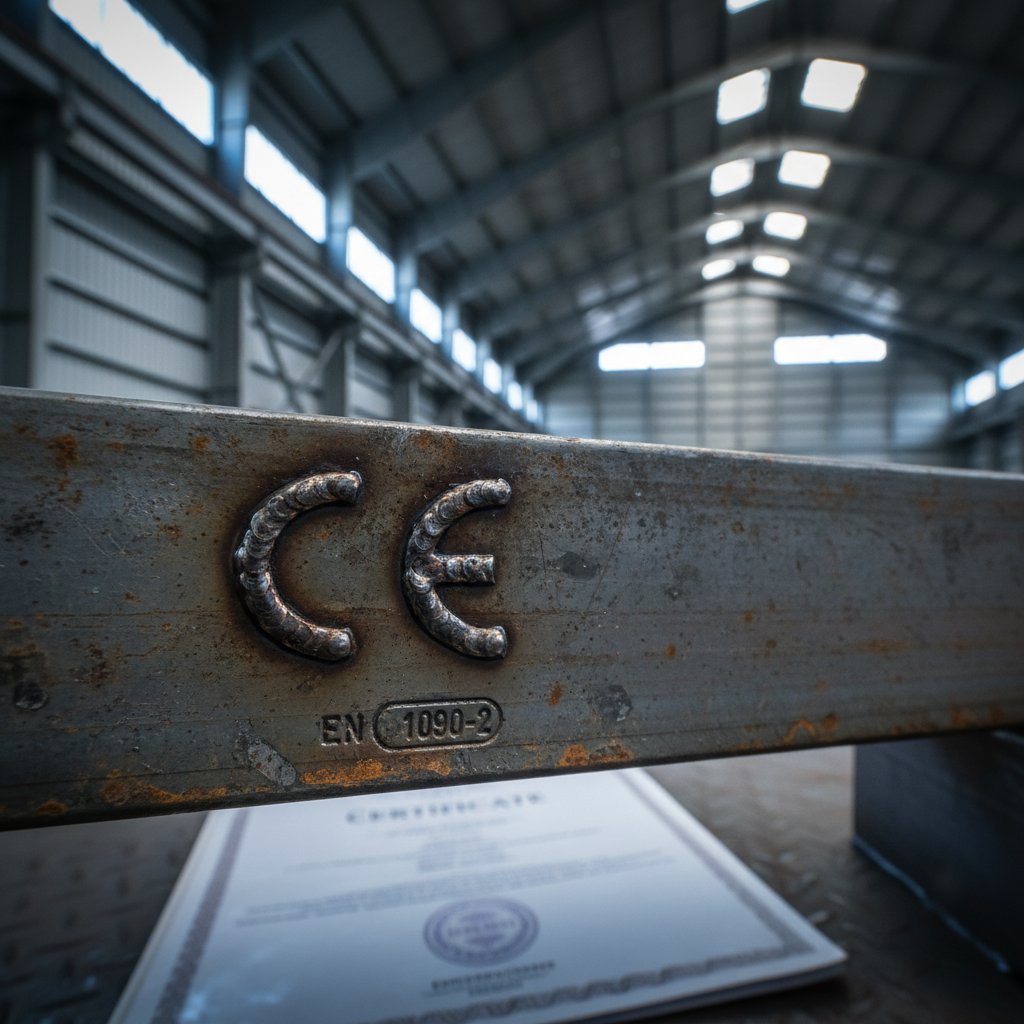
Since 2014, all load-bearing steel structures supplied to the European Union market must carry the CE mark in accordance with the EN 1090-1 and EN 1090-2 standards. This framework dictates strict factory production controls.
The standard defines several Execution Classes (EXC). Agricultural hangars, including a standard width agricultural hangar, usually require EXC2. If you plan to install a heavy overhead crane or if the structure will endure massive dynamic loads, EXC3 becomes mandatory. The Swed-Trac factory in Šilutė is fully audited and certified to manufacture structures up to the highest EXC requirements. We control everything: from tracing the exact origin of the steel to verifying welder qualifications and conducting ultrasonic testing on the welds.
Why does this matter for your insurance? If hurricane-force winds or record snowfall destroy your wide hangar, the loss adjuster from Allianz, AXA, or Baloise will immediately ask for the structural CE declaration. If you cannot produce it (because you bought an uncertified, cheap frame), the insurer will classify the building as illegal and unsafe. They will deny your claim. You will lose hundreds of thousands of euros. This is a critical point for any farmer in Germany, France, or the Nordic countries.
EU Directive 98/58/EC and national veterinary requirements for agriculture
If you intend to store grain, animal feed, or house livestock in your hangar, EU Directive 98/58/EC and the rules of your national veterinary service (such as Veterinäramt in Germany, DGAL in France, or NVWA in the Netherlands) come into force. A standard width grain storage hangar faces particularly strict hygiene regulations: - Protection against birds and rodents: The hangar must be completely sealed. The hangars we manufacture feature specialised sealing profiles to block pests, essential for a clean standard width grain storage hangar. - Moisture control: Condensation absolutely cannot drip onto the grain. We solve this using anti-condensation roof coatings or full roof insulation, ensuring optimal conditions within your standard width agricultural hangar. - Cleaning capabilities: Internal walls must be easy to clean, lacking hard-to-reach cavities where dust or mould could accumulate.
Competitor comparison: Swed-Trac vs the European market players
We are not alone in the European market. Competition is healthy; it forces us to sharpen our operations. But how do you separate genuine engineering from a cheap gimmick when choosing a supplier for your steel building? Let us compare Swed-Trac with other well-known names like LLENTAB, Röwer & Rüb, and Gooiermeer.
| Criteria | Swed-Trac (Us) | LLENTAB (Sweden) | Röwer & Rüb (Germany) | Gooiermeer (Netherlands) |
|---|---|---|---|---|
| Production site | Šilutė, Lithuania | Sweden / Various | Germany | Netherlands / Imports |
| Structure type | Steel frames | Steel frames | Equestrian / Steel frames | Often fabric / Temporary |
| CE EN 1090-2 | Yes, 100% certified | Yes, 100% certified | Yes, 100% certified | Depends on supplier |
| Warranty support | Fast (direct teams) | Good, but longer logistics | Premium but expensive | Average |
| Price level | Medium | High | Very High | Low / Medium |
LLENTAB is a formidable competitor offering excellent Swedish quality, but their complex logistics network often inflates costs and extends lead times for a hangar. Röwer & Rüb provide top-tier premium structures, heavily focused on the equestrian sector, but their pricing is extremely high for standard agricultural or industrial needs. Gooiermeer frequently leans towards rapid fabric and temporary solutions, which work well for short-term projects but lack true generational longevity of a robust steel building. When you choose Swed-Trac, you secure heavy-duty industrial quality at a fair price, backed by direct manufacturing control, perfect for your standard width agricultural hangar.
The process from the first call to the handover of the keys
Construction should never be chaotic. The truth is, a smooth build relies on a highly refined process. Ours consists of ten clear stages, ensuring your wide hangar is delivered efficiently:
- Needs analysis (one day): We listen to your vision, evaluate your site location, and understand your planned operations for your steel building.
- Commercial offer (two days): We prepare a detailed, transparent quote with zero hidden fees for your chosen hangar configuration.
- Contract and deposit: Once the numbers work for you, we sign the contract and you transfer the initial deposit.
- Design (two to four weeks): Our engineers draft the structural part of the project and hand it over to your architect to secure the building permit for your standard width agricultural hangar.
- Permit waiting period (two to four months): This is the bureaucratic stage at your local municipality, common across the EU from Poland to the Netherlands.
- Production in Šilutė (four to six weeks): As soon as the permit clears, we start cutting, welding, and painting the steel for your hangar.
- Foundation works: While we manufacture the frame, your local contractors cast the foundations using our exact drawings.
- Logistics: We safely transport the complete package to your site.
- Assembly (three to four weeks): Our professional crew erects the hangar like a massive, precision-engineered kit.
- Handover and warranty activation: We sign the final handover protocol and hand over all CE certificates and operating manuals.
Want a quote on a hangar? Call +370 645 18595 or email sales@swedhall.se - we will prepare an individual quote within 24 hours.
Frequently Asked Questions (FAQ)
Q: What is the average lifespan of a Swed-Trac steel hangar?
A: With proper maintenance, our steel hangars are designed to last 50 years or more. The S355 steel grade and high-quality anti-corrosion coatings ensure exceptional durability in the demanding European climate.
Q: Can Swed-Trac assist with the building permit application?
A: While we provide all necessary structural engineering drawings and CE certificates, the actual submission and liaison with your local municipality for the building permit is your responsibility. We recommend engaging a local architect who understands specific national and regional regulations.
Q: Is it possible to expand a Swed-Trac hangar in the future?
A: Yes, our modular design allows for future expansion. We can design the initial structure with expansion in mind, making it easier to add length later without significant structural modifications.
Q: What are the typical lead times from order to completion?
A: The overall timeline can vary significantly due to the permit waiting period, which is outside our control. From contract signing, expect 2-4 weeks for design, 4-6 weeks for production (after permit), and 3-4 weeks for assembly. The permit waiting period can range from 2 to 4 months.
Q: Do you offer financing options?
A: Swed-Trac does not offer direct financing. However, our structures are fully certifiable and eligible for EU CAP funding and various national agricultural investment schemes. We can provide all documentation required by financial institutions.
Q: What kind of warranty do you provide?
A: We offer a comprehensive 2-year warranty on the structural integrity of our steel frames and a 2-year warranty on cladding materials and assembly work, provided the structure is used and maintained according to our guidelines.
Q: Can I choose specific colours for the cladding?
A: Yes, you can choose from a wide range of RAL colours for both the roof and wall cladding, allowing you to match your existing farm buildings or local aesthetic requirements.
Q: What are the foundation requirements for your hangars?
A: Our hangars require a reinforced concrete strip or pad foundation. We provide detailed foundation drawings and load calculations that your local civil engineer and contractors will use to prepare the site.
Q: Do you install electrical systems or plumbing?
A: No, our scope of work focuses on the steel structure, cladding, doors, and windows. Electrical, plumbing, and other internal fit-outs are handled by local specialist contractors after our assembly is complete.
Q: How do you ensure quality control during manufacturing?
A: Our factory in Šilutė operates under strict Factory Production Control (FPC) systems, regularly audited to maintain our EN 1090-2 certification. This includes material traceability, qualified welders, and rigorous inspection at every stage of production.