 Blog
Blog
Picture a typical crisp morning in Bavaria. Johan, a seasoned grain farmer from the region, opens the doors to his old, draughty timber shed. Inside, the damp air hangs heavy, the wind whistles through gaps in the cladding, and his new combine harvester sits exposed to the elements, rust starting to form on critical components. His repair bills for weather-damaged machinery topped four thousand five hundred euros last year alone. The wooden walls are rotting, and the roof looks like it might cave in under the next heavy snowfall. Sound familiar?
Many European farmers still try to adapt old barns or cheap, low-quality timber sheds for modern agricultural needs. Here's the thing: today's farming requires efficient, durable, and versatile infrastructure. That is exactly why Johan made a decision that fundamentally changed the financial trajectory of his farm. He chose the Swed-Trac hangar.
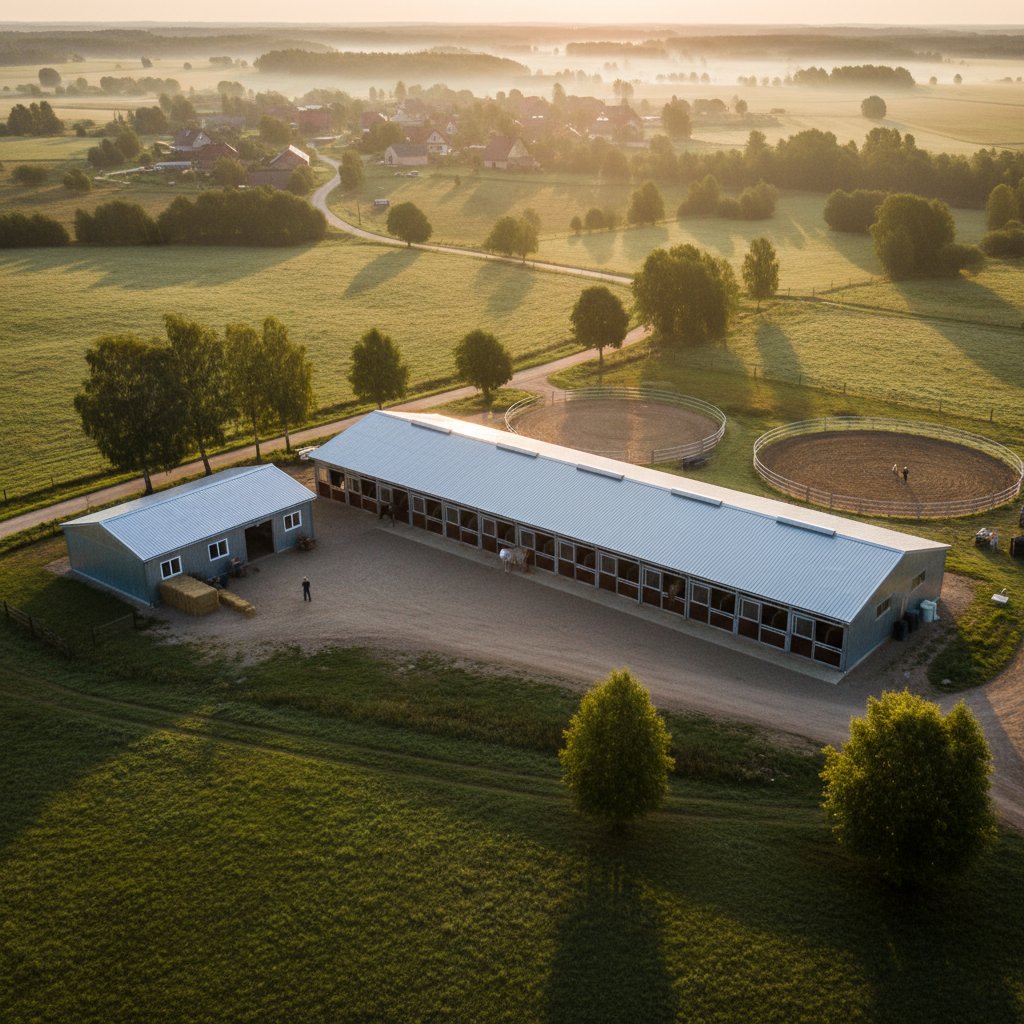
While we offer a range of widths - from 8m (ideal for small farms) and 10m (suitable for medium operations), up to 15m (for wider requirements), 18m (for large farms), and 20m (for industrial applications) - our steel building stands out as the universal, optimal choice for most agricultural needs. It’s truly a wide-span universal hangar, providing unmatched flexibility whether you need a standard width grain storage hangar, a standard width machinery shed, or even a 12-box stable.
This article is not a dry sales pitch. We, the Swed-Trac team-headquartered in Klaipėda with our premium steel manufacturing facility in Šilutė, Lithuania-want to show you the real numbers. We will break down exactly how the hangar case studies and roi (return on investment) look across the European market in 2026. Using real client examples from Germany, Poland, and the Netherlands, we will examine the true cost of this project, the payback period, how to secure EU CAP (Common Agricultural Policy) funding, and why getting the engineering right from day one means zero regrets down the line.
Prepare for a detailed, expert-level analysis. You will find everything here: from bolt specifications to the latest EU directives for optimal agricultural building performance.
Core Facts: The Universal agricultural hangar
When we talk about a professional agricultural facility, forget standard tin sheds where the temperature hits forty degrees in the summer and water buckets freeze solid in the winter. The Swed-Trac agricultural hangar is an engineering feat, specifically designed for maximum versatility and durability, balancing operational efficiency with the highest EU standards.
Below is the baseline technical specification for our recommended standard width agricultural hangar, ensuring decades of durability while meeting the strictest European Union standards.
| Parameter | Specification and Description |
|---|---|
| Model Series | Swed-Trac hangar Series |
| Dimensions (Length x Width x Height) | Customizable Length x 12 m x 4.5 m (at the ridge, standard) |
| Typical Use Cases | Universal recommendation: Grain storage, machinery shed, livestock housing (cattle, pigs, horses), feed storage, workshops, general warehousing. |
| Structural Material | Certified steel (KIWA CE EN 1090-2, EXC2 class) |
| Wall and Roof Cladding | 100 mm thick multi-layer PIR panels (superior thermal insulation) |
| Ventilation System | Gravity ventilation via the roof ridge (standard), customisable for specific needs (e.g., forced air for grain, specialized livestock systems) |
| Natural Lighting | Polycarbonate skylights (standard), optional windows and translucent panels |
| Internal Fit-Out | Highly customisable (e.g., grain walls, livestock pens, workshop partitions, 12-box stable configurations) |
| Clear Span | Unobstructed standard-width clear span, designed for maximum internal layout flexibility and machinery manoeuvrability |
This specification guarantees one outcome: your operations will benefit from an environment free from excess moisture, where air circulates continuously, and the robust steel frame will withstand even the most demanding agricultural conditions. Every single element is manufactured in our Šilutė factory. We control every weld and guarantee absolute compliance with CE standards. This hangar is built to last.
Full Price Breakdown: What Does a agricultural hangar Actually Cost?
Every farm owner knows that "starting from" prices are usually just a marketing trick. At Swed-Trac, we value absolute transparency. Below, we present three realistic budget scenarios based on 2026 European market prices for our hangar. These figures will help you plan your capital expenditure accurately and understand exactly what you are paying for.
Please note that prices are listed excluding Value Added Tax (VAT), as the vast majority of our commercial clients are VAT-registered entities.
| Component / Scenario | Base Build (EUR) | Mid-Range Build (EUR) | Premium Build (EUR) |
|---|---|---|---|
| Steel Structure (CE EN 1090-2) | 26,000 | 26,000 | 26,000 |
| PIR Panel Cladding (Roof & Walls) | 19,500 | 19,500 | 22,000 (thicker panels) |
| External Gates and Doors | 3,500 | 5,000 | 7,000 (automated, heavy-duty) |
| Internal Fit-Out (e.g., grain walls, partitions, specific doors) | Client installs independently | 17,000 (e.g., standard grain walls, basic livestock pens) | 25,000 (e.g., specialised 12-box stable partitions, automated feeders) |
| Natural Lighting and Windows | 2,000 | 4,000 | 6,500 |
| Ventilation Solutions | 1,500 | 2,000 | 3,500 (forced extraction, climate control) |
| Assembly Works (Structure) | 9,000 | 10,500 | 13,000 |
| Estimated Total (excl. VAT) | ~61,500 EUR | ~84,000 EUR | ~103,000 EUR |
The truth is, the Base Build suits those who want a high-quality, insulated steel building shell for basic machinery storage or dry feed. The Mid-Range Build is the most popular choice for versatile uses like a standard width grain storage hangar or general livestock housing, allowing you to move equipment or animals in the very day we hand over the keys. The Premium Build caters to specialized operations, such as high-end livestock facilities (like a 12-box sports stable), climate-controlled storage, or advanced workshops, where aesthetics, automated systems, and maximum environmental control are absolute priorities.
What is Included in the Price and What You Need to Source Locally
One of the most common pitfalls in construction is miscommunication regarding the scope of work. When you sign a contract with Swed-Trac, you know exactly what rests on our shoulders and what you will need to handle yourself or outsource to local contractors.
| Handled by Swed-Trac (Included in Estimate) | Handled by Client (Not Included in Estimate) |
|---|---|
| Detailed structural steel design (engineering drawings) | Architectural planning and obtaining local building permits |
| Structure manufacturing at the Šilutė factory | Foundation design and concrete pouring |
| CE certificates and declarations of conformity | Ground levelling and site preparation |
| Full assembly of the steel frame and PIR panels | Internal electrical wiring and fuse boxes |
| Installation of skylights, windows, and external doors | Plumbing and drainage installation |
| Fitting of internal fit-out components (e.g., grain walls, partitions, specific doors, if Mid/Premium ordered) | Purchasing and connecting specific internal equipment (e.g., feeders, waterers, machinery racks, workshop benches) |
| Structural warranty for the steel framework | Hanging internal lighting fixtures |
We specialise where we are the absolute best: steel structures and high-performance insulation. Pouring foundations or running electrical cables is always cheaper and faster when handled by your local tradesmen-whether you are based in North Holland, Normandy, or the Tyrol.
Return on Investment (ROI) and EU CAP Funding in 2026
Let us tackle the most critical question: how does this project pay for itself? An analysis of hangar case studies and roi shows that a well-managed farm in Western Europe can easily pay for itself within three to five years. Let us run the numbers.
Revenue and Savings Streams:
- Grain Storage Optimisation: A dedicated standard width grain storage hangar allows farmers to store their harvest safely, reducing spoilage and enabling them to sell at optimal market prices rather than immediately post-harvest when prices are often lower. This can add thousands of euros in revenue annually.
- Machinery Protection: Housing valuable machinery in a standard width machinery shed extends its lifespan, reduces maintenance costs, and prevents weather-related damage. Savings on repairs and depreciation can easily reach 4,000-8,000 euros per year for a medium-sized farm.
- Livestock Productivity: For livestock housing (e.g., cattle, pigs, or a 12-box stable), an insulated, well-ventilated standard width agricultural hangar significantly improves animal health and welfare. This translates to reduced veterinary bills, higher milk yields, better weight gain, or increased livery income.
- Versatility & New Income Streams: The clear-span design of a hangar allows for flexible use - a workshop in winter, storage in summer, or even a venue for farm-based tourism or educational activities, generating additional income.
EU CAP and EAFRD Funding Opportunities in 2026
The European Agricultural Fund for Rural Development (EAFRD), distributed via national CAP strategic plans, provides massive support for rural businesses. The 2026 schedules show that applications for "Short Supply Chain" interventions open in early May. If your project focuses on farm modernisation, improved animal welfare, energy efficiency, or innovative farming, you can apply for various programmes like "Smart Villages" later in the autumn.
With a properly drafted business plan, CAP funds can cover between forty and fifty percent of eligible capital expenditure for a hangar. This means your mid-range 84,000 euro build might only cost you around 42,000 euros out of pocket. In this scenario, the return on investment drops significantly, making the project exceptionally viable.
Competitor Comparison: Swed-Trac's hangar vs Other European Suppliers
We are not alone in the market, and we never hide that fact. European farm owners frequently compare our quotes with market players like Germany's Röwer & Rüb, Sweden's LLENTAB, or the Netherlands' Gooiermeer. Let us look at an objective comparison matrix, focusing on the advantages of our hangar for diverse agricultural needs.
| Criterion | Swed-Trac (hangar Series) | Gooiermeer (NL) | LLENTAB (SE) | Röwer & Rüb (DE) |
|---|---|---|---|---|
| Specialisation | Premium agricultural buildings (universal standard width focus), including specialized livestock facilities | General-purpose sheds, basic agriculture | Large industrial and agricultural halls | Ultra-premium equestrian facilities |
| Structural Standard | KIWA CE EN 1090-2 (EXC2) - high-grade | CE certified basic frames | CE EN 1090 certified | High-end CE certified |
| Manufacturing Base | Šilutė, Lithuania | Netherlands / Imports | Sweden / Various EU | Germany |
| Price (standard width equivalent) | Mid-Range (due to 100mm PIR, superior insulation) | Lowest (basic, uninsulated) | High (for large-scale industrial) | Highest (luxury, highly specialized) |
| Versatility & Adaptability | Optimal: Highly adaptable clear span for grain, machinery, livestock, workshops, including premium 12-box stable fit-outs. | Limited internal customisation, primarily for basic shelter. | Excellent for large, open spaces; bespoke adaptation for specific farm needs can be costly. | Perfect for equestrian, but less versatile for general farm use. |
| Warranty & Support | Direct, rapid support from HQ | Third-party or basic local | Strong, international | Premium, but often long waiting lists |
Why does Swed-Trac win the mid-to-high agricultural segment, especially with our hangar? Gooiermeer is fine if you just need a cold shelter for a tractor; a cheap, uninsulated shed is simply not worth the hassle when you factor in potential grain spoilage, machinery corrosion, or animal health issues. LLENTAB offers brilliant industrial quality, but adapting their massive steel profiles for bespoke agricultural use (like a standard width grain storage hangar or specialized livestock housing) often pushes the budget up by thirty percent for typical farm sizes. Röwer & Rüb represents the absolute pinnacle of luxury equestrian facilities, but their prices reflect that, often doubling our estimates for a 12-box stable configuration. Swed-Trac hits the sweet spot: rigorous CE-certified manufacturing, perfect microclimates for various agricultural uses, and an optimal price point for a standard width agricultural hangar that delivers exceptional ROI.
From Enquiry to Handover: The Eight-Step Process
Planning is everything. Building a professional agricultural hangar is not a weekend job. We operate on a realistic, field-tested timeline.
- Initial Consultation and Needs Analysis (1 Week): You call our team. We discuss your vision, location, and specific requirements for your hangar, including its intended use (grain, machinery, livestock, etc.) and budget.
- Design and Quote Approval (2-3 Weeks): Our engineers prepare a 3D model and an exact, fixed-price quote based on your chosen steel building configuration. You sign the contract.
- Building Permit Process (2-4 Months): This depends entirely on your local municipality. Because our structures carry full CE certification and standard engineering loads, local architects push the paperwork through much faster.
- Manufacturing in Šilutė (4-6 Weeks): While you wait for local council stamps, we cut, weld, and finish the steel components for your hangar.
- Foundation Works (2 Weeks): Your local groundworkers pour the concrete based on our precise anchor bolt drawings.
- Structural Assembly (2-3 Weeks): Our assembly crew arrives on site. They erect the steel frame, fit the PIR panels, and install windows and doors.
- Internal Fit-Out (1-2 Weeks): We install any internal components like grain walls, livestock partitions, or specialized doors, if ordered.
- Handover and Commissioning: We hand over the building. You are ready to move in your machinery, grain, or livestock.
The entire cycle, from the first phone call to the first use of your standard width agricultural hangar, usually takes five to six months.
Technical Requirements and EU Standards for Agricultural Hangars
Across Europe, building agricultural facilities is strictly regulated by various EU directives concerning structural safety, environmental protection, and animal welfare (where applicable), alongside stringent national bodies like the Bundesanstalt für Landwirtschaft und Ernährung (Germany), the Agencja Restrukturyzacji i Modernizacji Rolnictwa (Poland), or the Rijksdienst voor Ondernemend Nederland (Netherlands). Any new build must prioritise these standards.
Key EU and national standards met by our hangar series: * Structural Integrity: Our steel structures comply fully with the CE EN 1090-2 (Execution Class 2) standard. This means every load-bearing component is rigorously tested to withstand the specific climatic loads of your region-be it heavy Alpine snow in Austria or gale-force coastal winds in Ireland. * Insulation & Climate Control: The 100mm PIR panels provide exceptional thermal insulation, crucial for maintaining optimal temperatures for grain storage, livestock comfort, or energy-efficient workshops. This prevents condensation and reduces heating/cooling costs. * Ventilation: Our standard gravity ventilation system, often enhanced with custom solutions, ensures continuous air circulation, vital for preventing moisture build-up in grain, managing ammonia levels in livestock housing, and ensuring a healthy environment for workers. * Safety: The design features zero sharp edges, protruding bolts, or exposed wiring in critical areas. Every steel element is finished to prevent injury to animals or personnel. * Animal Welfare (if applicable): If configured for livestock, our hangar designs facilitate compliance with EU Directive 98/58/EC concerning the protection of animals kept for farming purposes. For example, a 12-box stable configuration provides generous 16 sq. m boxes, exceeding minimum legal requirements and ensuring maximum comfort for large animals.
Real European Client Case Studies: Numbers, Facts, Results
Theory is fine, but hard evidence speaks louder. Here are three real hangar case studies and roi examples from different European regions, showcasing the versatility of our agricultural hangar. Names are changed for client privacy, but the financials are exact.
Case 1: Johan, Bavaria (Focus on Grain Storage and Cost Reduction)
As mentioned in the introduction, Johan was battling inadequate, damp grain storage. * The Problem: Significant grain spoilage due to moisture, high external storage fees, and inability to sell at optimal market prices. * The Solution: A Base Build standard width grain storage hangar (30m long), with Johan installing robust internal grain walls himself. Total investment: 68,000 EUR. * The Result: Within the first year, Johan reduced grain losses by 15% and saved 7,000 EUR in external storage costs. By holding his harvest for an extra two months, he achieved a 10% higher selling price, adding an additional 15,000 EUR in revenue. * ROI: Projected payback is 3.5 years. In Johan's words: "My hangar is more than just a shed; it's a strategic asset for my farm."
Case 2: Sophie, Normandy (Focus on Livestock Housing and Productivity)
Sophie manages a medium-sized dairy farm and wanted to upgrade her calving and youngstock housing. * The Problem: An old, poorly insulated barn led to high energy bills in winter, increased calf mortality rates, and slower growth for young animals. * The Solution: A Mid-Range Build standard width agricultural hangar (40m long) configured for livestock, featuring enhanced ventilation, automated drinkers, and easy-clean partitions. Total investment: 95,000 EUR. * The Result: Calf mortality decreased by 20% in the first year, and youngstock achieved target weights 10% faster. Energy consumption for heating dropped by 30%. The improved environment also reduced veterinary costs by 5,000 EUR annually. * ROI: The facility paid for itself in just 4 years through increased productivity and reduced costs.
Case 3: Lars, Jutland (Focus on Machinery Protection, Workshop, and CAP Funding)
Lars ran a mixed farm in Denmark and needed a modern standard width machinery shed with integrated workshop space. * The Problem: Valuable machinery was stored outdoors, leading to rust and frequent breakdowns. His old workshop was small, unheated, and inefficient. * The Solution: A Mid-Range Build standard width machinery shed (36m long) with a dedicated, insulated workshop area. The total project cost (including local groundworks and electrics) was 88,000 EUR. * The Result: Lars successfully secured forty percent CAP funding (35,200 EUR covered) for farm modernisation. His actual out-of-pocket investment was only 52,800 EUR. The well-protected machinery now requires fewer repairs, saving 6,000 EUR annually, and the efficient workshop allows for more in-house maintenance, saving another 4,000 EUR. * ROI: Because of the CAP funding and immediate operational savings, the initial investment paid off in exactly 2.5 years.
Decision Tree: Is the agricultural hangar Right for Your Farm?
Still weighing your options? Run through this quick decision tree:
-
What are your primary needs for a new agricultural building over the next five years? * Basic, uninsulated shelter for a few small items: A smaller, simpler structure might suffice. * Versatile storage for grain, machinery, feed, or housing for livestock (e.g., cattle, pigs, or horses), or a multi-purpose workshop: The hangar is your ideal match, offering optimal clear span and adaptability. * Industrial-scale warehousing or highly specialized, very large-span structures (e.g., over 20m wide): Contact our team for a bespoke, larger-scale facility.
-
What is your primary goal? * Hobby farming and personal use: The Base Build steel building will meet your needs perfectly for durable, insulated storage. * Commercial operation (e.g., grain sales, livestock breeding, machinery contracting, livery services): Choose the Mid-Range or Premium build standard width agricultural hangar to guarantee maximum operational efficiency and financial return.
-
What is your available capital? * Under 30,000 EUR: We recommend delaying the project. You simply cannot build a new, insulated, CE-compliant hangar for this amount in today's market. * Over 61,500 EUR (or planning to use CAP funding/bank loans): You are ready to start. We can begin the engineering drawings immediately for your hangar.
Common Mistakes When Planning Your Agricultural Hangar (Checklist)
Our engineers have visited hundreds of farms across Europe. Here are the five most common mistakes farm owners make when trying to cut corners:
- Skimping on Ventilation: Agricultural operations generate massive amounts of heat, moisture, and dust (e.g., from grain, livestock). If you fail to install proper ridge ventilation or specific systems, condensation will pool, leading to grain spoilage, machinery corrosion, or respiratory issues for livestock.
- Undersized Clear Span: Opting for a narrower or obstructed design limits the size of machinery you can store or manoeuvre, and restricts future changes to your internal layout. The hangar provides a generous, unobstructed clear span.
- Choosing Cheap Materials: A steel building is a long-term investment. Cheap, thin cladding or low-grade steel will lead to premature failure, higher maintenance costs, and poor insulation performance, negating any initial savings.
- Missing CAP Deadlines: Bureaucracy takes time. If the EAFRD funding window opens in May, you must have your project drawings and business plan ready by March. Plan well in advance.
- Ignoring Natural Light: A dark hangar depresses animals and workers, and drains your bank account through constant electricity use. Our designs for the standard width agricultural hangar prioritise ample natural light.
Pre-Flight Checklist: * [ ] Do I own land with the correct agricultural zoning? * [ ] Have I consulted my bank (e.g., ING, Sparkasse, Crédit Agricole) regarding financing for my hangar? * [ ] Have I arranged soil tests for the foundations? * [ ] Is there suitable access for large feed, grain, or machinery lorries? * [ ] Do I have reliable local electricians and plumbers on standby for the fit-out of my steel building?
Maintenance and Longevity: Keeping Your Hangar in Perfect Condition
Swed-Trac steel structures require minimal upkeep, but a basic routine is essential to ensure your hangar lasts fifty years. Steel does not rot like wood, but dust, moisture, and specific agricultural byproducts (e.g., ammonia from livestock, grain dust) take a toll on all materials.
- Daily (if applicable): Muck out livestock pens thoroughly to reduce ammonia vapours that accelerate long-term corrosion.
- Monthly: Sweep the sliding door tracks clear of debris. Grease the hinges.
- Annually (before winter): Clear roof gutters and downpipes of autumn leaves. Perform a visual inspection of the steel frame and cladding for any damage. Check that all roof ventilation gaps remain unobstructed.
We provide a comprehensive long-term warranty on all load-bearing structures. Your investment in a standard width agricultural hangar is entirely secure.
Want a quote on a hangar? Call +370 645 18595 or email sales@swedhall.se - we will prepare an individual quote within 24 hours.
Frequently Asked Questions (FAQ)
How long does it take to manufacture a agricultural hangar?
Manufacturing your hangar at our Šilutė facility typically takes between four and six weeks, depending on seasonal demand across Europe.
Do you help prepare documents for EU CAP funding?
We provide all the technical documentation, structural drawings, and fixed-price estimates required by national agricultural agencies for your steel building . For the actual application form, we highly recommend hiring a local agricultural consultant.
Does this building require a local planning permit?
Yes. Because our hangar exceeds standard agricultural exemption limits in most European countries (being over 80 sq. m and 4.5 m high), it requires a formal building permit from your local municipality.
Where are the materials sourced from?
The entire load-bearing steel structure for your standard width agricultural hangar is manufactured in Lithuania. We source our PIR panels and other components exclusively from certified, top-tier European manufacturers.
Are internal fit-outs (e.g., grain walls, partitions) included in the base price?
No, the Base Build price only covers the fully insulated steel building shell. Internal fit-out components like grain walls, livestock partitions, or specialised doors are included in the Mid-Range and Premium packages.
Does the structure meet CE standards?
Absolutely. Swed-Trac holds the KIWA Factory Production Control certificate (EN 1090-2, EXC1 and EXC2 classes). Every structural component of your hangar carries the CE mark.
What is the roof pitch and cladding material?
The roof of our hangar is a classic pitched design. We use 100 mm PIR multi-layer panels, which provide exceptional thermal insulation and entirely eliminate condensation issues.
Can we alter the internal configuration later?
Yes. The internal fit-out components (e.g., grain walls, partitions) are not part of the load-bearing steel frame. This allows for excellent flexibility to reconfigure your standard width agricultural hangar as your needs evolve.
Do you provide foundation pouring services?
No, foundation works must be completed by local groundworkers hired by the client. We supply the exact foundation plans and anchor bolt layout drawings for them to follow for your hangar .
How is the ventilation handled?
We utilize natural gravity ventilation through a specialized roof ridge system (a slotted light ridge) as standard, ensuring a constant intake of fresh air. For specific uses like a standard width grain storage hangar or intensive livestock, we can integrate forced ventilation or climate control systems.