 Blog
Blog
Johannes from Bavaria always thought bureaucracy was just a waste of time. Four years ago, he decided to build a new agricultural hangar for his machinery and grain storage. He found a cheap contractor from across the border, paid in cash, received steel structures with zero documentation, and felt brilliant for saving nearly fifteen thousand euros. The hangar stood, the tractors were parked, and everything looked perfect. Until the winter of 2025.
That winter, heavy snow hit the region hard. One January morning, Johannes found his hangar roof sagging dangerously - the cheap steel trusses could not handle the load. Luckily, he managed to move his valuable machinery out safely. The real shock came when he called his insurance company, Allianz. The claims adjuster asked for the building's CE EN 1090-2 certificate and the original building permit. Since Johannes had neither, the insurer refused the claim. Saving fifteen thousand euros quickly turned into a seventy-thousand-euro disaster.
That is exactly when Johannes contacted us at Swed-Trac. We do not reinvent the wheel. We simply manufacture steel structures in Šilutė, Lithuania, strictly following the toughest European Union standards. Our headquarters in Klaipėda constantly fields calls from European farmers who got burned by choosing illegal or semi-legal building methods. In this article, speaking as the lead voice of the Swed-Trac engineering team, I will explain the exact legal requirements, certificates, and insurance details you need for an agricultural steel building in Europe. While we offer a range of widths - 8m for small farms, 10m for medium operations, 15m and 18m for wider needs, and 20m for industrial applications - our agricultural hangar is the most versatile and universally recommended choice for most agricultural needs. Its optimal dimensions make it ideal for everything from grain storage and machinery sheds to livestock housing.
If you plan to invest in serious infrastructure for your farm, read this to the end. It might save your money and your sanity.
Core facts: Swed-Trac standard width Universal Hangar specifications
Before diving into the legal jungle, we need to know what we are talking about. A standard width agricultural hangar is not just a shed. It is a complex engineering structure that requires flawless ventilation, natural lighting, and structural integrity to protect your assets, whether they are valuable machinery, precious grain, or livestock.
Here are the baseline specs for our hangar configuration, meeting all EU regulations. This universal width is designed to accommodate standard agricultural equipment, provide ample storage, and offer flexibility for various farm uses.
| Parameter | Specification / Value |
|---|---|
| Product code | ST-standard width (Swed-Trac standard-width Hangar) |
| Length and width | Customisable length x standard width |
| Wall height | 4 metres (optimal for machinery access and air circulation) |
| Structure type | Structural steel (S355 grade) |
| Certification | CE marking, EN 1090-2, EXC2 class |
| Roofing | Sandwich panels or anti-condensation steel sheets |
| Typical Use Cases | Grain storage, machinery shed, livestock housing, feed storage, general warehousing |
| Wind and snow loads | Calculated per local European region (Eurocode 3) |
| Production site | Šilutė, Lithuania (Swed-Trac factory) |
These parameters are not pulled out of thin air. Our constructors calculate every millimetre and every steel beam to withstand the harshest Bavarian winters and the fierce autumn winds of the North Sea coast, ensuring your steel building stands strong for decades.
Full price breakdown: what does peace of mind cost for a hangar?
Price is always the elephant in the room. When a client asks "what will the hangar cost?", the answer depends entirely on the level of comfort and automation you want. For a wide hangar, we offer three main scenarios. The table below shows estimated 2026 European market prices in euros, excluding VAT, for a typical standard width x 36m structure.
| Component | Base setup (EUR) | Medium option (EUR) | Premium solution (EUR) |
|---|---|---|---|
| Steel structure (CE EN 1090-2) | 26,000 | 26,000 | 29,500 (reinforced) |
| Roof and wall cladding | 17,000 (anti-cond sheet) | 31,000 (PIR 80mm panels) | 49,000 (PIR 120mm + aesthetic finish) |
| Internal partitions & doors (if needed) | 20,500 | 27,000 (sliding doors) | 40,500 (heavy-duty, powder-coated) |
| Gates and windows | 5,000 | 8,500 | 13,500 (automatic, tempered glass) |
| Assembly work | 9,500 | 12,000 | 17,000 |
| Design and documentation | 3,500 | 5,000 | 8,000 (full permit management) |
| TOTAL (excl. VAT) | ~81,500 EUR | ~109,500 EUR | ~157,500 EUR |
The base setup for a standard width agricultural hangar is perfect for those who want a high-quality, durable, yet simple solution for machinery or basic storage. The premium option caters to high-value grain storage, advanced livestock facilities, or operations where flawless aesthetics and maximum thermal insulation matter just as much as function.
What is included in the Swed-Trac offer and what is not
A common mistake is comparing quotes from different manufacturers without checking what hides behind the numbers. We play with open cards. Here is exactly what you get with us, and what you will need to handle yourself (or hire separate contractors for) when building your hangar.
| Included in the Swed-Trac project | Not included (client's responsibility) |
|---|---|
| Full steel frame with CE EN 1090-2 cert | Site levelling and groundworks |
| Factory anti-corrosion coating | Concrete foundations (we can recommend partners) |
| Supply and installation of roof and walls | Internal electricity and plumbing |
| All fasteners, screws, and flashings | Local grid connection fees |
| Internal partitions and fronts (if specified) | Internal equipment (e.g., grain handling, livestock feeders) |
| Technical execution design for structural part | Land use change permits (if needed) |
| Structural warranty (2 years) | Landscaping and paving |
Rights and certificates: why paperwork matters more than steel for your hangar
Here is the thing. You can have the most beautiful steel building in the world, but without the right paperwork, the law treats it as an illegal structure. Let's break down the four essential aspects that will determine your project's success.
1. The building permit process for an agricultural hangar
Across Europe, buildings fall into different regulatory categories. A agricultural hangar covering a substantial area (e.g., standard width x 36m = 432 square metres) will never qualify as a simple, permit-free structure. The truth is, you absolutely need a building permit.
The process looks like this: First, you need a plot with the right zoning (agricultural land with permission for farm buildings, or commercial land). Then, your architects prepare the design proposals, get connection conditions from local utilities, and draft the technical project.
We at Swed-Trac provide the structural execution design, which forms a core part of the overall application. Without our engineers' signatures and calculations, local planning authorities will not issue the permit. Getting this permit takes anywhere from three to six months, so plan well ahead for your hangar project.
2. CE EN 1090-2 standard: your guarantee of safety
If someone offers to build your standard width agricultural hangar and claims that "certificates are just paper, we will weld it in the barn for less," run away.
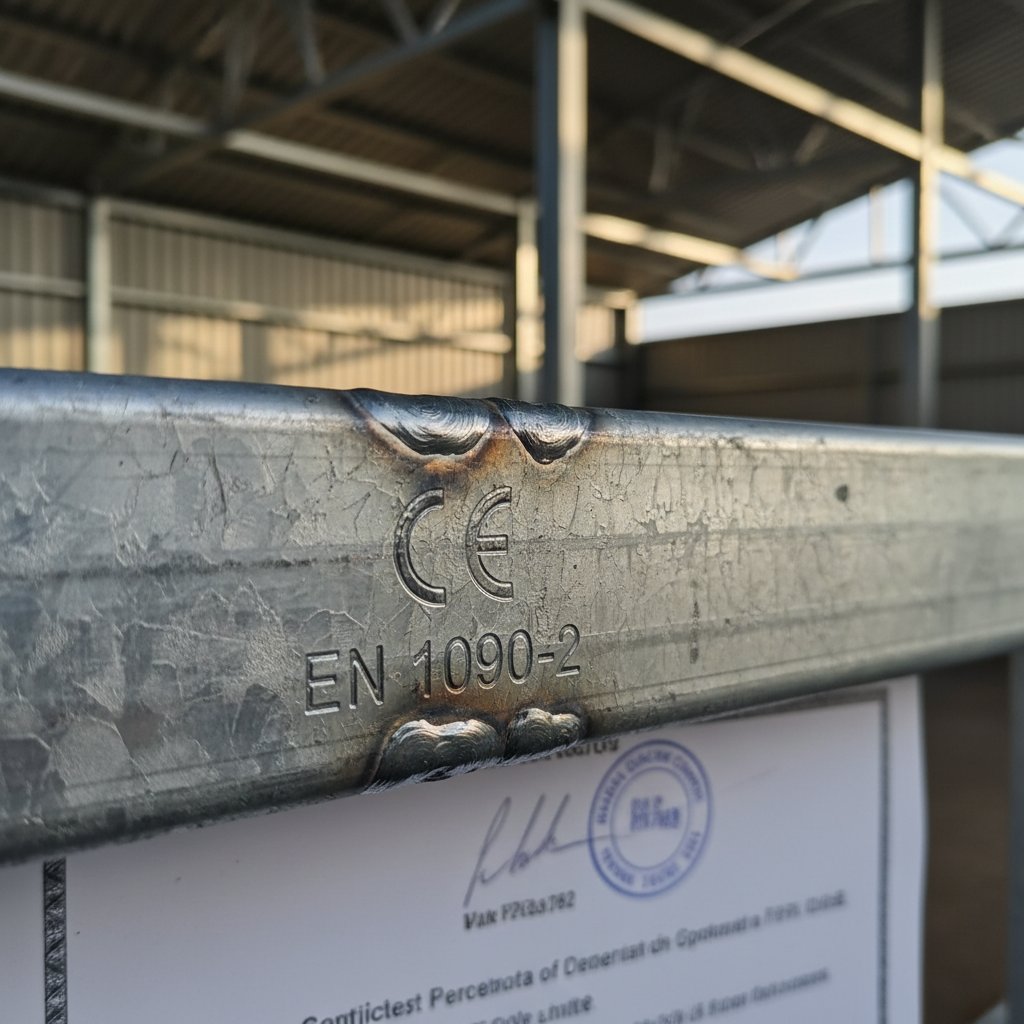
The European standard EN 1090-2 governs the manufacture and assembly of steel structures. It means every batch of steel is traceable. A certified welder executes every single weld. Before painting, we shot-blast the metal to SA2.5 class so the anti-corrosion coating lasts for decades.
Independent experts regularly audit our factory in Šilutė. When we deliver the structure to your site in France, Germany, or the Netherlands, the CE declaration of conformity comes with it. This document is mandatory for passing the final state building inspection. It is also strictly required if you want to secure EU Common Agricultural Policy (CAP) or EAFRD rural development funds. Without CE marking, the paying agency has every right to demand their grant money back. This is especially crucial for a wide-span universal hangar like our standard width model, where structural integrity is paramount.
3. EU Regulations and National Requirements for Agricultural Buildings in 2026
Agricultural buildings, including a standard width machinery shed or standard width grain storage hangar, must comply with a range of EU and national regulations. These go beyond just structural integrity and often cover environmental impact, safety, and, if applicable, animal welfare.
Key considerations for a modern agricultural hangar include: - Structural Integrity & Safety: Ensuring the building can withstand local wind and snow loads (Eurocode 1, 3). This is where our CE EN 1090-2 certification is vital. - Fire Safety: Compliance with national fire codes regarding materials, escape routes, and fire suppression systems. - Environmental Regulations: Proper management of runoff, waste, and emissions, especially for livestock or chemical storage. - Ventilation and Lighting: Adequate air circulation and natural light are crucial, whether for machinery maintenance, preventing moisture build-up in stored grain, or maintaining animal health if used for livestock. Our standard 4-metre wall height provides excellent air circulation. - Access and Egress: Ensuring sufficient door heights and widths for machinery, vehicles, and personnel. Our wide hangar design typically allows for large access points.
Ignoring these rules can lead to fines, operational restrictions, or even the forced closure of your facility.
4. Insurance policy aspects and liability
Let's look back at Johannes from Bavaria. Insurance companies are not charities. Before paying out tens of thousands of euros for storm or snow damage to your hangar, they send experts to find reasons not to pay.
The most common reason for a rejected claim is a breach of building regulations. If your agricultural building is constructed from untraceable metal without an EN 1090-2 certificate, insurers like AXA, Agria, or Allianz will argue the building was unsafe from day one. When you choose Swed-Trac, you get the complete document package. If disaster strikes, you simply hand over our CE declaration, the construction log, and the structural design. The insurers have no legal loopholes left to dispute the build quality of your steel building.
Also, if you employ staff on your farm, you carry legal liability for their workplace safety. A certified building protects you from criminal liability if an accident happens.
Competitor comparison: why Swed-Trac makes the most sense for your hangar
The European market has several strong players offering steel halls and shelters. But when you look at specialised agricultural steel buildings like our wide hangar, the differences become obvious. Let's compare Swed-Trac with the main alternatives.
| Criteria | Swed-Trac | LLENTAB (SE) | Röwer & Rüb (DE) | Gooiermeer (NL) |
|---|---|---|---|---|
| Production site | Šilutė, Lithuania | Sweden / EU | Germany | Netherlands |
| Price level | Medium / Accessible | High | Very High | Low to Medium |
| Agricultural focus | Specialised agricultural projects, incl. standard width universal | Industrial/General, some agricultural | Often niche (e.g., high-end equestrian) | Mostly general agricultural/cattle |
| CE EN 1090-2 | Strictly followed (EXC2) | Strictly followed | Strictly followed | Standard compliance |
| Warranty support | 24-hour response time | Good, but slower coordination | Excellent but expensive | Standard |
LLENTAB is a fantastic, time-tested Swedish company, but their pricing often stings, especially for mid-sized farms looking for a hangar. Röwer & Rüb is the gold standard for luxury, but you will pay a massive premium for the brand name. Gooiermeer and similar agricultural builders are great for basic shelters, but for a high-quality, certified standard width grain storage hangar or standard width machinery shed, Swed-Trac hits the sweet spot: top-tier Northern European quality at a price that actually makes sense.
Process from inquiry to handover: eight clear stages for your hangar
We hate empty promises. Our workflow is as clear as day. Here is what happens when you decide to work with us on your hangar project:
- Initial contact and needs analysis (one day): You call our headquarters. We discuss your vision, required dimensions (including the versatile standard width width), and location in Europe.
- Preliminary quote (three days): We provide a detailed commercial estimate based on your chosen level (Base, Medium, or Premium) for your wide hangar.
- Contract and deposit (one week): We agree on the details and sign the contract.
- Design (two to four weeks): Our engineers prepare the structural execution design for your local building permit application.
- Production in Šilutė (four to six weeks): The steel is cut, welded, shot-blasted, and painted.
- Foundation work (client's responsibility, parallel to production): While we manufacture the steel, your local contractors pour the foundations using our drawings.
- Delivery and assembly (two to three weeks): Our crew arrives at your site, erects the frame, and installs the cladding.
- Handover and documentation (one day): We hand over the keys, CE certificates, and warranty documents. We shake hands.
Technical requirements: what engineers need to know for a steel building
If you are reading this with your site manager, this section is for them. Our agricultural steel structures, especially the hangar, rely on strict engineering principles:
- Foundations: We typically use pile foundations with a reinforced concrete ground beam, or bored piles with anchor bolts. We hand over the exact anchor layout plans immediately after signing the contract.
- Steel grade: We use S355 structural steel, which has a higher yield strength than standard S235 steel. This reduces the structure's weight without sacrificing any strength, crucial for a wide-span universal hangar.
- Loads: We design strictly to Eurocode 3. Snow and wind loads are calculated precisely for your specific European region, whether you are in the windy coastal plains of North Holland or the snowy foothills of the Tyrol.
- Anti-corrosion: We apply epoxy priming with a polyurethane topcoat (to C3 or C4 corrosion class), specified to suit demanding agricultural environments.
Real customer cases: from farm challenges to EU success with Swed-Trac hangars
Theory is fine, but practice speaks louder. Here are three examples of how we solved real problems for European clients with our versatile steel hangars, including the popular standard width width.
Case 1: Johannes's rescue (Bavaria, Germany) As mentioned earlier, Johannes lost his cheap machinery shed to a snow collapse. He needed a fast solution because his valuable farm equipment was exposed. We designed a standard width machinery shed within two weeks, prioritised production in Šilutė, and built a new, fully certified hangar in two months. This time, Johannes got all the paperwork, successfully insured the property with Allianz, and has no regrets about investing in a certified wide hangar.
Case 2: Sophie's advanced grain storage (Normandy, France) Sophie runs a large arable farm and needed state-of-the-art grain storage. Her requirements were high: precise climate control, robust security, and flawless insulation to prevent spoilage. We adapted a standard width grain storage hangar model with 120-millimetre PIR panels on the roof and walls, integrating advanced ventilation systems. The local agricultural inspectors who evaluated the site called it one of the best-designed grain facilities in the region, highlighting the efficiency of the steel building for large-scale operations.
Case 3: Maarten's battle with bureaucracy (North Holland, Netherlands) Maarten secured EU EAFRD rural development funds to modernise his farm with a new multi-purpose hangar. The funding rules are ruthless - deviate from the project by a single centimetre or fail to provide European certificates, and the grant gets revoked. Maarten chose us specifically because we keep our paperwork spotless. We provided every EN 1090-2 conformity document, material origin certificate, and invoice exactly as the paying agency demanded for his standard width agricultural hangar. Maarten got his funding on time. It was entirely not worth the hassle of trying to cut corners.
Decision tree: Choosing Your Optimal Swed-Trac Hangar
Wondering where to start with your agricultural steel building project? Answer these questions to determine the best fit, with our hangar often being the optimal choice for most:
- Are you applying for EU CAP or rural development funds? - Yes: You absolutely need a fully certified solution. Choose our Base or Medium option for a steel building and strictly follow the bureaucratic requirements. - No: Move to the next question.
- Will the hangar be insulated or partially heated (e.g., for sensitive crops, livestock, or workshop space)? - Yes: Go with the Medium or Premium option featuring PIR sandwich panels. - No: The Base option with anti-condensation roof sheets and natural ventilation will do the job for a standard width machinery shed or basic storage.
- What is your budget? - Under 85,000 euros: Base setup for a wide hangar. - Under 115,000 euros: Medium setup with better insulation, ideal for a versatile standard width agricultural hangar. - Over 150,000 euros: Premium class hangar with automation and high-end finishes, perfect for advanced standard width grain storage hangar or specialist facilities.
General tips and warnings for beginners
Our engineers have seen it all. To stop you from tripping at the starting line, here is some golden advice for your agricultural building project:
- Never skip the anti-condensation roof layer. Agricultural activities often generate moisture. If you use bare steel sheets for your hangar, freezing condensation will drip on your machinery, grain, or livestock, leading to rust, spoilage, or health issues.
- Plan internal layouts carefully. While our wide hangar offers excellent clear-span space, consider the flow of machinery, personnel, and materials. Ensure main access routes are wide enough for safe passage of large equipment or feed trolleys.
- Sort out your land zoning early. You will not get a building permit if your land is zoned for forestry or recreation without special conditions.
- Ventilation is everything. A cold but well-ventilated hangar is infinitely better than a warm one full of dampness or fumes. Proper airflow protects machinery from rust, prevents mould in stored goods, and ensures healthy conditions for livestock.
Want a quote on a hangar? Call +370 645 18595 or email sales@swedhall.se - we will prepare an individual quote within 24 hours.
Frequently Asked Questions (FAQ)
How long does it take to manufacture and install a agricultural hangar?
Production takes about four to six weeks, and on-site assembly takes two to three weeks. Do not forget the building permit process, which can add several months beforehand.
Do your structures meet EU grant funding requirements?
Yes, absolutely. We issue CE EN 1090-2 declarations of conformity, which are mandatory when reporting to EU agricultural paying agencies.
Does Swed-Trac pour the concrete foundations?
No, we specialise in steel structures and cladding. However, we provide precise foundation drawings for your local groundworkers to follow.
What warranty applies to your agricultural hangars?
We provide a two-year warranty on the steel structure. Cladding and moving parts come with a standard two-year warranty.
Can I extend the hangar later?
Yes, our structures are modular. If your farm grows, we can easily remove the gable wall and extend the building for additional space.
Is it necessary to insulate an agricultural hangar in Europe?
It is not strictly necessary for all uses, but we highly recommend insulating at least the roof (using PIR panels) to prevent condensation and manage internal temperatures, especially for a standard width grain storage hangar or workshop.
What are the natural lighting requirements for agricultural hangars?
While specific regulations vary by country and use, generally, adequate natural light is recommended. We can integrate polycarbonate skylights that provide superb natural daylight, ensuring a bright interior for your steel building .
Why do insurance companies demand a CE certificate?
The CE certificate proves the building was engineered to withstand local wind and snow loads, and that the welding meets safety standards. Without it, the building is deemed unsafe and uninsurable.
Do you offer internal partitions or specific layouts with the building?
Yes, we can supply various internal fit-outs - from basic dividing walls for a standard width machinery shed to more complex partitions for livestock or segregated storage areas.
What steel grade do you use for the frames?
We strictly use high-quality S355 grade steel, ensuring maximum strength and longevity for your wide-span universal hangar .
Does an agricultural hangar need a lightning rod?
Under most European building codes, metal-framed buildings require proper grounding and a lightning protection system. This protects both your assets and electrical equipment.
How should I maintain the hangar structure long-term?
The most critical task is regularly cleaning any corrosive substances (like manure, if applicable) off the bottom of the steel columns. Ammonia will eventually eat through any anti-corrosion coating. We also recommend checking the bolt tightness once a year.
Do you deliver and build across Europe?
Yes. While our factory is in Šilutė and our HQ is in Klaipėda, Lithuania, we deliver and assemble agricultural hangars across Germany, France, the Benelux region, Scandinavia, and beyond.
Can we install clear roof sheets instead of wall windows?
Yes, this is a highly popular and cost-effective solution. We integrate polycarbonate skylights that provide superb natural daylight for your hangar .
What permits do I need before starting construction?
You will need a standard building permit from your local municipality. Before that, you may need to clear the project with environmental and, if applicable, heritage protection agencies.
Building an agricultural hangar is not like nailing together a birdhouse. It is a major investment in your business, your efficiency, and the protection of your farm assets. By choosing legal, certified solutions like our agricultural hangar, you are not just buying a pile of metal - you are buying peace of mind for decades. The Swed-Trac team is ready to turn your vision into reality, with no hidden fees, legal traps, or nasty surprises from your insurance company.
Ready to take the first step toward a certified, safe, and durable agricultural facility? Contact us today and let's discuss your hangar project!