 Blog
Blog
Do you really know what your farm needs?
Imagine Maria, a third-generation farmer from Poland, looking to expand her operations. Five years ago, she decided to add a new storage building to her farm. Hoping to keep her capital expenditure low, she opted for a basic, cheap metal shed from an unverified industrial supplier. "It has walls and a roof-what else does a farm need?" she thought at the time. Then the first harsh Baltic winter hit, and reality struck hard.
Here's the thing: modern farming demands specific environmental controls. Because Maria’s building lacked proper ridge ventilation and featured an uninsulated roof with no anti-condensation barrier, cold water constantly dripped onto her stored grain, leading to spoilage. Inside, her expensive combine harvester, meant to be protected, started showing signs of rust due to the trapped moisture. By spring, the inadequate space and poor air circulation made it impossible to efficiently sort and load her produce, costing her valuable time and market opportunities.
When Maria finally contacted our Swed-Trac team, her request was blunt: "I need a real agricultural facility, not a tin can that rains inside on a clear day." We sat down with her operational needs, assessed her specific crops and machinery, and designed a modern, agricultural hangar where air circulates naturally, moisture escapes through engineered roof ridges, and machinery is genuinely protected. Today, Maria operates one of the most efficient farms in her region, and she does not regret a single euro invested in proper infrastructure.
The truth is, if you are asking yourself how to choose an agricultural hangar, you are entirely in the right place. In this comprehensive guide, our Swed-Trac engineers and project managers-who design in Klaipėda and manufacture precision steel structures in our Šilutė factory-will reveal everything you must know. We cover every detail from the concrete foundations to the roof ridge, from realistic 2026 European market prices to securing EU CAP funding.
Key facts: Your Universal agricultural hangar
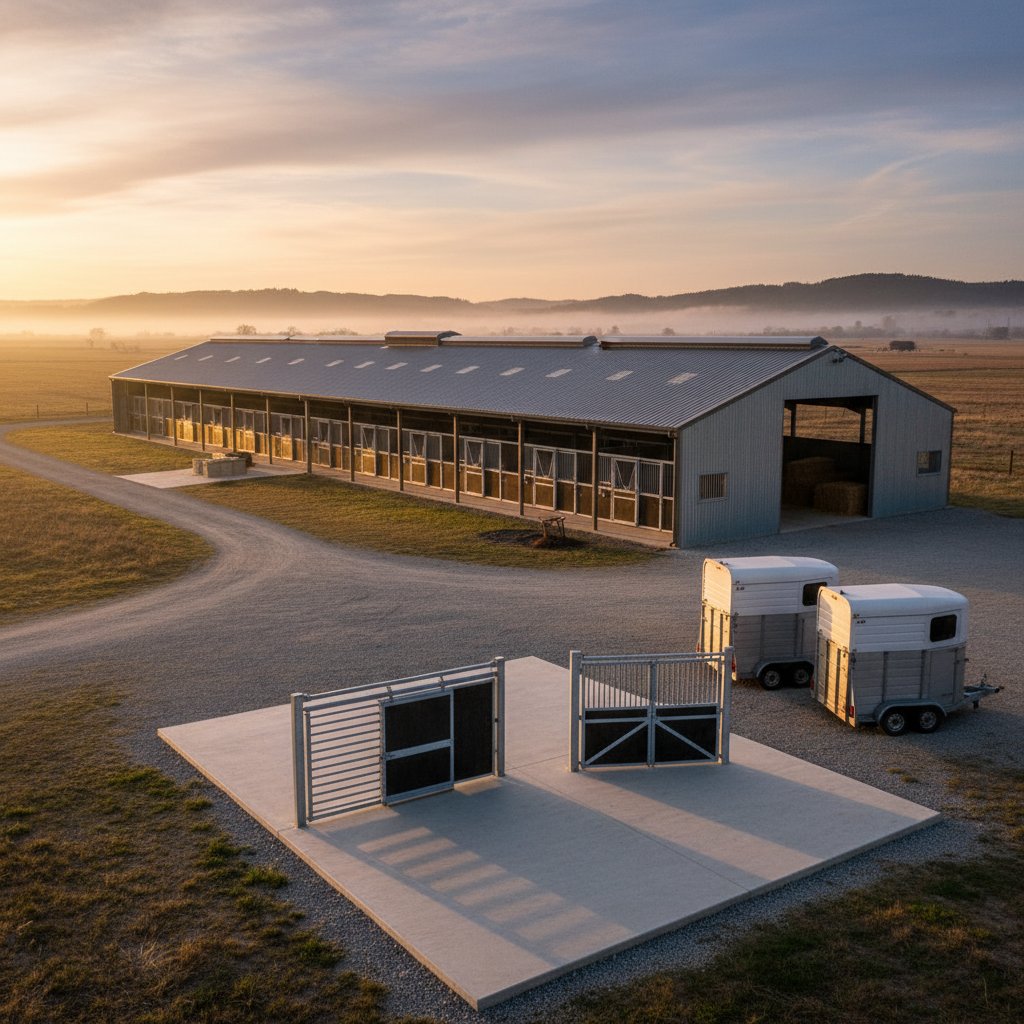
Before we dive into pricing structures and design nuances, we must clearly define our standardised product, internally coded as "ag-standard width". This is not just an empty steel shell; it is a dedicated engineering solution crafted specifically to ensure optimal conditions for grain, machinery, livestock, or general storage.
While our agricultural hangar is the go-to choice for most European farms, offering unmatched versatility and cost-efficiency, we also offer alternative widths of 8m (ideal for small farms or specific smaller machinery), 10m (suitable for medium-sized operations), 15m (for wider applications), 18m (catering to large farms with extensive equipment), and 20m (designed for industrial-scale storage or processing). The hangar receives our expert focus due to its universal applicability.
Below is the technical specification table for this core product, focusing on our recommended steel building.
| Parameter | Specification | Base Reference Price |
|---|---|---|
| Product code | ag-standard width (Agricultural Hangar) | From seventy-five thousand euros |
| Capacity | Universal agricultural use: optimal for grain, machinery, livestock, feed, and general storage. | Internal partitions not included in base price |
| Recommended dimensions | Width - twelve metres; Length - flexible, from 15m to 60m+ | Varies based on specific layout needs |
| Frame material | High-strength structural steel | Fully compliant with CE EN 1090-2 standard |
| Roof covering | Trapezoidal steel with anti-condensation drop-stop or PIR panels | From eight thousand euros (PIR upgrade surcharge) |
| Wall covering | Profiled steel, timber cladding, or sandwich panels | Depends on the selected insulation level |
| Warranty | Two years on the structural frame | Included in the base price |
These parameters guarantee that your standard width agricultural hangar will withstand severe European climate challenges-from heavy snow loads in the Austrian Alps to the blistering summer sun in southern France-providing a durable home for your farm assets.
Full cost breakdown: what does a standard width agricultural hangar actually cost?
One of the most frequent questions we hear from professional farmers and investors is: "What is the bottom line?" The answer is never static because the final figure depends heavily on your vision, your location, and your chosen materials. To give you absolute clarity, we have mapped out three distinct budget scenarios for a standard hangar (e.g., standard width x 40m) based on current European market rates.
| Scenario | Description | Estimated Price (EUR) |
|---|---|---|
| Basic (Utilitarian) | Uninsulated steel frame, roof equipped with an anti-condensation barrier, natural ventilation, no wall windows. Perfect for general machinery storage, hay, or basic dry storage. | Seventy-five thousand euros |
| Medium (Optimal) | Insulated roof (PIR sandwich panels), uninsulated walls featuring timber inserts for aesthetics, integrated skylights for natural daylight, professional mechanical ventilation system. Ideal for a standard width machinery shed or livestock housing. | One hundred and ten thousand euros |
| High-end (Premium) | Fully insulated climate-controlled building (PIR walls and roof), integrated wash bays with drainage, spacious heated office/workshop areas, premium exterior finishes. Optimal for a standard width grain storage hangar or climate-sensitive operations. | One hundred and sixty-five thousand euros |
You must understand that these figures cover the building's structural frame, exterior cladding, roof, and our assembly work. However, this is not the complete picture. When planning your total project financing with institutions like ING, Crédit Agricole, or Sparkasse, you must account for the groundwork and internal fit-out.
What is included in the estimate, and what remains your responsibility?
Absolute transparency is a foundational Swed-Trac value. We never promise what we cannot deliver, and we draw very clear lines of responsibility. Knowing exactly what you are paying for allows you to manage your cash flow without nasty surprises.
| Item | Included in Swed-Trac estimate? | Estimated cost if sourced locally (EUR) |
|---|---|---|
| Structural engineering design | Yes (fully included) | Not applicable |
| Steel frame manufacturing | Yes (produced in Šilutė, Lithuania) | Not applicable |
| Roof and wall cladding | Yes (based on chosen scenario) | Not applicable |
| Delivery to site | Yes (across mainland Europe) | Not applicable |
| Architectural project (for permits) | No (requires a local registered architect) | From four to eight thousand euros |
| Foundation casting | No (we provide structural drawings for your groundworkers) | From fifteen to twenty thousand euros |
| Internal partitions/bays | No (can be ordered from specialised suppliers or constructed locally) | From ten to twenty thousand euros |
| Engineering utilities (water, power) | No (installed by local certified tradesmen) | From ten to eighteen thousand euros |
Looking at this breakdown, you should comfortably add another forty to sixty thousand euros to the building's base price to achieve a fully functioning, ready-to-use agricultural facility.
Selection criteria: what to check before buying your standard width agricultural hangar?
When deciding how to choose your standard width agricultural hangar, you must evaluate functionality just as rigorously as the price tag. Modern farming operations require buildings that are efficient, safe, and adaptable. Here is a ten-point checklist our engineers developed over years of pan-European projects:
- Ventilation engineering: Does the building feature a continuous roof ridge vent? Proper air exchange is critical for preventing moisture build-up (vital for standard width grain storage hangar applications), managing ammonia fumes in livestock housing, and protecting machinery from rust.
- Natural light: Does the design incorporate roof skylights? Maximising natural daylight improves working conditions, reduces electricity bills, and benefits livestock welfare.
- Clear Span Width: The agricultural hangar offers an unobstructed, clear span interior. This is paramount for manoeuvring large modern farm machinery (tractors, combine harvesters), creating flexible storage bays for grain or feed, and easily configuring livestock pens without restrictive internal columns.
- Condensation control: If you opt for an uninsulated roof, a factory-applied anti-condensation fleece is absolutely mandatory to protect stored goods and machinery. For a standard width grain storage hangar, full insulation is often recommended.
- Structural integrity: The steel frame must carry the CE mark and comply with the European standard EN 1090-2 (Execution Class 2 or 3). Do not accept compromises here, especially with heavy snow or wind loads common across Europe.
- Wall protection: Depending on use, the lower section of interior walls (e.g., in livestock areas or where machinery might impact) may need reinforcement with heavy timber kickboards or concrete.
- Door dimensions: Main sliding doors must be tall and wide enough to easily accommodate a large tractor, combine harvester, or feed truck. The hangar width naturally supports these larger door openings.
- Floor/Drainage zones: Have you planned for specific areas with non-slip flooring, proper waterproofing, and heavy-duty drainage, particularly for wash-down areas, feed preparation, or certain livestock setups?
- Storage Environment: Dedicated, insulated, and dry spaces for feed, tools, or small equipment will protect your investments and improve operational efficiency.
- Absolute safety: The entire structure must be free of sharp protrusions, exposed wiring, or low-hanging steel brackets where machinery, livestock, or personnel could suffer injury.
Five most common buyer mistakes
During our years operating across Europe, we have witnessed countless situations where clients tried to cut corners, only to face repair bills running into tens of thousands of euros. Learn from these common errors:
- Mistake one: Skimping on roof insulation and condensation control. Choosing bare corrugated steel without an anti-condensation barrier is simply not worth the hassle. By autumn, your standard width agricultural hangar will turn into a damp cave, leading to grain spoilage, rust on machinery, and potential health issues for livestock.
- Mistake two: Ceilings that are too low. Modern farm machinery is increasingly tall. Ensure the clearance from the floor to the lowest roof truss allows for easy and safe movement of your largest equipment. Low ceilings also hinder proper air circulation.
- Mistake three: Sloppy foundations. Precision-engineered steel frames require perfectly levelled drilled or raft foundations. If your local groundworkers are off by just a few centimetres, assembling the steel frame becomes a logistical nightmare, compromising the integrity of your steel building.
- Mistake four: Ignoring EU CAP funding deadlines. If you plan to subsidise your build through the Common Agricultural Policy (CAP) or EAFRD rural development funds, you must follow the application calendar religiously. Missing a paperwork deadline usually means losing your grant for the entire financial year.
- Mistake five: Short-sighted planning. You need a standard width machinery shed today, but what about five years from now? We always advise clients to position the building on the plot so that we can easily remove the gable end and bolt on additional frame sections in the future, allowing your wide-span universal hangar to grow with your farm.
Competitor comparison: Swed-Trac, LLENTAB, and Ydre-Grinden
The European market features several strong players offering steel agricultural buildings. How do you choose the right partner? We have prepared an objective comparison so you can see exactly where Swed-Trac stands against respected industry peers.
| Company | Core Specialisation | Estimated base price for standard width x 40m Hangar (EUR) | Advantages | Disadvantages |
|---|---|---|---|---|
| Swed-Trac | Agriculture, specialised steel buildings, universal standard width hangars | From seventy-five thousand | In-house manufacturing in Šilutė, deep understanding of agricultural needs, CE EN 1090-2 certified, optimal standard width width. | We do not cater to the small domestic garage market. |
| LLENTAB (SE) | Warehouses, industrial halls, large-scale storage | From seventy thousand | Extremely fast production cycles, excellent standard storage solutions. | Less bespoke experience regarding specific agricultural micro-climate needs for a standard width grain storage hangar. |
| Ydre-Grinden (SE) | Basic agricultural shelters, fencing, simple stables | From sixty-five thousand | Very competitive pricing, great for basic field shelters or uninsulated storage. | Standardised lightweight profiles might struggle with heavy alpine snow loads or robust agricultural demands. |
We hold deep respect for our competitors, but we firmly believe that in the sector of steel agricultural buildings, Swed-Trac delivers the absolute best ratio of structural integrity, specialised agricultural knowledge, and sensible pricing, especially for our versatile hangar.
The process from the first call to handing over the keys
Construction projects are notoriously associated with stress, delays, and budget overruns. We actively dismantle that stereotype. Here are the eight steps defining how we work:
- Initial inquiry and scoping. You call us. We discuss your vision, your geographic location, your local climate loads, and your budget for your new standard width agricultural hangar.
- Preliminary estimate. Within one to two working days, we provide a clear commercial proposal containing hard numbers.
- Contract signing. Once the details align with your expectations, you sign the contract and transfer the deposit. We guarantee zero hidden fees.
- Structural design. Our Klaipėda-based engineers spend two to three weeks drafting detailed CAD models, frame blueprints, and foundation load plans specific to your steel building.
- Manufacturing in Šilutė. While you handle local planning permissions, we spend four to six weeks manufacturing and finishing the steel components in our Lithuanian factory.
- Foundation works. Your chosen local contractors pour the concrete foundations strictly following our technical drawings.
- Site delivery. We transport all structural components directly to your site, whether you are in rural Denmark or the French countryside.
- Assembly and handover. Our professional assembly crews erect the building in three to four weeks. You inspect the facility and sign the handover protocol.
Depending on how quickly your local municipality processes building permits, the entire journey usually takes between three and six months.
Technical requirements: foundations, standards, and EU funding rules
Erecting a commercial agricultural building requires more than just a visually pleasing structure-it must be legally compliant, structurally sound, and fully insurable.
Standards and certificates: Every Swed-Trac steel frame is manufactured under the strict European standard EN 1090-2. This means every weld and every high-tensile bolt is tested, documented, and carries the CE mark. This paperwork is non-negotiable if you want to insure the building with major providers like Allianz or Agria, or if you are applying for EU structural funds for your hangar.
Foundation specifics: For a steel building, we almost universally recommend drilled pier foundations connected by a reinforced concrete grillage. This method guarantees absolute structural stability even in the damp, shifting clay soils common across Northern Europe.
EU CAP Funding: The Common Agricultural Policy (CAP) offers significant opportunities for farmers to co-finance investments in modern agricultural infrastructure. Our standard width agricultural hangars are designed to meet the high standards often required for such funding, including criteria related to efficiency, environmental impact, and animal welfare (if applicable). We recommend consulting your national CAP paying agency (e.g., in Germany, Poland, or Sweden) to understand specific eligibility requirements and deadlines for your region.
Real European client cases: from Normandy to Tyrol
Numbers and specifications matter, but the real proof lies with the professionals who use our buildings every single day. Here are three distinct stories from across the continent, showcasing the versatility of our hangar solutions.
Laurent from Normandy (France): Grain Storage Hangar Laurent, a cereal farmer in Normandy, needed a reliable solution for storing his wheat and maize harvests. He opted for a standard width grain storage hangar from Swed-Trac, featuring 100mm thick PIR sandwich panels for both the roof and walls, combined with advanced ventilation. "The climate control is excellent. Even during humid harvest seasons, the grain remains dry, and I've seen a significant reduction in spoilage compared to my old, uninsulated shed. This steel building allows me to hold my produce for better market prices," Laurent notes.
Emma from North Holland (Netherlands): Machinery Shed Emma runs a mixed farm, and her priority was protecting her fleet of modern machinery, including a large tractor and a potato harvester, from the elements. We delivered a standard width machinery shed with a Basic specification, featuring an anti-condensation roof and extra-wide sliding doors. The hangar provided ample space for all her equipment, plus a dedicated workshop area. Emma successfully secured EAFRD rural development funding, bringing her total out-of-pocket expense for the Swed-Trac structure to just over seventy-five thousand euros.
Lukas from Tyrol (Austria): Universal Livestock and Feed Hangar Lukas needed a versatile building to house his dairy cattle during winter and store feed year-round. He chose a hangar, adapting the standard model to include specific ventilation for livestock and concrete bays for silage. Lukas particularly praises the integrated roof skylights: "The light transmission is so good we rarely touch the light switches during the day. The wide-span universal hangar also gives me enough room to easily manoeuvre my feed mixer, making daily chores much more efficient."
Decision tree: what configuration does your farm need?
If you are still weighing your options, use this straightforward decision tree to find your path to the ideal standard width agricultural hangar:
- Will you store moisture-sensitive crops like grain or hay, or house climate-sensitive livestock?
- Yes: Choose the Medium or Premium scenario featuring PIR panel insulation for your standard width grain storage hangar or livestock housing.
- No, primarily for machinery or general dry storage: The Basic scenario with an anti-condensation roof will serve you perfectly as a standard width machinery shed.
- Do you plan to integrate heated human spaces (offices, workshops, staff kitchens) directly inside the main building?
- Yes: Full wall and roof insulation is mandatory; otherwise, your heat loss and energy bills will be astronomical.
- No: You can safely opt for uninsulated walls, saving a significant portion of your budget.
- Is your capital strictly limited right now?
- Yes: Start by investing in the highest quality structural frame and roof. You can always finish the walls and internal fit-out later as your budget allows. Our steel building is designed for future-proofing.
Want a quote on a hangar? Call +370 645 18595 or email sales@swedhall.se - we will prepare an individual quote within 24 hours.
FAQ: Your questions about agricultural hangars answered
Q: Why is a hangar often recommended for agriculture?
A: A agricultural hangar strikes an optimal balance between cost-efficiency, versatility, and functionality for most European farms. It provides ample clear-span space for manoeuvring large modern farm machinery, constructing efficient grain storage bays, housing various types of livestock comfortably, and offering flexible layouts for feed or general storage. This universal width minimises structural complexity while maximising usable internal space.
Q: Can a Swed-Trac agricultural hangar be expanded later?
A: Yes, absolutely. Our steel frame structures are designed with modularity in mind. We always advise clients to consider future expansion during initial planning. By strategically positioning your steel building on your plot, we can easily remove a gable end and bolt on additional frame sections, extending the length of your hangar as your farm grows.
Q: What is the typical lifespan of a Swed-Trac steel agricultural hangar?
A: With proper maintenance, a Swed-Trac steel agricultural hangar, built with high-strength structural steel and compliant with CE EN 1090-2 standards, is designed for a lifespan exceeding 50 years. The robust materials and precision engineering ensure long-term durability against harsh weather and daily farm operations.
Q: How long does it take to get a quote for a hangar?
A: Once we have a clear understanding of your project requirements (dimensions, desired insulation level, location), our team typically provides a preliminary, transparent commercial proposal for your standard width agricultural hangar within one to two working days.
Q: Is EU CAP funding available for these types of buildings?
A: Yes, investments in modern agricultural buildings like our standard width agricultural hangars are often eligible for co-financing under the Common Agricultural Policy (CAP) and European Agricultural Fund for Rural Development (EAFRD). Eligibility criteria vary by country and region, so we highly recommend consulting your local CAP paying agency for specific details and application deadlines. Our buildings are designed to meet the high standards typically required for such funding.
Q: Can I customise the wall cladding for aesthetic reasons?
A: Absolutely. While profiled steel is a popular and cost-effective option, we offer various wall cladding choices, including timber inserts or full timber cladding. This allows your steel building to blend harmoniously with local architectural styles or your existing farm aesthetic, without compromising structural integrity.
Q: What is an anti-condensation barrier, and do I need it for my hangar?
A: An anti-condensation barrier is a fleece-like layer applied to the underside of uninsulated steel roof sheets. It absorbs moisture from the air, preventing it from dripping onto the contents of your hangar. It is highly recommended, if not mandatory, for any uninsulated agricultural building to protect stored grain, machinery, feed, or livestock from moisture damage. For a standard width grain storage hangar or climate-sensitive uses, full roof insulation (PIR panels) is often a superior alte