 Blog
Blog
Lars from Jutland had a clear dream and a seemingly brilliant business plan. He owned twenty magnificent sport horses, held the deeds to a beautiful plot of Danish countryside, and wanted to open a modern commercial equestrian facility. "How hard can it be?" he thought. "You put up a steel frame, throw a roof on it, hammer in some partitions, and the business runs itself." But when he walked into his local municipality to request a building permit, and later faced the strict inspectors from the national veterinary administration, his optimism evaporated instantly. It turned out that a commercial stable is not just a simple shed-it is a highly complex engineering and legal undertaking.
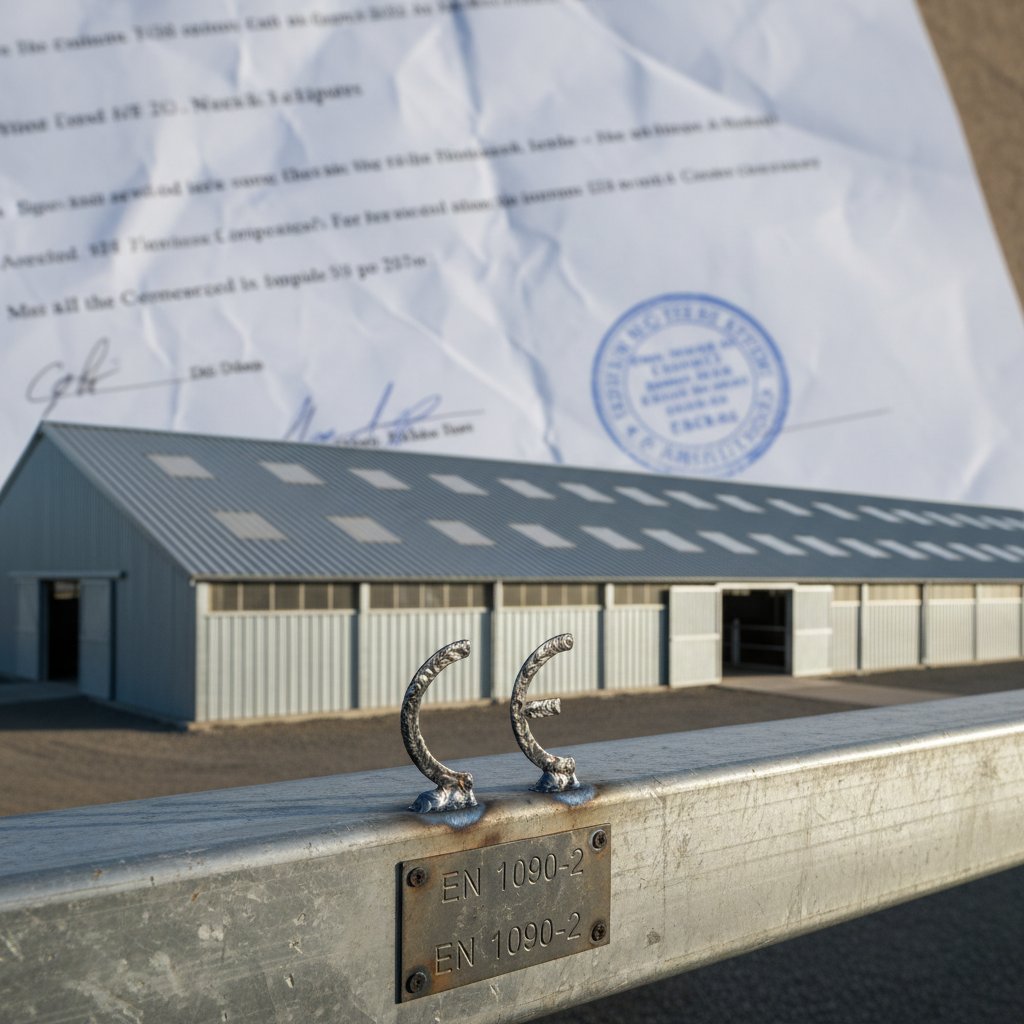
That was exactly when Lars contacted our Swed-Trac team. We listened to his struggles and immediately understood where the fundamental planning mistakes had been made. The problem was never a lack of funding. The issue was a complete misunderstanding of European legal nuances and mandatory structural certificates. A commercial stable requires far more than just nice-looking walls. It demands a CE EN 1090-2 certificate, a ventilation system that meets aggressive EU welfare requirements, and an airtight insurance policy.
In this article, speaking as a veteran Swed-Trac expert, I will explain the reality of building a commercial stable without any sugar-coating. We will cover exactly what permits you need, which certificates are non-negotiable, how insurance policies work across Europe, and what your specific responsibilities are as a facility owner. If you plan to build a commercial stable for twenty boxes (our flagship product, code "stb-20"), reading this text will save you thousands of euros and countless sleepless nights.
Core Facts: What Exactly is the "stb-20" Model?
Before we dive into the bureaucratic jungle of European building codes, we must clearly define the building we are discussing. A commercial stable for twenty boxes is not a small backyard structure. It is a serious engineering project, manufactured entirely at our dedicated steel facility in Šilutė, Lithuania, before being shipped across Europe.
| Specification | Detailed Description |
|---|---|
| Product Code | stb-20 |
| Primary Purpose | Commercial equestrian stable (twenty boxes) |
| Dimensions | Width: twelve metres. Length: thirty-six metres. |
| Total Floor Area | Four hundred and thirty-two square metres |
| Construction Type | Heavy-duty steel frame structure |
| Certification | CE EN 1090-2 (EXC2 class) - mandatory for public equestrian buildings |
| Roofing Material | Sandwich panels (PIR polyurethane core) for zero condensation |
| Box Dimensions | Three point three metres wide, three point three metres long |
| Central Aisle | Three-metre wide central corridor for safe horse passing |
This base model is engineered from the ground up to comply with all European Union structural and animal welfare standards. The absolute priority here is structural integrity and microclimate control. Horses are incredibly sensitive to dampness, stale air, and drafts, making the engineering of the building envelope critical.
Full Price Breakdown: What Does It Cost in 2026?
Clients across Germany, France, and the Netherlands constantly ask: "What is the final price tag for this setup?" The answer depends entirely on the finish level you want to achieve. Preliminary budget planning is absolutely vital, especially if you intend to apply for a commercial loan from Deutsche Bank or ING, or if you are targeting EU Common Agricultural Policy (CAP) and EAFRD rural development funds.
Below are three realistic scenarios reflecting 2026 Western European market prices. These figures are in euros, excluding VAT, and serve as an accurate orientation for your business plan.
| Component | Basic Package (Frame and Roof Only) | Medium Package (Insulated, Standard Boxes) | Premium Package (Turnkey, Smart Automation) |
|---|---|---|---|
| Design and Permits | 4,000 EUR | 6,000 EUR | 8,500 EUR |
| Steel Structure (CE Certified) | 38,000 EUR | 38,000 EUR | 38,000 EUR |
| Roof and Wall Cladding | 18,000 EUR (Uninsulated, cold) | 32,000 EUR (PIR panels) | 42,000 EUR (Premium PIR + timber cladding) |
| Box Partitions and Doors | Client installs themselves | 26,000 EUR (Standard steel) | 46,000 EUR (Powder-coated, solid oak panels) |
| Ventilation and Windows | 2,500 EUR (Natural draft) | 7,000 EUR (Forced extraction + polycarbonate) | 14,000 EUR (Smart climate control system) |
| Assembly Works | 9,500 EUR | 14,000 EUR | 20,000 EUR |
| TOTAL ESTIMATE | 72,000 EUR | 123,000 EUR | 168,500 EUR |
As the table shows, the raw steel frame costs the same across all scenarios. The final budget expands significantly based on the interior equestrian equipment, climate control technology, and aesthetic finishing choices.
What is Included and Excluded in the Standard Estimate?
To prevent any misunderstandings when you sign a contract with us, we draw a very hard line between our responsibilities as your steel building manufacturer and your responsibilities as the site developer.
| Included in Swed-Trac's Responsibility | Excluded (Client / Local Contractor Responsibility) |
|---|---|
| Steel structure manufacturing in Šilutė | Pouring foundations and all earthworks |
| Issuing the CE EN 1090-2 certificate | Bringing external utilities (water, electricity) to the site |
| Supplying and fixing roof and wall cladding | Installing outdoor manure management systems |
| Transporting the structure to your European site | Internal electrical wiring and plumbing inside the stable |
| Professional on-site building assembly | Land use rezoning procedures with local authorities |
We are steel and construction experts. We always leave the foundation work to your local concrete contractors. This approach is significantly cheaper for you, and it allows us to focus entirely on what we do best: precision steel engineering.
The Building Permit Process: Avoiding Bureaucratic Nightmares
Here's the thing: a commercial stable for twenty boxes covering over four hundred square metres is classified as a significant permanent structure everywhere from Bavaria to North Holland. This means one simple fact-without an official building permit, you cannot drive a single peg into the ground.
The process involves several mandatory steps across Europe. First, you need a topographical survey of your land. Then, your local architect prepares the design proposals, and a structural engineer draws up the technical project. This is exactly where Swed-Trac engineers step in to make your life easier. We provide all the necessary structural nodes, specific load calculations (tailored to your local snow and wind zones), and detailed blueprints. Your architect simply integrates our technical file into the master permit application.
These documents are then submitted to your local planning authority. If your land sits in a protected regional park or a strict agricultural zone, the approval process can drag on for three to six months. Never start earthworks before you have that official stamp. Unauthorized construction in 2026 results in massive fines across the EU, and legalizing a commercial business retroactively is virtually impossible.
The CE EN 1090-2 Standard: Why Your Building is Just an Expensive Shed Without It
The truth is, this is the single most critical legal nuance of your entire project. Within the European Union, every load-bearing steel structure must carry a CE mark in strict accordance with the EN 1090-2 standard. For commercial equestrian facilities, the EXC2 (Execution Class 2) standard is mandatory.
What does this mean on the ground? It means that every single piece of steel that arrives at our factory in Šilutė has a passport. We know its exact chemical composition and yield strength. Our welders hold specific European certifications, and every weld seam undergoes rigorous quality control. If you buy a cheap agricultural hangar from uncertified operators who weld in a barn without documentation, you are not buying a stable. You are buying a ticking liability bomb.
Without a CE EN 1090-2 certificate, your local building inspector will refuse to sign off on the structure. You will be denied the veterinary permits required to run a commercial operation. Worst of all, if a heavy winter snow load causes the roof to collapse and injures the horses, the legal and financial liability falls entirely on your personal shoulders. Swed-Trac guarantees absolute compliance with this standard, ensuring our clients sleep soundly.
EU Directive 98/58/EC and FEI Requirements in 2026: What You Must Know
Animal welfare regulations have tightened significantly. In 2026, the European Union's Directive 98/58/EC concerning the protection of animals kept for farming purposes-enforced locally by agencies like the Veterinäramt in Germany, the DGAL in France, and the NVWA in the Netherlands-imposes strict mandates on commercial stables.
First, let us look at box sizes. For a standard warmblood horse, the absolute minimum floor area is nine square metres. We strongly advise building boxes of at least ten to twelve square metres. If you plan to board pregnant mares, the spatial requirements increase further.
Second, air quality is heavily regulated. Horses generate massive amounts of moisture and ammonia. National veterinary inspectors now routinely measure ammonia concentrations in commercial stables. If your building lacks proper ventilation (combining natural ridge drafts with forced mechanical extraction), you will fail the inspection and your business license will be suspended.
Third, natural lighting. A stable cannot be a dark box. The total area of windows or translucent roof panels must equal at least ten percent of the floor area.
If you plan to host competitions, you must also comply with the International Equestrian Federation (FEI) biosecurity requirements. This dictates separate quarantine facilities for newly arriving horses and surfaces that can be rapidly disinfected. The polyurethane sandwich panels we supply are perfect for this, as they withstand high-pressure washing without degrading.
Stable Insurance: Protecting Your Assets and Your Liability
Insurance for a commercial stable is split into two distinct categories: property insurance and public liability insurance.
Property insurance covers damage from fire, severe storms, or heavy snow. Major European insurers like Allianz, AXA, and Agria are incredibly strict in 2026. Before issuing a policy, their underwriters will demand your final building completion certificate and the CE EN 1090-2 documentation. If you cannot produce these, you will either be denied coverage entirely or face a situation where a claim is rejected due to non-compliant construction.
Public liability insurance is even more critical. In a commercial stable, you are housing third-party assets-often extremely valuable sport horses. If a client's horse injures itself on a sharp edge of a poorly manufactured partition, the owner will take you to court. The partitions in our "stb-20" model are engineered with zero sharp edges, concealed hinges, and heavy-duty safety locks to absolutely minimize any risk of injury.
Competitor Comparison: Where Do We Stand in the European Market?
We are not alone in the European market. Several large corporations offer steel buildings. Let us look at the situation objectively and compare Swed-Trac with Röwer & Rüb (Germany), LLENTAB (Sweden), and Ydre-Grinden (Sweden).
| Criterion | Swed-Trac | Röwer & Rüb DE | LLENTAB SE | Ydre-Grinden SE |
|---|---|---|---|---|
| Core Specialization | Agriculture and equestrian | Premium equestrian facilities | Industrial and large agriculture | Equestrian equipment and stables |
| Manufacturing Base | Lithuania (Šilutė) | Germany | Sweden / Various | Sweden |
| CE EN 1090-2 Standard | Strict EXC2 control | Yes, highest level | Yes, high level | Yes |
| EU Vet/Welfare Adaptation | Maximum (we know horses) | Maximum | Moderate | Maximum |
| Price Level 12x36m | ~38,000 EUR (frame only) | Premium pricing | ~45,000 EUR (frame only) | High pricing |
| Warranty & Support | Fast, direct factory support | Excellent | Good, but slower | Excellent |
Our primary strength is not offering the absolute lowest price on the continent. If you just need a cheap canopy to park a tractor, other generic steel providers might be cheaper. But when the conversation shifts to animal welfare, aggressive moisture management, and strict legal compliance for a commercial equestrian business, Swed-Trac offers an unbeatable balance of top-tier engineering and accessible pricing.
The Process: From Initial Inquiry to Handing Over the Keys
How does this actually work in practice? We have refined a clear ten-step process that guarantees your commercial stable is built on time and without unnecessary stress.
- Initial Consultation: You contact our European sales team. We discuss your vision, the specifics of your land, and your funding strategy.
- Preliminary Estimate: We provide hard numbers. This is a detailed preliminary plan, not a wild guess.
- Contract Signing: Once the details align, we sign the manufacturing contract and you pay the deposit.
- Technical Design: Our structural engineers prepare the load calculations and blueprints for your local architect.
- Permit Approval: Your local team pushes the documents through the municipality. This phase takes a few months.
- Manufacturing in Šilutė: Once the permit is stamped, we begin cutting and welding the steel. This takes four to six weeks.
- Foundation Pouring: Simultaneously, your local concrete contractors pour the foundations using our precise anchor bolt plans.
- Site Delivery: We transport the entire steel frame and sandwich panels to your site anywhere in Europe.
- Assembly: Our professional crew erects the frame, installs the roof, and fits the partitions. This takes roughly three weeks.
- Handover: We hand over all CE certificates, warranty documents, and assist with your final building inspection.
Technical Requirements for Foundations and Engineering Networks
A commercial stable requires highly specific foundations. The most common approach across Europe is using bored pile foundations connected by a reinforced concrete ground beam (rostverk). This elevated ground beam is absolutely vital. It lifts the bottom edge of the steel walls away from the aggressive, damp environment of manure and wet bedding.
Water supply is an entirely separate engineering challenge. Twenty horses consume a staggering amount of water daily. Every box must be fitted with an automatic drinker. Because winters in regions like Bavaria or Denmark can still bring deep freezes, you must install heated drinkers or run heating cables along all water pipes to prevent bursting. Electrical wiring must be completely hidden and protected from rodents and the horses' teeth-all cables must run through heavy-duty steel conduits.
Real European Customer Cases
Theory is great, but practical execution speaks louder. Here are three different stories from across our European markets.
Sophie from Normandy, France: Securing EU CAP Funding Sophie planned to open a riding school and decided to apply for EAFRD rural development funds under the 2026 agricultural funding call. She required the highest quality Premium package because the funding board strictly evaluated projects based on innovation and animal welfare metrics. We prepared a flawless technical specification that guaranteed maximum points in her application. Today, her twenty-box facility operates at full capacity, and she projects a complete return on investment within seven years.
Thomas from Bavaria, Germany: Rural Tourism Integration Thomas chose the Medium package for his countryside tourism estate. He handled some of the interior timber finishing himself, saving around twenty thousand euros in the process. Our comprehensive documentation helped him pass the strict Veterinäramt inspections on the first try. He told us: "When you insisted on the forced mechanical ventilation, I thought it was an expensive luxury. Now I see it is totally worth the money-the air inside is always perfectly fresh."
Emma from North Holland, Netherlands: Professional Sports Base Emma needed a facility that met elite FEI standards because she constantly imports and exports showjumpers. We customized the "stb-20" model, expanding the boxes to four metres in width and integrating a dedicated biosecurity quarantine zone. Thanks to our flawless CE EN 1090-2 certification, she easily secured comprehensive liability coverage from Agria and now runs international training camps without a single compliance worry.
Decision Tree: Which Product Package Fits Your Needs?
If you are still debating which route to take, use this straightforward decision tree:
- Is your budget strictly capped (under eighty thousand euros)?
- Yes: Choose the Basic package. We build a legally compliant, fully certified steel frame and roof. You can install the boxes, insulation, and equipment yourself over time.
- Are you applying for EU CAP funding or a loan from Crédit Agricole, ING, or BNP Paribas?
- Yes: Choose the Medium or Premium package. Banks and European funds demand a fully finished, operational facility that meets all veterinary requirements from day one.
- Are you targeting elite sport horses and high-paying clientele?
- Yes: Only the Premium package will do. The investment in smart climate control and solid oak partitions will pay for itself through premium monthly boarding fees.
Master's Tips: The Most Common Mistakes When Planning a Stable
Over my career, I have overseen hundreds of agricultural builds. Here are the critical mistakes you must avoid:
- Cutting corners on ventilation. This is mistake number one. Horses handle freezing temperatures perfectly well, but they suffer terribly in damp, stagnant air. If you fail to install proper extraction chimneys, the roof will sweat condensation, and your horses will develop severe respiratory issues.
- Building narrow aisles. A three-metre wide central corridor is the absolute minimum. If you shrink the aisle to two and a half metres to save space, two handlers leading horses cannot pass each other safely.
- Choosing cheap roofing. Bare sheet metal without an anti-condensation fleece or a PIR core is a disaster in a stable. It will literally rain condensation directly onto your horses' backs.
Frequently Asked Questions (FAQ)
How long does it take to manufacture and assemble a commercial stable?
Manufacturing at our facility in Šilutė takes about four to six weeks from the moment the deposit is paid. The actual assembly on your site takes another three to four weeks, depending on local weather conditions.
Do you help prepare technical documents for EU CAP or EAFRD funding?
While we do not fill out the financial grant applications ourselves, we work closely with your chosen agricultural consultants. We provide all the necessary technical specifications, formal commercial offers, and structural certificates that European funding bodies demand.
What warranty applies to the "stb-20" model?
We provide a long-term structural warranty on the load-bearing steel frame in accordance with European Union commercial law. The sandwich panels and other specific components carry direct manufacturer warranties of two years.
Are bored pile foundations mandatory for a commercial stable?
Yes, we almost exclusively recommend bored or driven pile foundations connected by a concrete ground beam (rostverk). This ensures absolute structural stability and protects the base of the steel walls from the highly corrosive environment of horse urine and manure.
Do you deliver and assemble buildings all across Europe?
Yes, we operate across the pan-European market. Whether your farm is in the Austrian Tyrol, rural Belgium, or the Irish midlands, our logistics network and professional assembly crews will arrive on schedule.
Is it possible to expand a twenty-box stable in the future?
Absolutely. Our steel structures are engineered on a modular grid. If your business grows, we can simply remove the rear gable wall and bolt on additional steel frames to accommodate another ten or twenty boxes.
What are the exact veterinary requirements for box sizes?
The EU legal minimum is nine square metres, but for commercial applications, we install boxes that are three point three by three point three metres (nearly eleven square metres). This comfortably exceeds all 2026 animal welfare directives across member states.
Will your roofs withstand heavy snow loads in regions like Bavaria or the Alps?
Yes. Every single project is calculated individually by our engineers based on the specific snow and wind load zones of your exact location. The structure will fully comply with your national building codes.
How much does the technical structural design cost?
The structural engineering part (the steel calculations) is already included in our building price. You only need to pay your local architect to compile the final site plan and submit the master file to your municipality, which usually costs a few thousand euros.
Can I assemble the stable frame myself to save money?
Theoretically yes, we can supply just the materials. However, for a commercial facility, it is really not worth the hassle. You will void specific assembly warranties, and without professional lifting equipment and structural experience, you risk making incredibly expensive mistakes.
How is manure removal handled in this specific model?
We design exceptionally wide sliding doors at both gable ends of the building, allowing a compact tractor or skid-steer loader to drive straight down the central corridor. The external manure storage facility is a separate planning requirement you must coordinate with your local environmental agency.
Why do insurance companies demand the CE EN 1090-2 certificate?
Insurance underwriters base their risk models on legal compliance. If a building lacks the mandatory European safety certificate, it is legally considered an unauthorized or unsafe structure. Insurers simply will not cover the liability of a building that does not meet basic EU engineering laws.