 Blog
Blog
1. Why European farmers choose their own infrastructure
Imagine Jan, a dedicated mixed farmer in the fertile plains of Poland. Just a few years ago, he was wrestling with outdated wooden sheds for machinery, losing precious grain to moisture and pests in makeshift storage, and paying high fees for off-site feed warehousing. His valuable combine harvester, a significant investment, sat exposed to the harsh winter elements, leading to accelerated wear and costly repairs. Jan quickly realised that relying on inadequate or rented facilities was not just inconvenient; it was a constant drain on his capital, impacting his farm's efficiency and profitability.
That was the exact moment he contacted our Swed-Trac engineering team. His dilemma is universally understood across the European agricultural community: he needed a rapid, highly reliable, and permanent solution that could adapt to various farming needs - from machinery protection to grain storage and even temporary livestock housing. Crucially, he needed a solution that would not demand a multi-hundred-thousand-euro capital expenditure. We presented him with our heavily tested, flagship model - the standard-width wide universal agricultural hangar.
The core focus of this deep-dive analysis is the standard width agricultural hangar case studies and ROI (Return on Investment). As the lead project architects at Swed-Trac, we want to strip away the glossy marketing jargon. We will show you exactly what it costs to build a premium, steel building in Western Europe today, expose the hidden groundworks costs, and demonstrate exactly how fast this specific investment pays for itself.
Here's the thing: if you, much like Jan, are exhausted by the endless cycle of paying for external storage, battling equipment depreciation due to exposure, or struggling with inefficient on-farm logistics, this comprehensive guide is written for you. You will find no empty promises here. Instead, we deliver hard financial data, verified case studies from real European farm owners, and pragmatic engineering advice.
2. Core facts and specifications of the standard-width wide universal hangar
The hangar we manufacture is not a repurposed industrial shed or a basic steel garage. It is a highly specialised, precision-engineered structure designed entirely around the diverse needs of modern European agriculture. Farmers require expansive, unobstructed space, superior ventilation, and absolute physical security for their machinery, crops, and livestock. We engineered the hangar to meet and exceed the most rigorous European Union safety and structural directives.
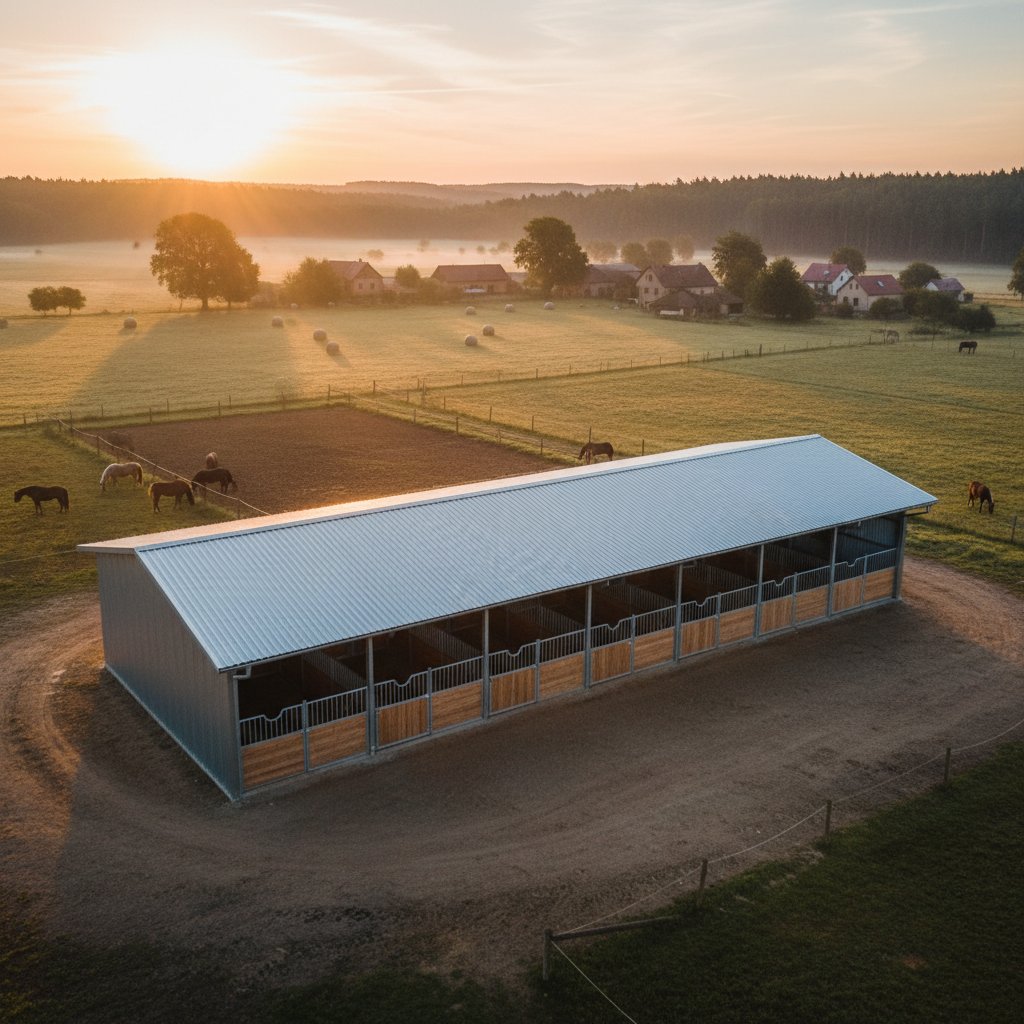
While we offer a range of widths to suit various farm sizes and industrial applications - 8m (ideal for small farms or ancillary storage), 10m (suitable for medium-sized operations), standard width (our UNIVERSAL and RECOMMENDED choice for most farmers), 15m (for wider machinery or larger storage volumes), 18m (catering to large-scale farms), and 20m (for industrial-scale operations or very large machinery) - the wide hangar stands out as the optimal choice. Its standard-width clear span width provides ample room for manoeuvring modern agricultural machinery, stacking grain efficiently, or creating versatile livestock pens, making it a truly wide-span universal hangar.
Below, we detail the foundational specifications of a typical standard width agricultural hangar (e.g., standard width wide x 18m long):
| Specification | hangar Parameters (Example: standard width x 18m) |
|---|---|
| Primary Purpose | Universal agricultural storage (machinery, grain, feed, livestock) |
| Construction Class | CE-certified structural steel complying with EN 1090-2 |
| Dimensions (Length x Width) | Eighteen metres in length, twelve metres in width |
| Eaves Height | Three and a half metres (optimised for machinery access & air circulation) |
| Ridge Height | Five metres |
| Wall Cladding | Multi-layer sandwich panels featuring a polyurethane (PIR) core |
| Ventilation System | Natural draft via engineered ridge slots and adjustable air vents |
| Clear Span | Twelve metres (no internal columns for maximum usability) |
We manufacture this model entirely in our proprietary production facility in Šilutė, while all structural engineering and architectural planning take place at our headquarters in Klaipėda, Lithuania. We absolutely refuse to import cheap, substandard steel frames from outside the EU. By controlling the entire supply chain from raw steel to the final tightening of the bolts on your site, we guarantee a lifespan measured in decades, not years.
3. Full cost breakdown: three realistic scenarios for a hangar
Every single farm across Europe is unique, and the required specification of an agricultural building varies wildly depending on your specific climate, crop, and machinery. Some clients in milder regions require only a robust frame and an insulated roof for machinery protection. Others demand a complete turnkey solution featuring advanced ventilation systems for grain storage or insulated walls for livestock. Below, we break down three realistic pricing scenarios for a steel building in the European market (all prices are indicated in euros, excluding VAT).
| Component / Phase | Basic Package (Eur) | Standard Package (Eur) | Premium Package (Eur) |
|---|---|---|---|
| Steel Frame (standard width wide) | 15,500 | 15,500 | 15,500 |
| Roof Cladding | 6,000 (single-skin steel) | 9,500 (with anti-condensation fleece) | 13,000 (PIR insulated panels) |
| Wall Cladding | None (client sources locally) | 10,000 (PIR panels, 60 mm) | 14,000 (PIR panels, 100 mm) |
| Doors and Gates | None | 3,500 (standard sliding doors) | 6,500 (insulated, integrated windows) |
| Professional Assembly | 4,000 | 6,000 | 8,000 |
| Estimated Total Investment | 25,500 EUR | 49,500 EUR | 57,000 EUR |
The basic package is almost exclusively chosen by farmers who already employ their own construction teams and wish to manage the cladding process to keep capital expenditure low. This is often suitable for a simple standard width machinery shed. The standard package remains our most requested option across Germany and France, striking an exceptional balance between upfront cost and long-term thermal performance, making it ideal for a standard width grain storage hangar or general multi-purpose use. The premium package is the definitive choice for professional operations requiring maximum insulation and environmental control, such as high-value crop storage or specialised livestock.
4. What is included in the estimate and what you must source locally
Absolute financial transparency forms the bedrock of our business model. We never hide secondary costs in the small print of a contract. When you sign an agreement with Swed-Trac, you know exactly where every euro goes.
| Included in the Swed-Trac Contract | Excluded (Client Responsibility) |
|---|---|
| Comprehensive structural engineering blueprints | Site levelling and initial groundworks |
| All structural steel frame components | Concrete foundation casting |
| Fully certified fixing elements (bolts, ground anchors) | Internal electrical wiring and lighting fixtures |
| Roof and wall cladding (based on selected package) | Plumbing and water supply installation |
| International freight to your site anywhere in the EU | Local planning permission fees |
| Assembly by our dedicated professional installation crew | Internal fit-out (e.g., grain walls, livestock pens, shelving) |
You might wonder why we do not handle the concrete foundations. The truth is, soil composition varies drastically across the continent. You will find heavy, water-logged clay in Normandy, loose shifting sand in North Holland, and solid bedrock in the Tyrol. We provide your local groundworkers with exact load-bearing calculations and anchor plans. A local concrete firm, familiar with your specific soil profile, will always complete the foundation work faster and at a much lower cost than an international team.
5. Return on Investment (ROI) and real financial savings with a hangar
Let us examine the financial mathematics of investing in your own standard width agricultural hangar. As we established in our opening case study, the costs associated with inadequate storage - such as rented facilities, crop spoilage, and accelerated machinery depreciation - can be substantial.
Consider a farmer currently spending approximately €1,000 per month on rented grain storage and another €1,000 per month on machinery repairs and accelerated depreciation due to outdoor exposure. That's an annual cost of €24,000.
Let us calculate the exact ROI for a hangar Standard Package: 1. Total hangar cost including assembly: approximately 49,500 euros. 2. Local foundations and electrical work (average): approximately 10,000 euros. 3. Total capital investment: 59,500 euros.
If you are financing the build entirely through private capital: * Your annual savings (by eliminating rental fees, spoilage, and reducing machinery depreciation): 24,000 euros. * Payback period (ROI): 59,500 / 24,000 = just under two and a half years.
Scenario leveraging EU CAP / EAFRD funding (2026 data): The European Agricultural Fund for Rural Development (EAFRD), part of the Common Agricultural Policy (CAP), actively issues grants for rural business modernisation. In 2026, application windows typically open in the first and third quarters. For agricultural infrastructure that improves efficiency, sustainability, and animal welfare, funding intensity frequently covers up to fifty percent of eligible costs. * Total capital investment: 59,500 euros. * EAFRD grant covers (50%): 29,750 euros. * Your personal capital required: 29,750 euros. * Payback period (ROI) with funding: 29,750 / 24,000 = just fifteen months!
Once this incredibly brief payback period concludes, your steel building generates pure financial savings. Furthermore, because steel structures maintain their structural integrity for decades, the asset value of your property permanently increases. European agricultural banks, including Crédit Agricole, ING, and Sparkasse, readily finance these builds because the underlying asset is so secure.
6. Competitor comparison: why Swed-Trac dominates the niche for standard width hangars
The European market features several massive players in the steel building sector. However, a generic steel shed designed for industrial warehousing is fundamentally different from a purpose-built standard width agricultural hangar engineered for the specific demands of farming. Let us compare Swed-Trac with key European alternatives focusing on agricultural applications: LLENTAB (Sweden), Frisomat (Belgium), and a typical local budget fabricator.
| Evaluation Criteria | Swed-Trac (hangar) | LLENTAB SE (Agricultural) | Frisomat BE (Agricultural) | Local Budget Fabricator |
|---|---|---|---|---|
| Market Positioning | Specialised / Universal Agricultural | Broad Industrial / Agricultural | Broad Industrial / Agricultural | Budget / Local |
| Agricultural Suitability | 100% purpose-built (all uses) | Highly adaptable, but less specialised | Highly adaptable, but less specialised | Varies, often basic |
| Base Price (Similar standard width footprint) | From ~25,500 EUR | From ~30,000 EUR | From ~28,000 EUR | From ~18,000 EUR |
| CE EN 1090-2 Certification | Yes (all components) | Yes | Yes | Varies, often EXC1 only or none |
| Design Focus | Optimised for standard width universal use | Flexible, wide range of sizes | Quick assembly, standard models | Cost-driven, minimal features |
LLENTAB and Frisomat offer fantastic, highly adaptable steel buildings for various sectors, including agriculture. However, their broader focus means their standard agricultural solutions might not be as precisely optimised for the "universal" sweet spot of the hangar as Swed-Trac's. A local budget fabricator might offer a lower initial price, but often at the expense of comprehensive engineering or full EN 1090-2 certification, which is legally required for structural steelwork in the EU and crucial for insurance and longevity. Swed-Trac occupies the perfect middle ground, delivering a strictly purpose-built standard width agricultural hangar at a highly accessible price point, designed specifically for the diverse needs of modern farming.
7. From initial inquiry to handing over the keys: the build process
Our operational workflow is refined to an industrial science. Here is exactly how your project for a steel building unfolds in reality:
- Needs Analysis (1-2 days): You contact our team. We discuss your specific vision, the topography of your land, and the primary uses for your hangar (e.g., standard width grain storage hangar, standard width machinery shed, livestock).
- Preliminary Proposal (2-3 days): We issue a highly detailed, transparent estimate.
- Contract Finalisation: Once you sign the agreement, we lock in your price. You are protected from sudden steel market fluctuations.
- Structural Engineering (1-2 weeks): Our architects generate the exact blueprints your local groundworkers need to pour the concrete.
- Manufacturing in Šilutė (3-5 weeks): The structural steel is laser-cut, welded, and factory-finished.
- Foundation Work: Simultaneously, your local contractors cast the concrete base on your site.
- Logistics and Delivery (1-3 days): The entire structure arrives at your European property via heavy freight.
- Erection and Assembly (1-2 weeks): Our veteran installation crew erects the steel frame and installs the cladding with absolute precision.
- Internal Fit-Out (3-5 days): The heavy-duty internal doors, and windows are secured in place. Any optional internal elements like grain wall supports or livestock partitions can then be installed by your team.
- Handover: The site is cleared of all construction debris, and we hand over the keys alongside your CE certification documents.
The entire journey, from your first phone call to having your standard width agricultural hangar ready for use, generally spans just eight weeks.
8. Strict technical and EU compliance for your standard width agricultural hangar
Erecting an agricultural building involves vastly more than simply putting up four walls and a roof. You are legally obligated to comply with EU safety standards and national mandates enforced by agencies such as the Landwirtschaftskammer in Germany, the Chambres d'Agriculture in France, or the Veterinary and Food Board in Estonia.
First, the physical environment must meet rigorous safety standards. Authorities demand that buildings contain zero sharp edges, no protruding bolts, and absolutely no toxic materials. In our hangar model, every single joint and fixing is either seamlessly hidden or heavily rounded to prevent injury to livestock or damage to machinery.
The structural steel itself must carry the EN 1090-2 certification. This legal mandate ensures that every single weld has been tested and that the building will withstand extreme regional weather, whether that is heavy Alpine snow loads or severe coastal winds in Brittany. This certification is not optional; it's a legal requirement for all structural steel components placed on the EU market. The truth is, major European agricultural insurers like Allianz, Agria, AXA, and Baloise will offer you significantly lower premium rates the moment you hand them an EN 1090-2 certificate. Without it, securing comprehensive insurance is incredibly difficult. Furthermore, general EU directives on health and safety for workers in agriculture apply to the design and use of such buildings.
9. Real European customer case studies: The hangar in action
Theory and spreadsheets are useful, but hard evidence speaks louder. Here are three verified case studies demonstrating how the hangar performs across different European climates and farming needs.
1. Piotr’s Grain Storage (Poznań, Poland) Piotr, a wheat and rapeseed farmer, was struggling with insufficient on-farm grain storage, forcing him to sell immediately after harvest at lower prices or pay for expensive commercial silos. He opted for our Standard standard width grain storage hangar package, featuring anti-condensation roof fleece and 60mm PIR wall panels, allowing him to store over 500 tonnes of grain. * The Result: The building maintains optimal temperature and humidity, significantly reducing spoilage and allowing Piotr to hold his crops until market prices are favourable. Piotr reports: "My investment in the standard width agricultural hangar paid for itself much faster than I expected. The quality of my stored grain has improved, and I'm no longer at the mercy of post-harvest price drops."
2. Lena’s Machinery Shed (Uppsala, Sweden) Lena runs a modern dairy farm with a fleet of expensive machinery, including a large tractor and a combine harvester. Her existing timber sheds were too small, and much of her equipment was stored outdoors, leading to rust and frequent breakdowns. Lena chose a Basic standard width machinery shed package, focusing on robust steel structure and ample clear span. * The Result: The hangar provides secure, dry storage for all her equipment, extending its lifespan and reducing maintenance costs. Lena notes: "The standard-width width is perfect. I can easily manoeuvre my largest machines, and the heavy steel frame gives me peace of mind against the harsh Swedish winters. It's a true wide-span universal hangar for my farm."
3. Hans’s Diversified Farm (Gelderland, Netherlands) Hans manages a diversified farm, producing vegetables and raising a small herd of beef cattle. He needed a versatile space for storing feed, packaging vegetables, and providing temporary shelter for young calves during cold snaps. He chose a Premium steel building with 100mm PIR insulation for climate control and high eaves for excellent ventilation. * The Result: The insulated standard width agricultural hangar provides a comfortable, hygienic environment for his calves and protects his harvested vegetables from temperature fluctuations. The clear span allows him to reconfigure the interior easily as his needs change. Hans comments: "The flexibility of this hangar is incredible. One week it's a calf nursery, the next it's a packing station. It's truly a multi-purpose asset."
10. Decision tree: how to choose the perfect hangar specification
Are you currently debating whether a hangar is the right fit for your property, and which specification to choose? Use this straightforward decision tree to clarify your needs:
- Do you need to store large modern agricultural machinery (e.g., combines, large tractors)?
- No: An 8m or 10m wide hangar might suffice for smaller equipment or basic storage.
- Yes: The hangar is the mathematically optimal choice, providing essential manoeuvring space.
- Will you be storing grain, sensitive feed, or housing livestock (even temporarily)?
- No (only machinery/basic storage): Select the Basic package without heavy insulation. Your main priority is robust weather protection.
- Yes: You must select the Standard or Premium package. The PIR panels and adjustable ventilation are non-negotiable to prevent spoilage, ensure animal welfare, and control condensation.
- Do you have an experienced agricultural building team on site capable of steel erection?
- Yes: You can order the Basic package (frame and roof only) and drastically reduce your assembly costs for your steel building.
- No: Always choose the full turnkey assembly service. It is not worth the hassle of managing complex steel erection yourself.
11. General advice and incredibly costly mistakes when building your hangar
Over our years of engineering agricultural buildings, we have witnessed countless expensive errors made by first-time developers. Here are the pitfalls you must avoid when planning your standard width agricultural hangar:
- Failing the ventilation strategy: This is one of the biggest mistakes in agricultural building design. Stored crops, feed, and livestock generate moisture and heat. If you seal a hangar like a modern residential house, the resulting condensation and trapped humidity can lead to crop spoilage, mould, and respiratory issues for animals. Our hangar features specifically calculated ridge gaps and adjustable vents that create a continuous natural draft without causing damaging crosswinds.
- Using unsuitable materials for structural load-bearing: While timber has its place, for the main structural elements of a wide-span universal hangar, it is a liability. It can be prone to rot, fire, and pest damage, and its strength-to-weight ratio limits clear span capabilities. Structural steel, fully EN 1090-2 certified, is the only logical, permanent solution for a durable steel building.
- Missing EU CAP / EAFRD funding deadlines: If you intend to leverage European agricultural grants, you must begin the paperwork at least six months in advance. The bureaucracy can be heavy, but the financial reward, often covering up to 50% of eligible costs, is immense.
- Compromising on width or height: Never try to save money by shrinking the dimensions of your hangar. Modern agricultural machinery is large, and adequate height is crucial for ventilation and overhead access. A standard-width width is essential for comfortable manoeuvring and efficient use of space. Similarly, sufficient eaves height is vital for safe operation of equipment.
> Want a quote on a hangar? Call +370 645 18595 or email sales@swedhall.se - we will prepare an individual quote within 24 hours.
12. Frequently Asked Questions (FAQ) about the standard width agricultural hangar
Exactly how long does the hangar manufacturing process take?
Production at our primary facility in Šilutė typically requires between three to five weeks from the moment the final contract is signed and the deposit is cleared.
Do the concrete foundations for a steel building require special engineering?
Yes. The foundations must safely distribute the total weight of the steel structure and handle local wind and snow loads according to Eurocode standards. We supply your local groundworkers with highly precise engineering blueprints, allowing them to cast the exact pad or strip foundations required for your specific soil type.
Can a standard width agricultural hangar be expanded later?
Yes, our modular design allows for future expansion. The length of our hangars can be extended by adding additional bays, providing flexibility as your farm's needs grow. This is one of the key benefits of choosing a Swed-Trac steel building .
What kind of maintenance does a steel hangar require?
One of the major advantages of our factory-finished steel frame is its minimal maintenance requirement. Regular checks for general wear and tear, and ensuring ventilation systems are clear, are usually sufficient.
Is the hangar suitable for all types of livestock?
The hangar can be adapted for various livestock, from cattle to sheep or poultry, by adding appropriate internal partitions and specific ventilation/feeding systems. Its generous width provides excellent space for animal welfare, and insulation options allow for climate control. However, specific welfare regulations for each livestock type must be considered during internal fit-out.