 Blog
Blog
Picture a common scenario. Klaus, an arable farmer from Bavaria, faced the same headache every single autumn. His modern combine harvester, a machine worth a quarter of a million euros, spent the winter outside, shielded by nothing but an old, wind-battered tarp. Meanwhile, his freshly harvested grain went straight to rented commercial storage facilities thirty kilometres away, where every month of storage ate a massive chunk out of his hard-earned profit. The machinery rusted, its resale value plummeted, and the relentless rental invoices bled the farm's budget dry. Sound familiar?
This is exactly the problem a high-quality hangar solves. We are not talking about a random pile of steel and tin. This steel building is a strategic farm investment that, when planned correctly, pays for itself in under three years. In this guide, we strip away the empty marketing jargon and dry theory. We deal in hard, tangible facts, focusing on why the standard width agricultural hangar is the optimal choice for the vast majority of European farmers.
As the lead engineering writer for Swed-Trac, I speak with farmers across Europe every single day. From the flatlands of North Holland to the alpine foothills of Tyrol, the specific daily challenges vary, but the underlying mathematical logic for smart investment stays exactly the same. In this comprehensive guide, we will break down three real cases from our European clients, calculate the exact Return on Investment (ROI) for a hangar, compare our structures against the main competitors on the continent, and answer every technical question you might have.
If you are trying to figure out whether a wide hangar is the right move for your farm, and you want to see the real numbers without the sugar-coating, you are in exactly the right place.
Why the agricultural hangar is Your Optimal Choice: Key Facts and Specifications
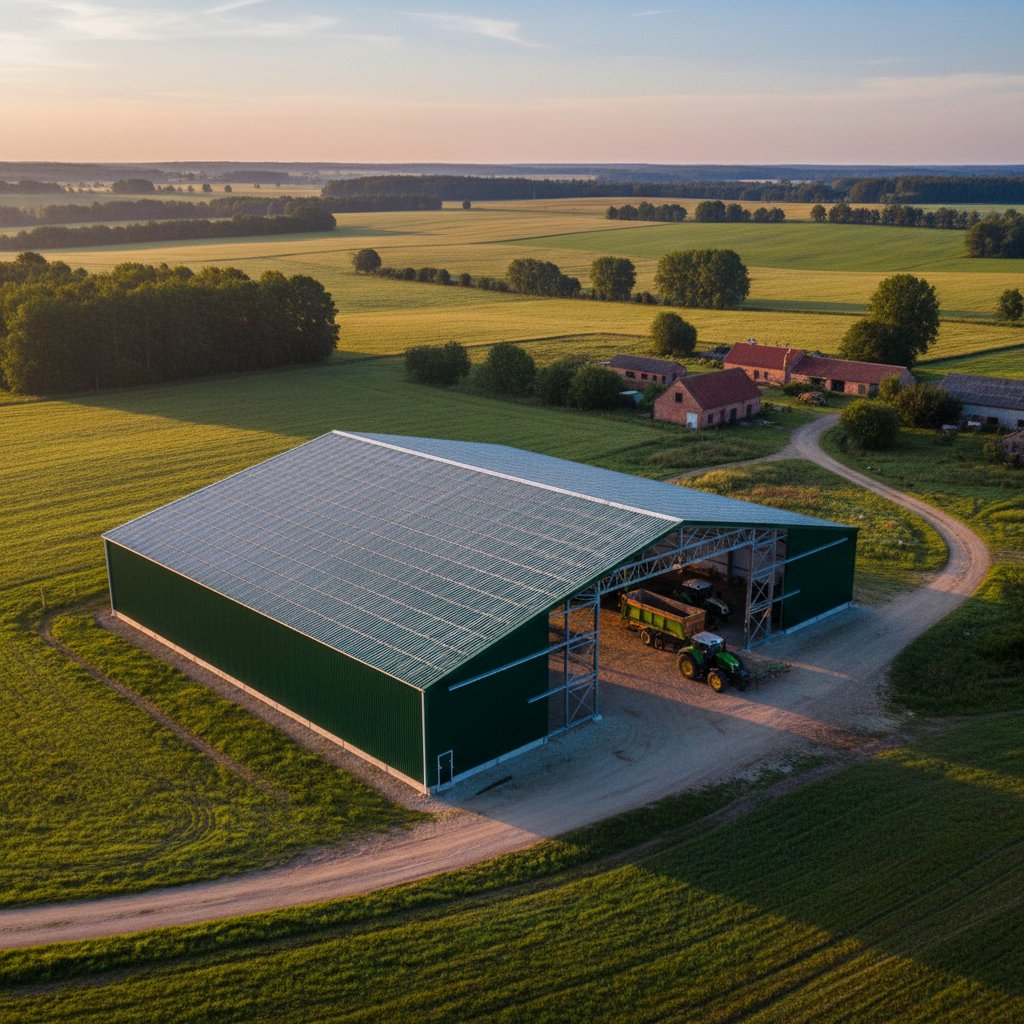
The standard-width width is the gold standard in agriculture, and our std-12x30 model remains our absolute best-seller for mid-sized European farms. Why is a hangar so highly recommended and considered a wide-span universal hangar? Because a span of this size requires zero internal support columns. You can manoeuvre a massive tractor, a heavy-duty trailer, or a telescopic handler freely, without the constant fear of clipping a load-bearing pillar. This makes a standard width machinery shed incredibly versatile. The thirty-metre length gives you three hundred and sixty square metres of highly usable floor space - enough room to house your entire primary machinery fleet or stockpile thousands of tonnes of grain, making it an ideal standard width grain storage hangar.
While the standard-width width is our primary recommendation for its universal applicability, Swed-Trac offers a range of widths to suit specific farm sizes and needs: * 8m wide hangars: Ideal for small farms or specialist storage. * 10m wide hangars: A good option for medium-sized operations with slightly less space. * standard width wide hangars (UNIVERSAL - RECOMMENDED): The optimal choice for most agricultural applications, offering maximum flexibility without internal supports. * 15m wide hangars: Suitable for wider machinery or larger storage volumes. * 18m wide hangars: Designed for large farms or extensive storage requirements. * 20m wide hangars: Our largest standard option, often used for industrial-scale operations or very large machinery.
Below is the detailed technical specification for our highly popular 12x30m model, fully updated to meet the strict 2026 European building standards.
| Parameter | Specification / Value |
|---|---|
| Length × Width | 30 m × 12 m |
| Total Area | 360 sq. m. |
| Eaves Height | From 4.5 m to 6.0 m (optional) |
| Ridge Height | From 6.0 m to 7.5 m |
| Structure Type | Pitched roof, steel frame construction |
| Steel Grade | High-strength structural steel S355 |
| Certification | CE marked according to EN 1090-2:2018+A1:2024 |
| Cladding Options | PVC Tarpaulin (900 g/m²), Profiled steel sheeting, Sandwich panels (PIR/EPS) |
| Snow Load | Calculated for specific European climate zones (from 1.2 to 2.5 kN/m²) |
| Production Site | Šilutė, Lithuania (Factory), Klaipėda (Headquarters) |
We manufacture our structures in our Šilutė factory in Lithuania. This means you do not buy a pig in a poke from an unknown overseas broker. Every single steel beam for your steel building is processed, welded, and finished strictly adhering to the highest European Union norms.
Full Price Breakdown: What Does a hangar Actually Cost?
"What is the final price?" This is the first question farmers ask. The answer depends entirely on your chosen scenario. In 2026, steel and building material markets have stabilised across Europe, allowing us to provide highly accurate estimate ranges for our recommended standard width agricultural hangar. We divide our projects into three main scenarios: basic, mid-range, and premium.
1. Basic Scenario (Cold hangar, steel cladding) This hangar option is ideal for machinery parking or basic inventory storage, where temperature fluctuations are not a critical issue. * Steel framework: ~16,000 EUR * Roof and wall cladding (profiled steel T-18/T-35): ~7,500 EUR * Gates (mechanical, sliding, two units): ~2,500 EUR * Fasteners, bolts, wind braces: ~2,000 EUR * Total preliminary price (excl. VAT): ~28,000 EUR
2. Mid-Range Scenario (Anti-condensation roof, suited for grain) If you plan to store grain or fertilisers, you absolutely must protect the produce from dripping condensation. This standard width grain storage hangar option uses steel sheeting equipped with a special anti-condensation fleece. * Steel framework (reinforced for retaining walls): ~18,000 EUR * Cladding (standard walls, fleece-lined roof): ~10,000 EUR * Gates (industrial overhead doors): ~3,800 EUR * Fastening and sealing elements: ~2,200 EUR * Total preliminary price (excl. VAT): ~34,000 EUR
3. Premium Scenario (Fully insulated with sandwich panels) This is the ultimate solution for a hangar used for vegetable storage, heated workshops, or facilities where staff work daily. We use PIR panels (one hundred millimetres thick) for maximum thermal efficiency. * Steel framework (adapted for heavier loads): ~20,000 EUR * Sandwich panels (walls and roof): ~22,500 EUR * Gates (insulated, automatic) and personnel doors: ~5,000 EUR * Steel trims, rainwater systems: ~3,500 EUR * Total preliminary price (excl. VAT): ~51,000 EUR
Note: Prices are listed in euros, excluding Value Added Tax. The final sum might fluctuate slightly depending on your specific regional snow load requirements and farm topography. Prices for other widths (8m, 10m, 15m, 18m, 20m) would vary based on material usage and structural design.
What is Included in the Estimate, and What is Left to the Client?
Transparency is the Swed-Trac signature. We never hide extra costs in the fine print. For your ROI calculations to be accurate, you need to know exactly what you get for your money when investing in a wide hangar, and what work you will need to handle yourself or outsource to local contractors.
| Position | Included in the Swed-Trac Package | Client Responsibility (Not Included) |
|---|---|---|
| Design | Structural engineering drawings, load calculations. | Architectural design (if local council demands it), securing the building permit. |
| Groundworks | None. | Site levelling, topsoil removal, access road preparation. |
| Foundations | Anchor bolts and base fixings. | Drilling/casting concrete foundations, building inner retaining walls for grain. |
| Structure | Fully complete steel frame. | None. |
| Cladding | Steel sheets, tarpaulin, or sandwich panels as chosen. | None. |
| Engineering Networks | None. | Electrical wiring, lighting, plumbing, ventilation systems. |
| Assembly | Available as an optional extra service from our crews. | Renting lifting equipment (crane, telehandler) if you assemble it yourself. |
ROI and Savings Calculation Methodology for a hangar
standard width agricultural hangar cases and ROI-this is not just a popular search phrase; it is the fundamental survival question for any modern business. How do you accurately calculate your Return on Investment? Let's take a concrete example of a hangar and run the math together.
Let's say you choose the mid-range scenario for thirty-four thousand euros. Add the foundation work and assembly, and your total investment sits at roughly forty-eight thousand euros.
The First Source of Savings: Machinery Depreciation A new tractor or combine harvester left out in the open, hammered by rain, snow, and UV rays, depreciates roughly five percent faster than one kept in a dry standard width machinery shed. If your machinery fleet is worth three hundred thousand euros, that five percent translates to fifteen thousand euros a year strictly in retained value. On top of that, you slash your maintenance bills for electronic faults, rust removal, and repainting.
The Second Source of Savings: Grain Storage If you rent commercial silos, the average European price for storing a tonne of grain per month in 2026 runs into several euros, completely ignoring the massive transport costs to get it to the elevator during the harvest rush. With your own three hundred and sixty square metres in a standard width grain storage hangar, you can safely store about five hundred tonnes of grain (depending on the pile height). The eliminated rental and transport costs easily reach between seven and ten thousand euros in a single season.
EU CAP and EAFRD Funding in 2026 The Common Agricultural Policy (CAP) and the European Agricultural Fund for Rural Development (EAFRD) offer massive support via national paying agencies. Grants for farm modernisation can cover anywhere from forty to sixty percent of eligible costs. If your steel building project qualifies and you secure a fifty percent grant, your personal investment drops in half-down to twenty-four thousand euros.
The Final ROI Result: By saving roughly twenty-five thousand euros annually (machinery value retention plus eliminating commercial storage fees), your twenty-four thousand euro investment (backed by EAFRD) pays for itself in less than a single year. Even without any EU grants, the investment for a wide hangar fully pays out in about two years. That is a phenomenal metric in any industry.
Competitor Comparison: Swed-Trac vs LLENTAB vs Röwer & Rüb vs Gooiermeer
The European market is flooded with offers. How do you separate genuine quality from a cheap, short-lived fix? We conducted a thorough market analysis in the spring of 2026. Here is an objective comparison of the main players across the continent, using our recommended hangar as the benchmark.
| Criterion | Swed-Trac | Gooiermeer NL | LLENTAB SE | Röwer & Rüb DE |
|---|---|---|---|---|
| Price Level (12x30 m) | Mid-Optimal (~28k EUR base) | Lower (focus on tents/lighter structures) | Higher (from 35k EUR base) | Premium (Equestrian/Heavy duty focus) |
| Production Location | Lithuania (Šilutė) | Netherlands / Imports | Sweden / EU facilities | Germany |
| Certification | EN 1090-2 (CE marked) | Basic CE for standard kits | EN 1090-2 (CE marked) | EN 1090-2 (CE marked) |
| Structural Strength | S355 steel, adapted for local snow loads | Standard lightweight profiles | High (proprietary branded profiles) | Extremely high, heavy gauge steel |
| Customer Service | Personal engineer, 24h response time | Good, but highly standardised | Excellent, but slower bureaucratic process | Bespoke, premium service |
Why choose Swed-Trac for your standard width agricultural hangar? While Gooiermeer offers great rapid-deployment tents for temporary storage, and Röwer & Rüb builds stunning, high-end equestrian facilities (with a matching price tag), Swed-Trac finds the perfect balance for the working European farmer. LLENTAB is a massive, highly respected player, but their overheads push their base prices much higher. The truth is, our factory in Šilutė gives us a unique edge: we produce premium S355 steel frames adhering to the exact same EN 1090-2 standards as the Swedish and German giants, but at a significantly more accessible price point for your steel building.
The Process from Inquiry to Building Handover
How does this work in the real world? Farmers value absolute clarity and strict deadlines. Here are the ten steps of turning an empty field into a modern wide hangar.
- First Contact (One Day): You call us or fill out the online form. We discuss your specific needs, your region, and your vision for your hangar.
- Preliminary Estimate (Two Days): We send a detailed commercial offer featuring three price scenarios for your chosen standard width agricultural hangar. No hidden fees.
- Contract Signing (One Week): We iron out the final details, sign the contract, and you pay the initial deposit.
- Technical Design (Two to Three Weeks): Our engineers draft the structural drawings required for your foundation work and your local building permit.
- Paperwork (One to Two Months): You submit the plans to your local council (Gemeinde, Mairie, or municipality) to secure the building permit.
- Production in Šilutė (Three to Four Weeks): The steel for your steel building is cut, welded, and finished. Everything happens under one roof.
- Foundation Work (Parallel to Production): Following our exact blueprints, you or your local contractor cast the concrete foundations.
- Delivery to Site (One to Three Days): The structure is loaded onto trucks and delivered directly to your farm anywhere in Europe.
- Assembly (One to Two Weeks): An experienced crew erects the steel frame and installs the cladding. A good crew covers about fifty square metres a day.
- Handover: We sign the final acceptance act. You receive your CE certificates, warranty documents, and maintenance manuals.
Technical Requirements and Standards in 2026
When building agricultural structures today, you must navigate increasingly strict European and national regulations. This applies equally to our popular hangar and other widths.
Foundations and Engineering For a hangar (e.g., 12×30 m), drilled pier foundations with a reinforced concrete ground beam are the standard. If you intend to park heavy machinery in your standard width machinery shed, you must pour an industrial reinforced concrete floor inside. Proper drainage around the perimeter is absolutely critical; you do not want spring thaw water pooling around your steel base plates.
Veterinary and Hygiene Regulations (EU Directive 98/58/EC) If you plan to store animal feed or grain destined for the food industry in your standard width grain storage hangar, you must comply with strict hygiene norms. Regulators like the Veterinäramt in Germany, the DGAL in France, or the NVWA in the Netherlands are inspecting farms much more aggressively in 2026. They look closely at how different products are separated. The interior of the hangar must be easy to clean, and the structure cannot feature inaccessible cavities where rodents or birds might nest. You cannot store chemical fertilisers next to animal feed without a solid partition. Our closed steel profiles and tightly sealed sandwich panels clear these regulatory hurdles with ease for any standard width agricultural hangar.
The EN 1090-2 Standard This is not just a fancy badge. This standard dictates the technical requirements for manufacturing steel structures in Europe. It means every single weld is inspected, and the steel's tensile strength is proven via laboratory testing. Here's the thing: major European insurers like Allianz, AXA, or Agria will outright refuse to insure farm buildings in 2026 if they lack CE marking under EN 1090-2. With Swed-Trac, you never have to worry about this-your paperwork for your steel building will be flawless.
Real European Customer Cases: Numbers That Speak for Themselves
Theory is great, but practice is better. Here are three detailed cases from our European clients, showing exactly how a standard width agricultural hangar (specifically 12×30 m) changed their farm dynamics. Names and exact locations are slightly altered to respect client privacy, but the financial figures are one hundred percent real.
Case 1: Klaus, Bavaria, Germany (Arable Farming) * The Problem: Klaus grows wheat and rapeseed. Every autumn, he rushed to sell his harvest straight from the field because he had nowhere to store it. Grain buyers know this, so harvest-time prices are always rock bottom. * The Solution: In 2024, he ordered a Swed-Trac standard width grain storage hangar featuring an anti-condensation roof and heavily reinforced two-metre-high concrete retaining walls inside. * The Investment: Thirty-four thousand euros for the hangar plus sixteen thousand euros for the groundwork and retaining walls. * The Result: Klaus now safely stores up to six hundred tonnes of grain. In the spring of 2025, he sold his crop for forty-five euros more per tonne than the harvest-time price. His extra profit was twenty-seven thousand euros in a single season. * ROI Time: Less than two years. "Worth the money, every single cent," Klaus told us. "It completely changed how I trade my grain."
Case 2: Jean, Normandy, France (Mixed Farming) * The Problem: Jean raises beef cattle and runs a large machinery fleet. His expensive hay bales were rotting in the field, losing massive nutritional value, while his tractors sat buried in winter mud. * The Solution: Leveraging EAFRD rural development funds, he bought a basic cold standard width machinery shed with standard profiled steel cladding. * The Investment: Twenty-eight thousand euros. The French paying agency covered fifty percent. Jean's out-of-pocket cost was fourteen thousand euros. * The Result: Feed spoilage dropped to zero, saving him roughly four thousand euros a year in lost nutrition. Machinery repair bills fell by another three thousand euros annually. * ROI Time: Exactly two years. Today, the hangar generates pure savings for the farm.
Case 3: Lars, Jutland, Denmark (Vegetable Farming) * The Problem: Growing carrots and potatoes requires a dedicated space for sorting and packing during the freezing winter months. The facility must maintain a positive temperature so staff can work comfortably and the produce does not freeze. * The Solution: A premium wide hangar, fully insulated with one hundred millimetre thick PIR sandwich panels. * The Investment: Fifty-five thousand euros (including high-bay lighting, automatic insulated gates, and ventilation). * The Result: Lars created a modern, highly efficient workspace. Thanks to the exceptional thermal insulation, his winter heating bills are practically non-existent. Staff productivity shot up, and the vegetables remain in pristine condition all winter long. * ROI Time: Around four years. According to Lars, the investment paid off not just financially, but by giving him peace of mind knowing his harvest is secure.
Decision Tree: Which Hangar Width Fits Your Needs?
Still on the fence about which hangar option suits you best? Follow this simple logic. While the hangar is our universal recommendation, consider these points:
- Do you have exceptionally small machinery or limited space, or perhaps a very specific, smaller storage need? * Consider: An 8m or 10m wide hangar might be more suitable. * Otherwise: The wide hangar offers superior flexibility for future growth.
- Will staff work inside during winter, or will you store temperature-sensitive produce (vegetables, liquids)? * YES: You absolutely need a premium insulated hangar with sandwich panels (PIR/EPS). This applies to any width, but a hangar provides ample working space. * NO: Move to the next question.
- Do you plan to store bulk grain, fertilisers, or open animal feed, requiring a dedicated standard width grain storage hangar? * YES: You must choose a steel roof with an anti-condensation fleece. A basic tarpaulin is not worth the hassle here due to severe moisture dripping risks. This is a critical feature for any standard width agricultural hangar used for grain. * NO: Move to the final question.
- Are you looking for the most economical way to protect machinery from rain and snow, needing a standard width machinery shed? * YES: Go with a cold hangar featuring profiled steel sheeting or a heavy-duty PVC tarp. It offers the best price-to-performance ratio for a vehicle fleet, providing ample space for manoeuvring. * For exceptionally large machinery or industrial needs: Consider our 15m, 18m, or 20m wide hangars.
General Advice and Warnings
Over our years in the industry, we have seen it all. We want to protect you from the most common pitfalls when investing in a wide-span universal hangar like our steel building:
- Do not skimp on the foundations. Sometimes farmers try to save a few euros by pouring shallow footings. In regions like the Alps or Scandinavia, the frost line goes deep. Inadequate foundations will cause structural heaving, warping your frame and tearing your cladding. This is crucial for any wide hangar.
- Beware of cheap imports. The market is full of obscure, ultra-cheap hangars imported from outside the EU. Often, they are engineered for non-existent snow loads. When a proper European winter hits, these structures simply buckle, crushing the expensive machinery inside. Always demand a CE certificate and a structural calculation proving your hangar can handle the snow load in your specific postal code.
- Do not delay your CAP funding applications. Bureaucracy moves slowly. If you plan to build next spring, start preparing your paperwork, getting your quotes for your standard width agricultural hangar, and talking to your agricultural consultant this autumn.
Want a quote on a hangar? Call +370 645 18595 or email sales@swedhall.se - we will prepare an individual quote within 24 hours.
Frequently Asked Questions (FAQ)
How long does it take to manufacture a 12×30 m hangar?
Production at our Šilutė factory typically takes between three and four weeks after the contract is signed and the deposit clears for your steel building .
Do I need a building permit for this hangar?
This depends heavily on your local municipality (Gemeinde, Mairie, etc.) and the zoning of your land. While agricultural land often benefits from simplified planning procedures, a 360 square metre structure like a hangar usually requires formal approval. Always consult a local architect.
What kind of warranty do you provide?
We offer a two-year warranty on the steel framework, while the cladding materials carry manufacturer warranties of two years for your wide hangar .
Can I assemble the hangar myself?
Yes. We supply highly detailed assembly blueprints with the structure. However, we strongly recommend having previous experience with heavy steel construction and access to proper lifting equipment like a telehandler when erecting a hangar .
Do you help with EU CAP or EAFRD grant paperwork?
We do not fill out the grant applications directly, but we work closely with your agricultural consultants. We rapidly provide all the CE certificates, technical drawings, and official commercial offers the paying agencies require for your standard width agricultural hangar .
Can the length of the hangar be extended later?
Yes, the modular steel frame design by Swed-Trac allows you to easily extend any of our hangars, including the hangar , in the future by adding extra bays (usually in steps of four or six metres).
How should I maintain the hangar in winter?
Our hangars are engineered to withstand the specific snow loads of your region. However, in the event of a freak, once-in-a-decade blizzard, keep an eye on the roof accumulation and safely remove the snow if it exceeds the engineered limits for your steel building .
Is a steel roof incredibly noisy during heavy rain?
There is some noise, but if you select the anti-condensation fleece lining, it doubles as excellent acoustic insulation, drastically dampening the sound of heavy rain in your hangar .
What is the best floor type for storing grain?
We strongly recommend a power-floated, reinforced concrete floor over a heavy damp-proof membrane. This prevents ground moisture from ruining the bottom layer of your grain and keeps the local veterinary inspectors happy in your standard width grain storage hangar .
Can you deliver the hangar anywhere in Europe?
Yes, we organise logistics across the entire continent. The delivery cost simply depends on the haulage distance from our factory in Lithuania to your farm for your chosen wide hangar .
Do you offer financing or leasing?
We cooperate closely with major European banks and leasing firms like ING, BNP Paribas, and Deutsche Bank. We can point you towards financial partners who specialise in agricultural assets for your standard width agricultural hangar .
How much does it cost to insure the hangar?
Because our steel structures carry full CE marking and comply with the EN 1090-2 standard, major insurers like AXA, Baloise, or Generali apply their most favourable standard rates. The exact premium depends on your farm's overall risk profile and the specifications of your steel building .
Can we install skylights in the hangar?
Absolutely. We can integrate transparent polycarbonate skylight panels into the walls or the roof of your hangar , saving you a fortune on daytime lighting costs.
Will condensation damage my combine harvester's electronics?
If you build a cold steel hangar without an anti-condensation membrane, water droplets will form on the ceiling during spring and autumn and drip directly onto your machines. We always recommend at least the basic fleece lining if you are parking modern, sensor-heavy equipment in your standard width machinery shed .
Where can I see one of your hangars in person?
We have hundreds of completed projects across Germany, France, the Netherlands, Scandinavia, and beyond. Contact us, and we will happily point you to the nearest built hangar in your region so you can inspect the quality yourself.
A wide hangar is not just an expense. As we have seen from real European customer cases and detailed ROI breakdowns, it is a highly intelligent investment that protects your most valuable assets, allows you to react more flexibly to market prices, and significantly enhances the efficiency and profitability of your farm.