 Blog
Blog
Meet Klaus. Klaus farms nearly three hundred hectares of fertile land in Bavaria. Last autumn, he faced a classic European farming headache: three expensive combine harvesters, two seed drills, and a mountain of fertiliser sat in his yard. Above them? Only open skies and relentless rain. Klaus knew his machinery was losing value faster than it could dry after an October storm. He opened his browser and typed: agricultural hangar how to choose.
At first, he nearly made the most expensive mistake of his life. He almost bought a cheap, flimsy tent hangar from a reseller with zero local presence in Europe. Luckily, Klaus booked a flight and visited our Swed-Trac headquarters in Klaipėda. We sat down, drank some coffee, and untangled his farm's exact needs. We suggested our standard, battle-tested hangar (code: std-12x30), whose structures are engineered and manufactured right in our factory in Šilutė, Lithuania, before being shipped directly to his farm. Today, Klaus smiles: "I invested smartly. Not worth the hassle of cheap alternatives. My machinery is dry, the grain is safe, and the neighbours are jealous."
If you are eyeing a truly versatile, wide-span universal hangar, this guide is for you. There is no sense in throwing tens of thousands of euros down the drain. In this expert breakdown, the Swed-Trac team strips away the marketing fluff. We will cover everything from realistic 2026 European prices for a steel building and EU Common Agricultural Policy (CAP) funding schedules to the glaring mistakes buyers make. Settle in. This is the most detailed guide on the European market for your next standard width agricultural hangar.
Key facts: understanding the universal agricultural hangar
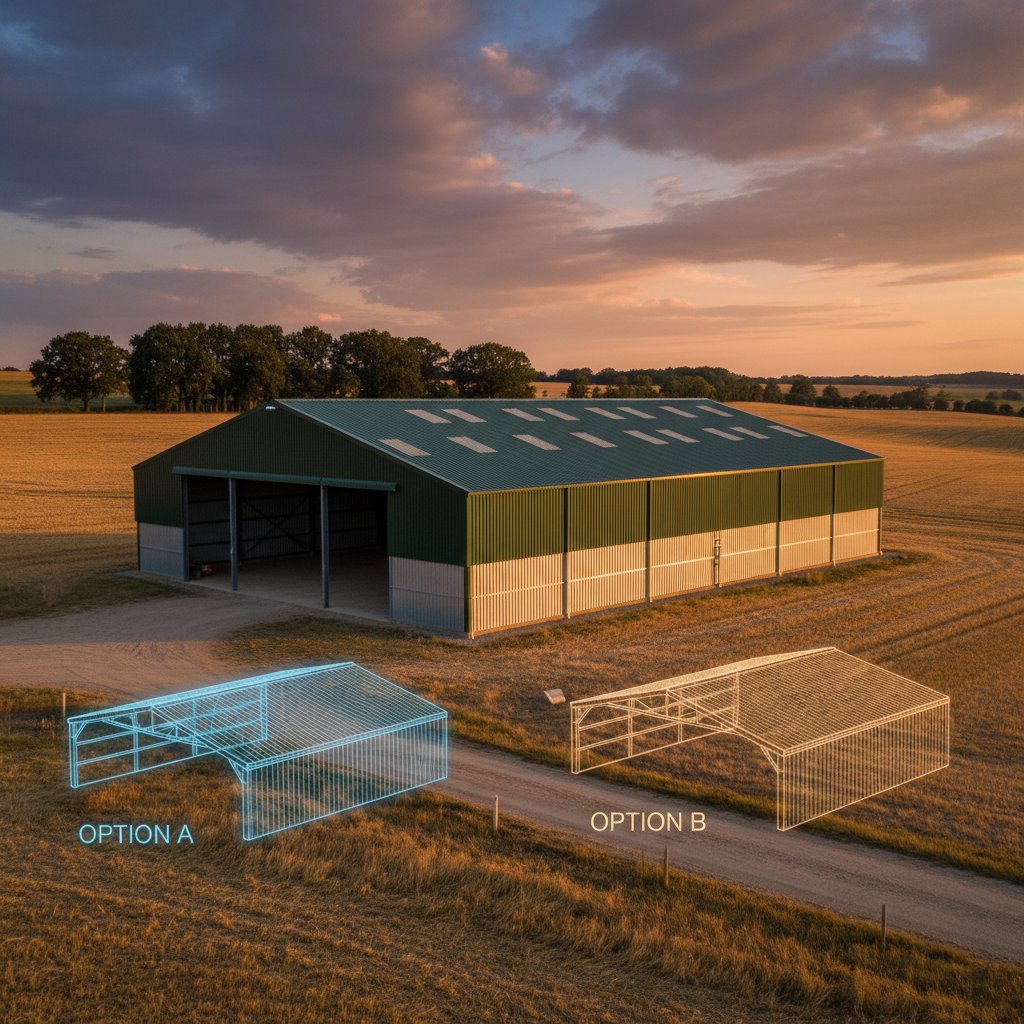
When we talk about a agricultural hangar, we are looking at the ultimate sweet spot for European farms. This universal width, especially in a common length like 30 metres, provides an optimal footprint of 360 square metres. This is ample room to easily house heavy machinery, store grain reserves, or shelter livestock, without demanding a massive plot of land. It’s why the hangar is our primary recommendation for most farmers.
While our agricultural hangar is the undisputed champion for most agricultural needs, Swed-Trac offers a range of widths to perfectly match your farm's scale and specific requirements. We engineer robust steel buildings in widths from: * 8m: Ideal for small farms or specialist storage, like small implements or workshop space. * 10m: Perfect for medium-sized operations requiring a bit more room than smaller sheds. * standard width: (UNIVERSAL - RECOMMENDED) This is the optimal choice for the vast majority of European farmers, offering unmatched versatility for machinery, grain, and livestock. * 15m: For wider machinery, increased storage capacity, or operations with larger vehicle fleets. * 18m: Catering to large-scale agricultural enterprises needing significant covered space. * 20m: Suited for industrial applications, very large farm complexes, or specialised operations requiring maximum clear-span space.
Regardless of the width, every Swed-Trac steel building is designed with the same commitment to quality and durability. However, the hangar consistently proves to be the most cost-effective and adaptable solution.
To understand why this model dominates the market, look at the engineering. Swed-Trac hangars are not just welded chunks of metal. They are precision-engineered structures meeting the strictest European Union standards. Below are the specifications for our recommended standard width x 30m agricultural hangar:
| Parameter | Specification (Model: std-12x30) | What this means for the farmer |
|---|---|---|
| Dimensions (Width × Length) | standard width × 30 metres | Optimal footprint (360 square metres) for manoeuvring machinery. |
| Eaves height | 4 to 6 metres | Plenty of clearance for tall tractors and combine harvesters in your standard width machinery shed. |
| Steel grade | S355 structural steel | High-yield strength steel, engineered for damp European conditions. |
| Snow load | 1.5 kN/m² | Built to withstand heavy, wet winters from the Alps to Scandinavia without buckling. |
| Certification | CE marked, EN 1090-2 (EXC2 class) | Mandatory for legal compliance and securing EU CAP/EAFRD funding for your steel building. |
| Production location | Šilutė, Lithuania | European manufacturing guarantees stringent quality control and reliable delivery. |
Here's the thing: this hangar features a clear-span design. Zero internal support columns. You get one hundred percent usable space. You can pivot a telehandler, pile grain, or install racking systems without dodging pillars, making it a truly wide-span universal hangar.
Full price breakdown: how much will you actually pay for a hangar?
Hidden costs plague this industry. Competitors routinely advertise a "bare" frame, only for the final invoice to double. We believe in absolute transparency. Your standard width agricultural hangar's price hinges entirely on the insulation level you need. Here are three realistic scenarios for the European market in spring 2026 for a 12x30m steel building.
| Component | Cold Hangar (Basic) | Partially Insulated (Medium) | Premium Insulated (Sandwich Panels) |
|---|---|---|---|
| Purpose | Machinery storage, grain | Livestock, sensitive equipment, fertiliser | Heated workshops, staff zones, strict climate storage |
| Steel frame (S355) for hangar | €27,500 | €27,500 | €27,500 |
| Roof and wall cladding | €3,600 (Profiled steel sheet) | €5,800 (Steel sheet with anti-condensation drop-stop) | €21,500 (100 mm Polyurethane PIR panels) |
| Doors (Two mechanical) | €2,200 | €2,600 | €3,600 (Fully insulated) |
| Delivery across Europe | €1,200 | €1,200 | €1,200 |
| Estimated total (excl. VAT) for your steel building | €34,500 | €37,100 | €53,800 |
Note: Prices serve as a baseline and fluctuate slightly with global steel indices, but they accurately reflect the reality of the 2026 European market for a hangar.
You see the jump in cost? If you just need a roof to keep the rain off a tractor, the cold standard width machinery shed does the job perfectly. But if you plan to set up a winter workshop where your team will work in December, the premium sandwich-panel version is worth the money. For a standard width grain storage hangar, the partially insulated option is often ideal.
What is included and what is left out for your steel building?
Honesty builds good business. When you receive a Swed-Trac quote for your standard width agricultural hangar, you know exactly where your euros go. Finding out you are five thousand euros short for foundation work mid-build is a nightmare.
| Included in Swed-Trac Basic Package | Excluded (Client responsibility or optional extra) |
|---|---|
| Robust S355 steel frame | Foundation casting (bored piles or concrete slab) |
| Chosen wall and roof cladding | Ground levelling and site preparation |
| All structural fasteners (bolts, nuts, anchors) | Electrical wiring and lighting installations |
| Two standard gable-end doors | Local municipal building permit fees |
| Technical structural design (engineering drawings) | Complex ventilation systems (if required for livestock) |
| CE marking and Declarations of Conformity | Value Added Tax (VAT) |
We exclude foundations from the base price for a simple reason: European soil varies wildly. A farm in Jutland might need simple bored piles, while a marshy plot in North Holland demands a heavy-duty concrete raft slab. Every site is unique. We calculate foundation estimates separately after assessing your specific ground conditions for your hangar.
How to choose: expert checklist and common mistakes for your hangar
When figuring out the agricultural hangar puzzle, you need to know what to scrutinise. You are not buying a tractor you can test drive; you are erecting a building meant to last decades. The hangar is an investment, so choose wisely.
Pre-purchase checklist (What you must verify)
- Zoning regulations: Is your land zoned for agriculture? If so, the planning permission process is far simpler across most EU member states for an agricultural steel building.
- Snow load zones: Europe is divided into precise snow load zones. Coastal areas see less snow but face brutal winds, while the Alpine foothills endure heavy snowfall. Demand a frame engineered to withstand at least 1.5 kN/m² for your hangar.
- Steel thickness and grade: Never accept anything less than S355 grade steel. Thin, inferior metal will warp after a few harsh seasons.
- Protective finish: A proper factory-applied protective finish is non-negotiable in farming. Fertiliser salts, animal ammonia, and constant dampness will eat through ordinary paint in three years. This is crucial for the longevity of your steel building.
- CE Certification: Without an EN 1090-2 certificate, you will not secure any EAFRD funding, and local authorities can force you to tear the building down. Ensure your hangar is fully certified.
- Door clearance: Measure your tallest piece of equipment (usually a combine harvester with beacons) and add at least half a metre of safety margin. The standard width width allows for excellent manoeuvrability.
- Ventilation: Storing grain demands natural airflow to prevent condensation from ruining the crop. This is particularly important for a standard width grain storage hangar.
- Future expansion: Will you need a longer building in five years? Swed-Trac structures allow you to bolt on extra bays seamlessly, extending your hangar.
- Manufacturing base: Choose European manufacturers (like our Šilutė factory). When you need a spare part or warranty support, you do not want to wait months for a shipping container from Asia.
- Contract transparency: Ensure the contract explicitly states who handles the assembly and who holds liability for structural defects for your standard width agricultural hangar.
Five common buyer mistakes
- Blind price chasing: Farmers occasionally pick a supplier offering a price three thousand euros cheaper. Later, they discover the quote excluded ground anchors, the cladding is paper-thin, and the frame lacks legal certification. This often happens when looking for a hangar and opting for the absolute cheapest.
- Ignoring condensation: If you buy a cold hangar with bare steel roofing, water will drip onto your machinery every spring and autumn. This ruins fertiliser and accelerates rust. You must opt for anti-condensation fleece on the roof panels, especially for a standard width machinery shed.
- Underestimating foundations: Skimping on concrete is a fast track to disaster. If the ground settles unevenly, the steel frame twists, and your doors will jam permanently. This is critical for the stability of any steel building.
- Forgetting veterinary rules: Planning to house livestock or feed? National veterinary services (like the Veterinäramt in Germany or NVWA in the Netherlands) enforce strict hygiene rules under EU Directive 98/58/EC. Walls must be washable. Sandwich panels are perfect for this; exposed steel profiles are not.
- Missing CAP funding deadlines: People start looking for a hangar the week the grant application opens. Preparing the technical drawings takes time. Start the process at least a month early for your standard width agricultural hangar.
EU CAP and EAFRD funding in 2026: how to get your money back?
If you are reading this in 2026, we have excellent news. The European Agricultural Fund for Rural Development (EAFRD), operating under the current Common Agricultural Policy (CAP), has clear funding schedules for farm infrastructure upgrades.
Under the approved 2026 framework, the core initiative for "Sustainable Investments in Agricultural Holdings" opens its primary application window from September 1st to September 28th. Small and medium-sized farms can apply under simplified procedures during this period.
What does this mean for your balance sheet? You can reclaim between forty and sixty percent of your hangar's total cost. The Swed-Trac team has years of experience helping farmers navigate these grants. We provide the exact commercial quotes, CE certificates, and structural blueprints that EAFRD evaluators demand for your steel building.
Let's talk Return on Investment (ROI). Say you purchase a €37,000 partially insulated hangar. Machinery left exposed to the elements loses about five percent of its value annually due to rust and moisture damage to sensitive electronics. If your fleet is worth €300,000, you bleed €15,000 every single year. The hangar pays for itself in under three years-even without EU grants! Factor in the CAP funding, and your ROI drops to a staggering eighteen months.
We also partner with major European agricultural lenders like Deutsche Bank, Crédit Agricole, and ING. If you prefer to keep your working capital fluid, you can finance the build through leasing, spreading the cost of your standard width agricultural hangar over five to seven years.
Competitor comparison: why Swed-Trac stands out for your hangar
The European market is vast, but the serious players are well-known. We respect our competitors, yet we want to give you an objective look at how we stack up against LLENTAB, Röwer & Rüb, and Gooiermeer when considering a hangar.
| Criteria | Swed-Trac | LLENTAB (SE) | Röwer & Rüb (DE) | Gooiermeer (NL) |
|---|---|---|---|---|
| Base price (12×30 m) | ~€34,500 | From €38,000 | From €45,000 | ~€26,000 - €29,000 |
| Manufacturing base | Šilutė, Lithuania | Sweden / Europe | Germany | Netherlands / Imports |
| Steel quality | S355 structural steel | High | Premium | Average (often lighter gauge) |
| CE EN 1090-2 | Yes, full EXC2 | Yes | Yes | Depends on the batch |
| Warranty & Support | Swift direct support | Good, but complex corporate structure | Excellent but expensive | Minimal |
| Client profile | Demands high quality and direct factory relationship for their steel building | Wants a massive corporate brand | Premium equestrian/farming | Seeking the absolute cheapest option |
Data gathered from publicly available 2026 market information.
Gooiermeer often lures buyers with rock-bottom prices, but that usually means thinner steel or imported structures that might fail strict CAP grant requirements. LLENTAB and Röwer & Rüb build fantastic structures, but you pay a heavy premium for the brand name and corporate overhead. The truth is, Swed-Trac gives you top-tier European engineering for your hangar without the inflated price tag. Our steel is cut, welded, and finished in our Šilutė factory. If you need a custom part mid-build, we manufacture and ship it directly-no waiting weeks for third-party suppliers to resolve the issue.
The process from inquiry to handing over the keys for your standard width agricultural hangar
How does this work in reality? We have engineered a workflow that saves your time and protects your sanity when acquiring your steel building.
- Inquiry and initial consultation (Day 1): You call us or fill out a form. We pin down your exact needs (what you are storing, site conditions).
- Preliminary quote (Day 2): We deliver a detailed estimate where you see exactly where every euro goes for your hangar.
- Site assessment (Week 1): Our engineer reviews your farm's ground conditions and access routes for heavy transport.
- Contract signing (Week 2): We finalise the specifications, sign the agreement, and you pay the deposit.
- Technical design (Week 3): We draft the structural blueprints required for the foundations.
- Foundation work (Weeks 4-5): You or our local partners cast the foundations. The concrete needs time to cure.
- Production in Šilutė (Parallel): While your concrete sets, we manufacture and finish your steel building frame.
- Delivery and assembly (Weeks 6-8): The steel arrives on site. A professional crew erects the frame, installs the cladding, and fits the doors in one to two weeks.
- Handover and warranty (Week 9): We inspect the finished building together, shake hands, and hand over your compliance documents and long-term warranty for your new hangar.
The entire process takes roughly two months. Start talking to us in May, and by mid-July, you will be parking your combines in a brand-new, secure standard width machinery shed.
Technical requirements: what you must know for your steel building
You cannot improvise when constructing an agricultural building. Everything must comply with rigorous technical regulations.
EN 1090-2 Standard: This harmonised European standard dictates how steel structures are manufactured and assembled. Farm hangars typically fall under Execution Class 2 (EXC2). This mandates that every weld is inspected, and every piece of steel has full traceability. Swed-Trac holds all these certifications, guaranteeing your hangar is one hundred percent legal.
Veterinary and Hygiene Rules: Storing grain, feed, or animals brings EU Directive 98/58/EC into play. National regulators like the DGAL in France or the NVWA in the Netherlands require facilities to be easily cleaned, disinfected, and sealed against rodents and birds. Even for a cold standard width grain storage hangar, you must install sealed plinth details and anti-bird mesh in the ventilation gaps.
Foundations: A 12×30 metre building exerts immense downward pressure, especially when the roof is buried under winter snow. The most reliable foundation consists of bored concrete piles linked by a reinforced ground beam. If you intend to drive heavy loaders inside or pile grain directly against the walls, we strongly recommend casting a continuous, double-reinforced industrial concrete slab for your standard width agricultural hangar.
Real European client cases for the hangar
Theory is fine, but practical results matter more. Here are three real Swed-Trac projects from different European regions, all benefiting from the versatility of a hangar.
Case 1: Protecting combines and fertiliser in Normandy, France Thomas, an arable farmer in Normandy, bought two new tractors. His old timber barn lacked the required clearance. He chose our partially insulated 12×30 m hangar with an anti-condensation roof. The solution: Because Thomas needed to keep his fertiliser bone-dry in the damp coastal climate, the drop-stop roof membrane was vital for his standard width grain storage hangar. The result: Thomas stopped losing thousands of euros to clumped, moisture-ruined fertiliser. He hit his ROI in just two and a half years.
Case 2: Grain storage in North Holland, Netherlands Johan's agricultural cooperative was expanding rapidly and ran out of space for the autumn harvest. They needed a building capable of withstanding the lateral pressure of piled grain. The solution: We adapted the standard 12×30 m model, reinforcing the lower two metres of the steel frame and adding heavy-duty retaining walls. This created an ideal standard width grain storage hangar. The result: The cooperative secured a massive grain store for a third of the cost of traditional concrete silos, easily passing all NVWA inspections.
Case 3: Modern sheep farm in Jutland, Denmark Lars decided to transition to high-welfare sheep farming. He required a warm, impeccably ventilated environment for lambing season. The solution: A premium insulated standard width agricultural hangar clad in 100 mm polyurethane (PIR) sandwich panels, featuring a bespoke ridge ventilation system. The result: The flock winters comfortably, the microclimate remains stable with zero condensation, and Lars secured a fifty percent EAFRD grant because the facility met top-tier ecological standards.
Decision tree: which steel building to choose?
If you are still weighing your options for a new agricultural hangar, follow this simple logic. While our agricultural hangar is the optimal choice for most, consider these factors:
-
What are you storing? * Only machinery (tractors, implements). -> For a dedicated standard width machinery shed, choose the Cold Hangar with profiled steel sheets. * Machinery, fertiliser, and grain. -> For a versatile standard width grain storage hangar, choose the Partially Insulated Hangar with an anti-condensation roof. * Livestock, heated workshops, sensitive goods. -> Choose the Premium Insulated Hangar with sandwich panels.
-
What is your budget? * Under €35,000. -> Stick to the basic, cold hangar configuration. * Over €50,000. -> Upgrade to the fully insulated steel building version with premium doors and natural light panels.
-
Are you applying for CAP/EAFRD grants? * Yes. -> You absolutely need certified technical drawings, planning permission, and CE declarations. Swed-Trac provides the complete compliance package for your standard width agricultural hangar.
For anything outside the universal standard width width, consider: * Small farms / specialist needs (8m, 10m): If space is extremely limited or you only need to shelter smaller equipment, these widths can be more economical. * Large-scale operations (15m, 18m, 20m): For very wide machinery, extensive storage requirements, or industrial-scale applications, these larger widths provide the necessary capacity.
However, for the vast majority of European farms, the hangar offers the perfect balance of space, cost-efficiency, and adaptability.
General tips and warnings for your new hangar
Before you sign anything, keep these final industry tips in mind.
Winter building: Many assume construction stops in November. Steel structures can be erected perfectly well in the dead of winter. The trick is to cast the concrete foundations before the deep frosts hit. Get the groundworks done in autumn, and we will assemble your steel building in January without a hitch.
Insurance: If you use EU funding, insuring the building is mandatory. Major agricultural insurers like Allianz, AXA, and Agria offer highly favourable premiums for CE-certified steel buildings like our standard width agricultural hangar. Avoid unbranded tent structures-getting them insured against snow collapse is practically impossible.
Maintenance: A properly engineered steel frame lasts a lifetime, but the building still needs a quick check. We provide a simple maintenance schedule. Once a year (ideally in spring), walk around the structure, check for loose bolts, and clear the gutters of leaves. It takes an hour and guarantees decades of flawless performance for your hangar.
Want a quote on a hangar? Call +370 645 18595 or email sales@swedhall.se - we will prepare an individual quote within 24 hours.
Frequently Asked Questions (FAQ)
How long does it take to manufacture a 12×30 m hangar?
Production in our Šilutė factory takes about four to six weeks. Assembly on your farm takes another one to two weeks.
Do I need planning permission for this building?
This depends entirely on your local municipality and national laws. At 360 square metres, a hangar often qualifies for simplified agricultural planning procedures, but you still need formal approval and technical drawings.
Can I extend the hangar later?
Yes. Swed-Trac structures are modular. If you need more space in a few years, we simply remove the gable end wall and bolt on additional steel bays to your steel building.
What is the best foundation?
For farming, bored piles with a reinforced ground beam work best. If you are running heavy machinery inside, a solid reinforced concrete slab is the superior choice for your standard width machinery shed.
Do EU CAP funds cover these buildings?
Absolutely. Our standard width hangars carry the EN 1090-2 certifications required by EAFRD and national paying agencies to approve your grant application.
What happens if it snows heavily?
Our standard hangar model is engineered to handle a 1.5 kN/m² snow load, which easily covers standard European climate zones. Snow generally slides off the roof naturally, but during extreme blizzards, keep an eye on the accumulation.
Do you provide a warranty?
Yes. We provide a two-year structural warranty on the steel frame, alongside the manufacturer's warranties for the roof and wall cladding for your standard width agricultural hangar.
Can I assemble the hangar myself?
While the frame bolts together logically, we strongly advise using professional assembly crews. Proper alignment and safe lifting of heavy steel require specialised equipment and experience.