 Blog
Blog
Meet Lars. He is a third-generation arable farmer from Jutland, Denmark, managing just over two hundred hectares of prime agricultural land. Three years ago, he invested in a standard wide hangar from Swed-Trac, specifically a 12x30m model. His goal was entirely practical: he needed to protect three large combine harvesters from the coastal weather and secure a dry, well-ventilated space for temporary grain storage during the chaotic peak of the harvest season. Lars, like most busy farmers, initially thought: "Build it and forget it."
Then came his first harsh North Sea winter, and my phone rang. Lars was frustrated. He complained that heavy condensation was pooling on the roof interior and dripping onto his equipment. Worse, on highly windy nights, the PVC canvas was flapping against the steel frame with a noise that kept his family awake. Operating as Swed-Trac’s senior copywriter and technical advisor, I booked a flight, rented a car, and drove out to his farm. We drank a pot of strong black coffee and walked out to inspect the structure.
The truth is, the problem was entirely avoidable. Lars had never once checked the canvas tensioners after the initial installation, leaving the fabric dangerously loose. On top of that, his farmhands had stacked massive grain bags directly against the ventilation louvres, completely suffocating the building's airflow. We spent an hour tightening the ratchets and clearing the vents. Today, his hangar looks and functions as flawlessly as the day our crew handed over the keys.
This story perfectly illustrates a core reality of modern farming infrastructure. We at Swed-Trac manufacture incredibly tough, long-lasting hangars. Our production lines run non-stop in our Šilutė factory, and our central office in Klaipėda coordinates logistics across the continent. Yet, even the finest engineering requires a baseline of human attention. Farmers constantly search the internet for advice on agricultural hangar 12×30 m maintenance and durability, but they usually find nothing but vague marketing brochures.
You deserve hard engineering facts. In this comprehensive guide, I will break down exactly how to maintain a 12×30 m structure on a daily, monthly, yearly, and five-year basis. I will cover the financial realities, the European regulatory landscape, and how to ensure your steel building survives decades of heavy agricultural use.
The Universal Choice: Core Facts About the standard width Agricultural Hangar
The wide hangar is the undisputed workhorse of European agriculture. While Swed-Trac offers a range of widths from 8m for small farms to 20m for industrial applications, the standard width width stands out as the optimal choice for most farmers across the EU. It truly is a wide-span universal hangar, perfectly balancing capacity, cost, and operational flexibility.
We offer various widths to suit diverse needs: * 8m hangars: Ideal for smaller farms or specific storage needs like compact tractors or feed. * 10m hangars: A solid choice for medium-sized operations requiring more space than an 8m, but not the full universal capacity. * standard width hangars (UNIVERSAL - RECOMMENDED): This is our expert focus. A standard width agricultural hangar provides unmatched versatility for the majority of farming activities. * 15m hangars: For those needing extra width beyond the standard width standard, accommodating slightly larger machinery or more extensive storage. * 18m hangars: Suited for large farms with substantial equipment fleets or significant storage volumes. * 20m hangars: Designed for industrial-scale operations, offering maximum clear-span space.
Why do the standard width dimensions dominate farms from Normandy to North Holland? A thirty-metre length allows massive modern machinery to manoeuvre comfortably without complex reversing. The wide hangar is the structural sweet spot: it is wide enough for heavy equipment but narrow enough to eliminate the need for expensive, space-consuming internal support pillars. You get three hundred and sixty square metres of pure, uninterrupted operational space. This makes a standard width machinery shed or standard width grain storage hangar incredibly efficient.
| Parameter | Technical Specification | Practical Benefit for the Farmer |
|---|---|---|
| Dimensions | 12 m width × 30 m length | Easily accommodates three large combine harvesters or roughly one thousand tonnes of grain. |
| Total Area | 360 square metres | The optimal size to secure EU CAP funding without triggering complex industrial zoning regulations. |
| Frame Material | Structural steel (S355) | Engineered for demanding environments with ammonia, chemical fertilisers, and coastal moisture. |
| Roof Cladding | PVC canvas (900 g/m²) or steel sheet | Canvas allows natural daylight to penetrate, slashing electricity bills. Steel provides maximum physical security. |
| Snow Load | Up to 2.5 kN/m² | Effortlessly handles the deepest snowfalls in Bavaria or the Tyrol without structural risk. |
| Wind Load | Up to 28 m/s | Engineered to withstand brutal North Sea storms and relentless gales in open, unsheltered fields. |
Full Price Breakdown: From Basic to Premium for Your hangar
Every farmer counts their euros. That is just smart business. The final price of your hangar depends entirely on your operational scenario. We refuse to sell a one-size-fits-all template. One farmer simply needs a waterproof roof to keep the rain off his tractors, while another requires a fully insulated, climate-controlled workshop where a mechanic can comfortably strip an engine block in the dead of January.
Below, I have broken down the pricing for our three most popular configurations for a 12x30m hangar. These figures reflect current European market rates (amounts are in euros, excluding VAT). While prices for other widths will vary, this example of a steel building provides an excellent benchmark for the optimal choice for most farmers.
| Component / Phase | Scenario A (Cold Canvas) | Scenario B (Cold Steel Sheet) | Scenario C (Warm PIR Panels) |
|---|---|---|---|
| Structural Frame (S355 Steel) | €15,400 | €17,500 (Reinforced) | €19,600 (Maximum load bearing) |
| Cladding (Roof and Walls) | €6,300 (Heavy-duty PVC) | €8,400 (Profiled steel) | €22,400 (PIR sandwich panels) |
| Doors (Two sliding units) | €2,100 | €2,100 | €3,500 (Fully insulated doors) |
| Pan-European Delivery | €1,500 | €1,500 | €1,500 |
| Installation Labour | €2,500 | €3,500 | €4,500 |
| Total Estimated Investment | €27,800 | €33,000 | €51,500 |
The cold canvas option (Scenario A) remains the fastest and most economical solution on the market. For basic storage needs, it typically pays for itself in just two to three harvest cycles. This makes a standard width agricultural hangar an incredibly cost-effective investment.
What is Included in the Estimate (And What is Not)
The most common mistake buyers make when comparing quotes from different manufacturers is comparing apples to oranges. Many companies hide their actual costs behind vague terminology. At Swed-Trac, we operate with total transparency. No hidden fees. No tiny print.
Included in our base price: - Detailed architectural and structural engineering drawings required for your local planning office. - A complete S355 steel frame featuring all necessary bolts, brackets, and tensioning elements. - Your chosen cladding material (900 g/m² PVC canvas, profiled steel, or PIR sandwich panels). - Two heavy-duty sliding doors with industrial-grade tracking hardware. - Full CE certification documentation (EN 1090-2 compliant).
Not included in our base price: - Groundwork, site levelling, and soil preparation. - Concrete foundations (whether you choose continuous footings, concrete blocks, or screw piles). - Value Added Tax (VAT), which varies depending on your specific EU member state. - Fees associated with securing local building permits or environmental impact assessments. - Internal electrical wiring, lighting fixtures, and plumbing.
The Maintenance Schedule: Daily, Monthly, Yearly for Your steel Building
Here's the thing. There is no such thing as a maintenance-free building. If a salesperson tells you otherwise, they are lying. A steel building is a massive sail catching the wind, a heavy shelf holding up the snow, and a busy hub of diesel machinery. To ensure your investment lasts thirty years rather than five, you must implement a strict, predictable maintenance routine.
Daily and Weekly Checks: The Baseline
You do not need to walk around with a clipboard every morning, but you do need situational awareness.
First, look at the sliding doors. Agricultural environments are filthy. Mud, grain dust, and loose straw will inevitably accumulate in the bottom tracks of your doors. If you force a door over compacted mud, you will eventually bend the tracking guide or derail the wheels. Keep a stiff broom nearby and sweep the tracks clear every few days.
Second, monitor your ventilation. If you are using the hangar for livestock or wet grain, airflow is non-negotiable. EU Directive 98/58/EC lays down strict rules concerning the protection of animals kept for farming purposes, specifically mandating adequate air circulation to prevent respiratory diseases. Your national veterinary and food authorities-whether that is the Veterinäramt in Germany, the DGAL in France, or the NVWA in the Netherlands-will penalise you if they find blocked vents during an inspection. Never stack hay bales, grain bags, or fertiliser pallets against the ventilation louvres.
Monthly Inspections: Tension and Friction
Once a month, particularly during the stormy autumn and winter seasons, you need to walk the perimeter of your standard width agricultural hangar and inspect the tensioners. This applies specifically to the PVC canvas models.
Canvas hangars rely on constant, high-pressure tension to maintain their structural integrity. When the wind blows, a loose tent flaps. That flapping creates friction against the steel frame. Over time, friction wears away the protective coating on the PVC, leading to micro-tears, water ingress, and eventually, catastrophic failure during a storm.
Take a standard wrench and check the ratchets at the base of the structure. If the canvas yields too easily when you push against it, tighten the ratchets until the fabric is taut and sounds like a drum when struck. It takes ten minutes, but it adds a decade to the lifespan of your cladding.
Yearly Audits: Cleaning and Corrosion Control
Pick a dry week in late spring to conduct your annual audit.
If you have a PVC tent, wash it. Farms located near the coast in Normandy or Ireland often deal with aggressive algae growth, while inland farms battle dust and diesel exhaust soot. Dirt degrades the UV-protective layer of the canvas. Use a long-handled soft-bristle brush, plenty of water, and a mild, non-abrasive soap. Never use harsh chemical solvents or high-pressure power washers at close range, as you will strip the protective lacquers right off the fabric.
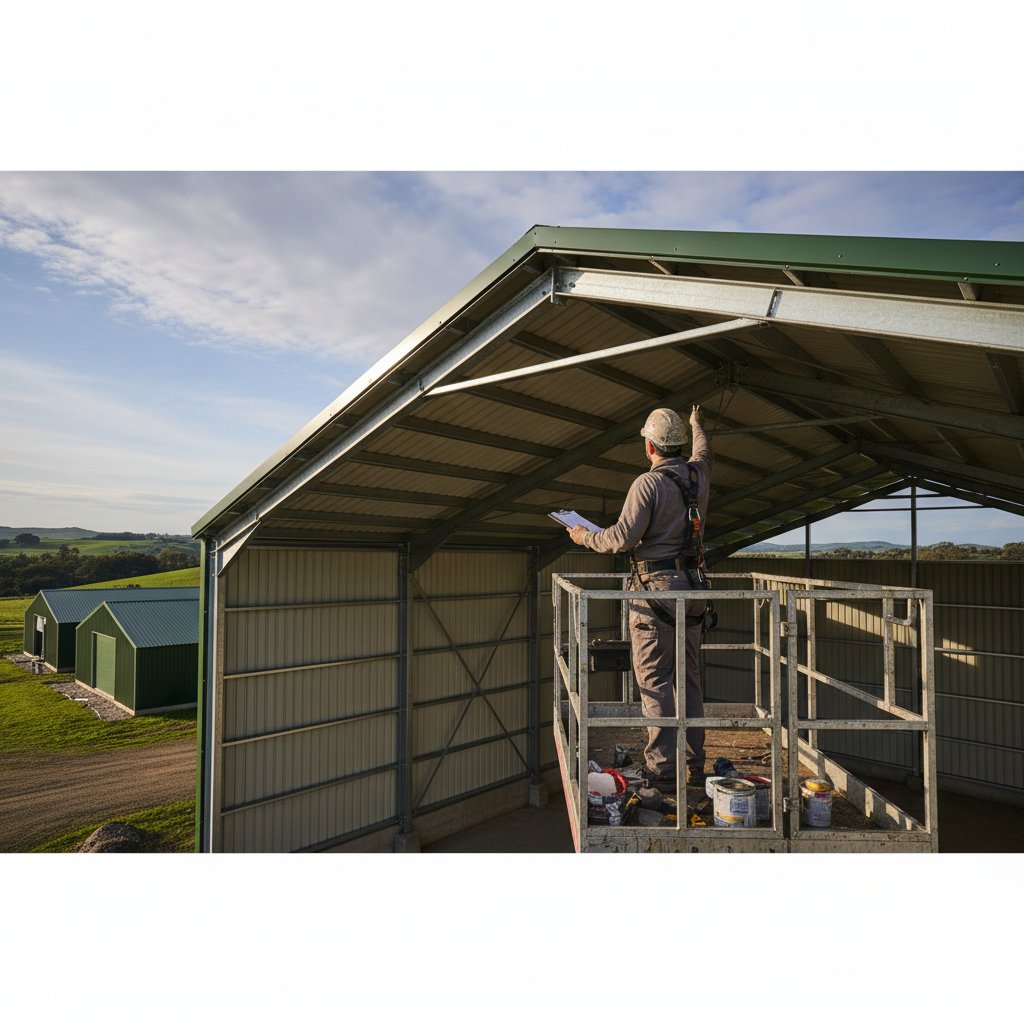
Next, inspect the steel frame. S355 steel is exceptionally tough, and our factory finish keeps it sound under normal conditions. However, tractors have a habit of reversing into things. If a heavy loader scrapes the frame and exposes bare steel, rust will eventually take hold. If you find a deep scratch, clean the area with a wire brush and apply a high-quality anti-corrosion primer.
The Five-Year Structural Review
Every five years, you need to look at the ground. Check the anchor bolts securing the base plates to your concrete foundation. Ground vibrations from heavy machinery and the natural freeze-thaw cycle of the earth can occasionally cause concrete to micro-fracture or bolts to slightly loosen. Take a torque wrench and verify that every primary anchor bolt meets the specified torque rating in your engineering manual.
If you notice significant pooling of water around the base of the hangar, you need to re-grade the soil outside. Standing water degrades concrete over time and turns the entrance of your hangar into a dangerous mud pit.
Navigating European Regulations and Animal Welfare for Your hangar
Farming in Europe means dealing with bureaucracy. There is no escaping it. However, a Swed-Trac hangar is engineered to make compliance as painless as possible.
If you intend to house cattle, sheep, or horses in your hangar, you fall under the jurisdiction of EU Directive 98/58/EC. This directive dictates minimum standards for lighting, space, and air quality. A poorly designed, unventilated steel shed will fail an inspection from the NVWA or the DGAL instantly.
Our hangars are designed with high-ridge ventilation systems and optional side-mesh panels that guarantee continuous fresh air exchange, drastically reducing ammonia buildup. Furthermore, for equestrian applications, our structures comply with the rigorous safety standards set by the FEI (Fédération Équestre Internationale). There are no sharp internal edges, no exposed dangerous bolts, and the acoustic properties of the taut PVC prevent horses from spooking during heavy rain.
Every component we ship carries the CE mark, proving absolute compliance with the EN 1090-2 standard for steel structures. When the local building inspector arrives, handing them a certified EN 1090-2 dossier usually ends the conversation in your favour.
Funding Your standard width Agricultural Hangar: EU CAP and EAFRD
Do not pay for your new infrastructure entirely out of pocket if you do not have to. The European Union provides massive financial support for farm modernisation.
Through the Common Agricultural Policy (CAP) and specifically the European Agricultural Fund for Rural Development (EAFRD), farmers can often reclaim between 30% and 60% of their capital expenditure on new buildings.
The standard width agricultural hangar, particularly the 12x30m model, hits the absolute sweet spot for these grants. At 360 square metres, it is large enough to drastically improve your farm's operational efficiency-a key metric for grant approval-but small enough to avoid the brutal environmental impact assessments required for massive industrial complexes.
To secure EAFRD funding, you need a solid business plan showing how the standard width grain storage hangar will reduce post-harvest grain losses, improve animal welfare, or protect expensive machinery from depreciation. Because Swed-Trac provides fully compliant, CE-marked architectural drawings from day one, your grant application process is streamlined. We give you the exact paperwork the agricultural funding boards want to see.
Financing and Insurance: Protecting Your Investment in a steel Building
A hangar is a capital asset. How you finance and protect that asset determines your long-term profitability.
Working with European Banks
When you walk into a branch of Deutsche Bank, Sparkasse, Crédit Agricole, ING, or BNP Paribas to ask for an equipment or infrastructure loan, the risk assessor is going to look closely at what you are buying.
If you try to finance a cheap, uncertified steel shed imported from outside the EU, the bank will either reject the loan or hit you with punishing interest rates. They know cheap steel collapses, leaving them with a defaulted loan and a pile of scrap metal.
Because a Swed-Trac steel building is built from EN 1090-2 certified S355 steel, banks view it as a highly secure, low-risk asset. The CE certification proves the building will stand for decades, making it excellent collateral. Our clients routinely secure highly favourable financing terms precisely because our engineering documentation is flawless.
Getting the Right Insurance
You must insure your wide hangar against fire, storm damage, and heavy snow loads. We work closely with clients who use major European agricultural insurers like Allianz, AXA, Agria, Baloise, If, and Generali.
Insurance premiums are calculated based on risk. If you live in the Bavarian Alps or the Austrian Tyrol, snow load is the primary risk factor. Standard agricultural sheds often max out at a snow load capacity of 1.0 or 1.5 kN/m². When you show your Allianz agent that your Swed-Trac hangar is certified to withstand up to 2.5 kN/m² of snow and wind speeds of 28 m/s, your risk profile drops dramatically.
Many of our clients find that the annual savings on their insurance premiums easily cover the cost of their yearly maintenance routine. It is worth the money to buy a structure that the insurance companies implicitly trust.
How We Compare to the Competition for Your hangar Needs
The truth is, you have options. The European agricultural construction market is crowded, and you should always compare quotes. But you must understand exactly what you are comparing, especially when looking for a standard width agricultural hangar.
If you look at German manufacturers like Röwer & Rüb, you will find exceptional quality. They build magnificent equestrian facilities. However, their pricing is astronomical. If you just need a robust, dry place to park three John Deere combines and store a thousand tonnes of barley, paying their premium is simply not worth the hassle.
Swedish giants like LLENTAB build incredibly heavy, permanent steel halls. They are fantastic structures, but they require massive concrete foundations, lengthy construction times, and huge budgets. They lack the rapid deployment and flexibility of a Swed-Trac PVC hangar.
Other Swedish players like Ydre-Grinden and Myrby make great local products, but once you factor in the pan-European export costs and cross-border logistics, their prices inflate rapidly.
In the Netherlands, companies like Gooiermeer excel in specialized sheet piling and specific groundwork infrastructure, but their focus is not on rapid-assembly agricultural hangars.
Swed-Trac occupies the perfect middle ground. Because we manufacture in Šilutė and manage logistics from Klaipėda, our overheads remain controlled. We deliver premium S355 European steel and 900 g/m² PVC at a price point that makes immediate economic sense for the working farmer. You get elite, CE-certified durability without the luxury brand markup, making our wide hangar the smartest investment for your farm.
Want a quote on a hangar? Call +370 645 18595 or email sales@swedhall.se - we will prepare an individual quote within 24 hours.
Frequently Asked Questions (FAQ)
How long does the PVC canvas actually last?
Under normal European weather conditions, a 900 g/m² PVC canvas will last between 15 and 25 years, provided you maintain the tension correctly. UV radiation is the primary degrading factor. When the canvas eventually reaches the end of its lifespan, you do not need to buy a new hangar . We simply manufacture a replacement cover, and our crew can swap it out in a single day, leaving your steel frame completely untouched.
Can I install the hangar myself to save money?
Yes, you can. We supply a comprehensive, step-by-step assembly manual. If you have a telehandler, some heavy-duty tools, and three practical farmhands, you can erect the 12×30 m cold tent scenario in about four to five days. However, hiring our professional installation crew guarantees the job is done rapidly and ensures your warranty remains absolutely watertight.
Do I need to pour a massive concrete foundation?
Not necessarily. The foundation requirements depend entirely on your local soil composition and the specific wind load of your region. While a continuous concrete ring beam is the gold standard, many farmers successfully use pre-cast concrete blocks or heavy-duty screw piles. Screw piles are particularly popular because they require no curing time and can be removed if you ever decide to relocate your steel building .
How does the hangar handle extreme heat in the summer?
If you choose the PVC canvas option for your wide hangar , we highly recommend selecting a white roof. The white fabric reflects a massive amount of solar radiation, keeping the interior surprisingly cool even during a July heatwave in southern France. For maximum climate control, you would need to upgrade to Scenario C (PIR sandwich panels), which provides total thermal isolation from the outside weather.
Is it difficult to get planning permission for a PVC hangar?
In most European jurisdictions, securing planning permission for a temporary or semi-permanent PVC structure is significantly faster and cheaper than applying for a permanent brick or heavy steel building. Because our hangars do not always require deep, permanent foundations, many local councils classify them differently. However, you must always consult your local planning office before breaking ground. We provide all the structural drawings you need to support your application.