 Blog
Blog
A Real Story from Bavaria: When Paperwork Looks Scarier Than a Storm
Picture the scene: you are Hans, a seasoned farmer from Bavaria. Your farm is expanding, your machinery fleet is growing, and this year’s harvest promises to be a record-breaker. You urgently need new space, and a wide hangar offering three hundred and sixty square metres sounds like the perfect solution. You opt for a standard hangar, twelve metres wide and thirty metres long - a truly universal width for diverse agricultural needs. How complicated could it be? You pour the foundations, assemble the steel frame, attach the cladding, and enjoy the peace of mind.
But reality in the European Union cuts you down at the knees faster than an unexpected frost in May. Hans assumed a steel building like this would not require serious paperwork. "It is just a tin shed for tractors and grain," he thought. But when inspectors from the local Veterinäramt arrived to check his grain storage conditions, and EU Common Agricultural Policy (CAP) auditors demanded his CE EN 1090-2 declarations of conformity, his smile vanished. Worse still, it turned out the building exceeded the local permit-free threshold, meaning a full planning permission and building permit were mandatory.
This is exactly the kind of situation our team at Swed-Trac resolves for European farmers every single day. Our headquarters are based in Klaipėda, with a highly modern production line operating in Šilutė, Lithuania. We do not just manufacture premium steel structures; we untangle the most complex bureaucratic knots across the continent. In this detailed, expert guide, we will examine everything you must know about the legal foundation, certificates, insurance nuances, and responsibilities resting on your shoulders when building a standard width agricultural hangar in 2026.
Key Facts About the 12×30 m Agricultural Hangar
Before diving into the legal waters, we must clearly define the product we are discussing. While Swed-Trac offers a range of widths - from compact 8m hangars for small farms to expansive 20m industrial solutions - the wide hangar is our universal recommendation and most popular choice for the vast majority of European farms. This isn't just a pile of welded pipes; it's a highly engineered steel building, calculated to withstand the harsh winters of the Alps and the fierce autumn gales of the North Sea coast. Its versatility makes it an ideal wide-span universal hangar for various agricultural applications.
Below is a table detailing the primary specifications of a standard 12x30m configuration, showcasing why the hangar is so highly regarded:
| Parameter | Specification / Description |
|---|---|
| Length | Thirty metres (customisable) |
| Width | Twelve metres (Universal, recommended) |
| Total Area | Three hundred and sixty square metres |
| Building Class | Permanent structure (exceeds standard permit-free thresholds in most EU states) |
| Structural Material | High-strength structural steel, factory painted |
| Wall and Roof Cladding | Profiled steel sheet (cold) or sandwich panels (warm) |
| Snow and Wind Loads | Calculated according to specific Eurocode zones (e.g., coastal winds, Alpine snow) |
| Production Standard | Full compliance with the CE EN 1090-2 standard |
| Production Location | Šilutė, Lithuania |
This standard width agricultural hangar is spacious enough to allow large agricultural machinery and combine harvesters to manoeuvre freely, making it an excellent standard width machinery shed. It can also safely store thousands of tonnes of grain, serving as an efficient standard width grain storage hangar. However, its very size means that, in the eyes of the law, it is a serious piece of infrastructure.
While the standard width width is highly versatile, Swed-Trac also offers: * 8m hangars: Ideal for small farms or specific storage needs. * 10m hangars: A good fit for medium-sized operations. * 15m hangars: For those requiring slightly wider spans. * 18m hangars: Suited for larger farms and more extensive machinery. * 20m hangars: Designed for industrial-scale agricultural enterprises.
The hangar strikes the perfect balance between cost-efficiency, usability, and regulatory compliance for most European farmers.
Full Price Breakdown: How Much Does 360 Square Metres Actually Cost?
One of the most frequent questions we hear from farmers is: "What is the final price for a hangar?" The answer is never a single number because every farm has different operational needs. We do not hide our figures; we always provide a transparent estimate. A preliminary calculation is essential for planning your budget or applying for EAFRD rural development funds. This example focuses on a 12x30m configuration, representing a highly popular and optimal choice for many.
Here are three realistic scenarios for a steel building based on 2026 European market prices (prices exclude Value Added Tax).
| Component | Base Version (Cold Hangar) | Mid Version (With Anti-Condensation Drop-Stop) | Premium Version (Insulated with Sandwich Panels) |
|---|---|---|---|
| Steel Structure (CE Certified) | 16,500 EUR | 16,500 EUR | 18,500 EUR (reinforced for panels) |
| Roof Cladding | 5,800 EUR | 7,500 EUR (with anti-condensation fleece) | 17,500 EUR (PIR panels) |
| Wall Cladding | 5,000 EUR | 5,000 EUR | 14,000 EUR (PIR panels) |
| Gates (Two Standard) | 3,500 EUR | 3,500 EUR | 6,500 EUR (insulated, automatic) |
| Project Documentation (Structural Part) | Included | Included | Included |
| Total Preliminary Price | ~30,800 EUR | ~32,500 EUR | ~56,500 EUR |
Note: Prices may fluctuate slightly depending on global steel market trends, but Swed-Trac always strives to maintain stability for our clients. Upgrading to the mid or premium version is almost always worth the money when protecting valuable assets in your standard width grain storage hangar or standard width machinery shed.
What is Included in the Hangar Package, and What Must You Handle Yourself?
To avoid misunderstandings, it is vital to draw clear lines of responsibility. We do not just sell a box of parts; we deliver a complete engineering package for your wide hangar. However, specific groundworks and bureaucratic steps remain the responsibility of you or your local contractors.
| What Swed-Trac Provides (Included in Package) | What the Client Must Prepare (Not Included) |
|---|---|
| Steel structure engineered for individual load requirements | Topographic site survey and geological soil tests |
| Full package of CE EN 1090-2 certificates and declarations of conformity | Local architectural project and municipal building permit application |
| Premium quality profiled steel sheets or sandwich panels | Foundation pouring and ground levelling works |
| Fasteners, bolts, wind braces, ridge caps | Internal utility networks (electricity, ventilation, plumbing) |
| Detailed assembly instructions and structural drawings | Value Added Tax (VAT) |
| Factory warranty for the structure and cladding | Final building commission and handover to local authorities |
Building Permits for an Agricultural Hangar: Everything You Must Know
Let us move to the most critical part: the legal foundation. Across Europe, building regulations are strict. If a structure is small enough, it might fall under permitted development rights, meaning less paperwork.
Here's the thing: the standard width agricultural hangar we are discussing, typically configured at twelve metres wide and thirty metres long, equals three hundred and sixty square metres. In almost every European country-whether you are in Germany, France, Poland, or the Netherlands-a steel building of this size automatically triggers the need for a full building permit. No exceptions apply here.
The process consists of several key steps: 1. Topography and Geology: First, you must call in surveyors and geologists. They will assess the soil and prepare a site plan. 2. Hiring an Architect: You will need a certified local architect who will prepare the general architectural project and adapt it to your specific plot. 3. Structural Engineering: This is where we step in. Swed-Trac engineers prepare the detailed structural drawings required for the overall project for your wide hangar. 4. Municipal Submission: Your architect submits all documents to the local planning authority. Municipal specialists, environmental officers, and other agencies will review the project. 5. Permit Issuance: If everything meets the local codes, you receive your building permit and can begin pouring the concrete.
This process typically takes anywhere from three to six months. We always advise our clients: if you plan to build in the summer, start sorting your paperwork in the winter.
The CE EN 1090-2 Standard: Your Guarantee of Peace and Security
You will still find local handymen across Europe offering to weld a hangar together from scrap metal of unknown origin. "Cheaper, no paperwork," they promise. In 2026, taking that route is a straight path to disaster, especially for a substantial investment like a hangar.
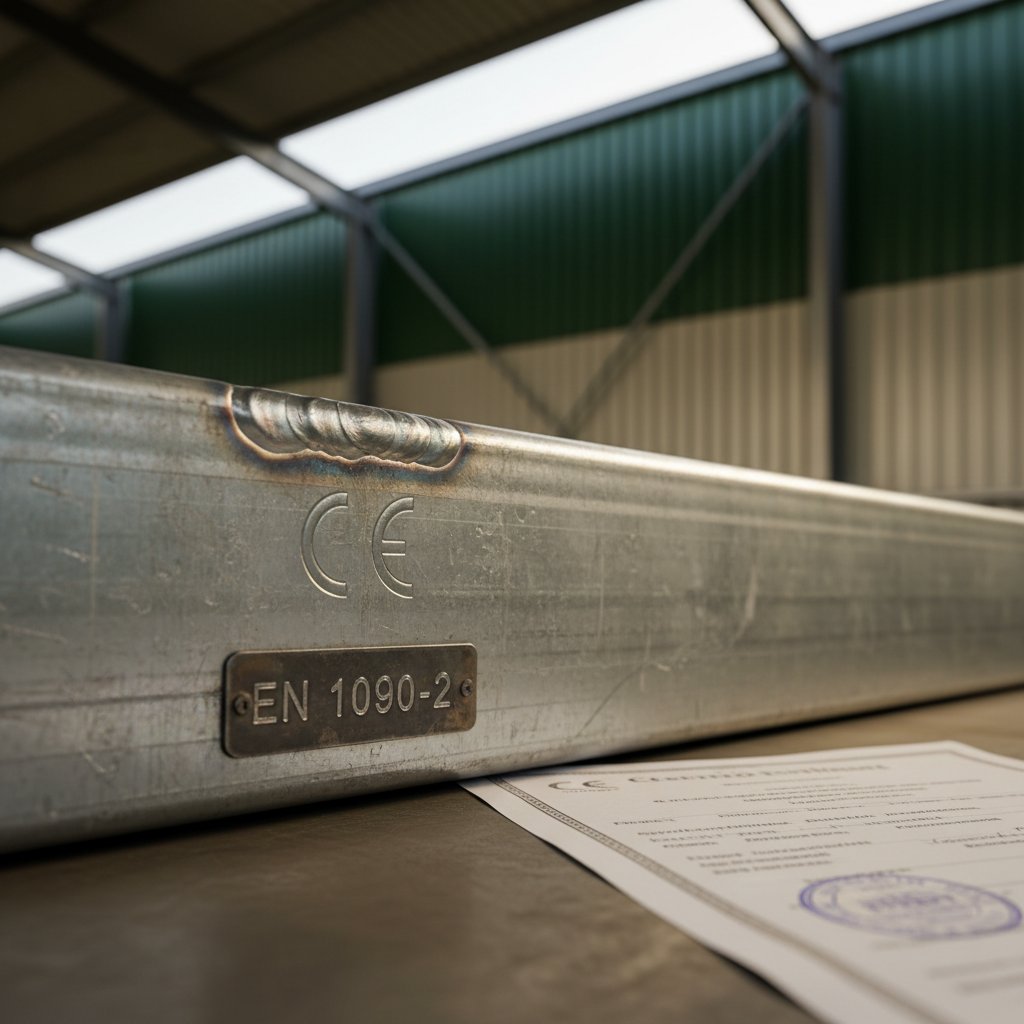
Under European Union directives, all structural steelwork must comply with the CE EN 1090-2 standard. This is not a mere formality. This certificate proves that: - The steel is traceable right back to the factory furnace where it was smelted. - The welding was performed by certified specialists using calibrated equipment. - The seams were tested using ultrasound or other non-destructive methods. - The structure is engineered to withstand the specific wind and snow loads of your region.
Our factory in Šilutė undergoes rigorous audits by independent experts. When you buy a steel building package from us, you receive a declaration of conformity. Without this document, you will not get a building permit, you will fail the final building inspection, and crucially, no insurance company will cover your property. It is simply not worth the hassle to build without it.
EU Directive 98/58/EC & Veterinary Requirements in 2026: Preparing for Inspection
If you intend to use your standard width agricultural hangar for grain storage, you must be prepared for visits from your national food and veterinary authorities-whether that is the NVWA in the Netherlands, the DGAL in France, or the Veterinäramt in Germany. In 2026, regulations under EU Directive 98/58/EC have become even stricter, particularly regarding traceability and hygiene.
Inspectors focus heavily on the following aspects for a standard width grain storage hangar: - Bird and Rodent Control: The hangar must be sealed. Gaps between the walls and the roof must be covered with special eaves combs or mesh so birds cannot build nests. - Moisture Management: Grain hates moisture. If you choose a cold hangar without an anti-condensation membrane, condensation will build up on the roof and drip directly onto your harvest. This leads instantly to mould and severe sanctions from inspectors. Our mid and premium packages solve this problem entirely. - Separation of Treated Grain: This is a critical rule for 2026. Treated (chemically coated) seed grain must never come into contact with food or feed grain. It must be stored in a separate room or a hermetically sealed zone. If an inspector finds traces of treated grain in your pile of milling wheat, the entire harvest will be condemned. - Wall Cleaning: The structure must allow for easy cleaning after the season. Steel walls are ideal for this, as they can be washed down with high-pressure hoses.
EU CAP Funding: Seizing Opportunities This Year
Modernising a farm entirely out of pocket is tough. That is why many farmers turn to the EU Common Agricultural Policy (CAP) and EAFRD rural development funds for support. In 2026, application windows open in several stages-spring, summer (July), and late autumn (November-December).
For your application to succeed, funding agencies will require three commercial offers from different suppliers to prove you have chosen the most economically viable option. Swed-Trac always prepares official, detailed commercial offers rapidly, meeting all EU funding requirements for your wide hangar.
Funding bodies strictly verify supplier reliability and product certificates. Because we provide full CE documentation, our clients never face issues with funding approval. If you opt for a bank loan or leasing through major lenders like Crédit Agricole, ING, or Sparkasse, their assessors will demand these exact same documents. Planned correctly, an investment in a high-quality standard width agricultural hangar pays for itself within five to seven years, depending on the quality of the preserved harvest and the extended lifespan of your machinery.
Hangar Insurance: Why a Policy is Just a Piece of Paper Without Proper Documents
Climate change across Europe is bringing increasingly extreme weather. Summer tornadoes in the low countries and massive wet snow loads in the Alpine regions are becoming the norm. Insuring a new hangar is absolute necessity.
However, insurance brokers have become incredibly cautious. If your hangar is built from unverified materials, lacks a building permit, and has no CE EN 1090-2 declaration, the insurance company can refuse to pay out after a disaster. They will argue the building was illegal or failed to meet safety standards.
With Swed-Trac, this risk does not exist. Our steel building structures are calculated strictly according to Eurocodes. If you live on the coast where wind speeds are higher, we design stronger trusses. When insurance companies like Allianz, AXA, or Agria see our engineering stamps and factory certificates for your wide-span universal hangar, they issue policies without hesitation and often apply better premium rates.
Competitor Comparison: Swed-Trac, LLENTAB, Röwer & Rüb, and Gooiermeer
The European market is highly competitive. To remain objective, we provide a fair comparison with other known market players based on 2026 data, using the popular 12x30m hangar as a benchmark.
| Criterion | Swed-Trac | LLENTAB | Röwer & Rüb | Gooiermeer |
|---|---|---|---|---|
| Base Price (12×30 m) | ~30,800 EUR | ~34,000 EUR | ~36,000 EUR | Often cheapest |
| Production Location | Lithuania (Šilutė) | Sweden / Poland | Germany | Netherlands / Imports |
| CE EN 1090-2 Certificate | Yes, full package | Yes | Yes | Depends on supplier |
| Customer Service | Direct, dedicated | Corporate | Premium, local | Can lack direct support |
| Warranty Support | Fast (direct from factory) | Good | Good, but expensive | Complicated |
The truth is, our greatest strength lies in our centralised production in Šilutė and our headquarters in Klaipėda. We are not just resellers. We control the entire production chain ourselves, allowing us to react flexibly to your needs and resolve any issues rapidly. When you sign a contract with us for your wide hangar, you deal directly with the manufacturer, not a middleman.
The Process from First Enquiry to Handover: Eight Steps
How does this work in practice for your new standard width agricultural hangar? Here are the eight clear stages we will navigate together:
- First Contact: You call us or fill out an online form. We discuss your needs (grain, machinery, fertiliser).
- Preliminary Offer: Within one working day, we provide a detailed estimate you can use for your CAP funding application or bank loan.
- Contract Signing: We finalise the details, sign the contract, and you pay the deposit.
- Engineering Design: Our engineers prepare the structural drawings required for your building permit.
- Production in Šilutė: While you handle permits and pour foundations, we manufacture the steelwork for your steel building. This takes about four to six weeks.
- Delivery to Site: We deliver all materials directly to your farmyard using our own transport.
- Assembly: A crew hired by you, or recommended by us, assembles the hangar. Everything fits together perfectly because the components are laser-cut.
- Document Handover: We hand over all CE certificates, warranty documents, and maintenance instructions.
Technical Requirements: Foundations, Soil, and Loads
Even the finest hangar will collapse if the foundations are poor. A three hundred and sixty square metre building requires a solid base.
Depending on the geology of your plot, two types of foundations are most commonly used: - Drilled Pier Foundations: The most economical and fastest method. Holes are drilled, reinforcement is dropped in, and concrete is poured. A ground beam is formed on top. - Strip Foundations: Used where the soil is weak or heavy wall loads are expected (for example, if you plan to pile grain directly against the walls, though we strongly recommend using special retaining walls to avoid damaging the hangar cladding).
Anchor bolts, to which the hangar columns are fastened, must be cast into the concrete with millimetre precision according to our drawings. Any deviation will require costly corrections during assembly.
Real Customer Cases: Three Different Stories from European Fields
Real examples speak louder than promises. Here are three stories from different European regions, highlighting the success of our wide hangar solutions.
Case One: Grain Storage in Normandy Jean, a farmer from Normandy, France, was looking for a reliable solution for his harvest. He chose a mid-range standard width grain storage hangar with an anti-condensation membrane. Because he stored milling wheat, DGAL inspectors arrived for a scheduled check. They found absolutely nothing to fault: no bird nests, no moisture drips, perfect hygiene. Jean called us later to say: "I do not regret choosing you for a second. My neighbour built a shed using local handymen and just received a massive fine for ruined grain."
Case Two: Machinery Park in Bavaria Hans from Bavaria needed to upgrade his tractor and combine fleet, requiring a large standard width machinery shed. He applied for EAFRD funding. Because we provided all the necessary certificates and a highly detailed estimate, his project was approved by his local Sparkasse bank without delay. The standard width agricultural hangar was fully assembled in two weeks.
Case Three: Storm Testing in Jutland Last winter, the Jutland peninsula in Denmark was battered by a severe blizzard. Snow levels reached record highs. Lars’s neighbour had an old, uncertified hangar that simply collapsed under the weight. Lars’s Swed-Trac steel building stood firm. Although a piece of wind bracing suffered minor damage from the gale-force winds, his insurance company, Agria, received our CE documents and covered the cosmetic repair costs instantly, without a single dispute.
Decision Tree: How to Choose the Right Option for Your Farm?
If you are still hesitating about which solution is best for you, use this simple decision tree. Remember, the wide hangar is often the optimal choice for its versatility and cost-effectiveness.
-
What do you plan to store in the hangar? - Machinery, fertiliser, implements: Choose the base cold hangar. - Grain, vegetables, sensitive equipment: An anti-condensation membrane is mandatory (mid package) for your standard width grain storage hangar. - You plan to set up a workshop or heated rooms: You need the premium package with polyurethane (PIR) sandwich panels.
-
Do you have the time and desire to handle building permits? - Yes, I can wait a few months: Excellent, the standard width agricultural hangar (e.g., 12x30m model) suits you perfectly. You will get maximum space and a highly versatile wide-span universal hangar. - No, I need a building yesterday and without the red tape: Then you must choose a smaller model (e.g., 8m or 10m wide) that fits under your local permit-free threshold. However, you will sacrifice significant space.
-
Are you planning to apply for EU CAP funding? - Yes: You must demand a full package of certificates from your supplier. We guarantee this entirely for your steel building.
General Advice and Common Mistakes Farmers Make
Years of experience in the market allow us to see exactly where farmers slip up. Here is a common mistake you must avoid, especially when investing in a substantial structure like a hangar:
- Buying cladding that is too thin. Some farmers try to save money by choosing 0.4 mm steel sheets, which buckle under the first heavy snowfall or high wind. Always insist on at least 0.5 mm structural cladding to ensure the longevity and safety of your investment.
Want a quote on a hangar? Call +370 645 18595 or email sales@swedhall.se - we will prepare an individual quote within 24 hours.
Frequently Asked Questions (FAQ) About Agricultural Hangars
Q1: What is the average lifespan of a Swed-Trac agricultural hangar?
A1: With proper maintenance and given our high-quality structural steel and CE EN 1090-2 compliance, our hangars are designed for a lifespan of 50 years or more.
Q2: Can I install solar panels on the roof of a Swed-Trac hangar?
A2: Yes, absolutely. Our structural engineers can calculate the additional load requirements for solar panel installations during the design phase. This ensures your roof can safely support the panels.
Q3: Is it possible to expand the hangar later?
A3: Yes, our modular design allows for future expansion. We recommend planning for potential expansion during the initial design phase to make the process smoother and more cost-effective.
Q4: Do you offer assembly services?
A4: While we primarily supply the complete hangar kit and detailed assembly instructions, we can recommend experienced assembly teams in various EU countries. Many clients also choose to use their own local construction teams.
Q5: How long does it take from order to delivery?
A5: Typically, production takes 4-6 weeks after the engineering design is finalised and the deposit is received. Delivery times vary depending on your location within the EU but are usually within a few days to two weeks after production completion.
Q6: What kind of warranty do you provide?
A6: We offer a comprehensive factory warranty covering the steel structure and cladding materials against manufacturing defects. The specifics are detailed in your contract.
Q7: Can I customise the hangar's dimensions beyond the standard 12x30m?
A7: Yes, while the standard width width is our highly recommended universal standard, we offer customisable lengths and other widths (8m, 10m, 15m, 18m, 20m) to perfectly match your farm's unique requirements.