 Blog
Blog
1. The Starting Point: Is a Steel Hangar Really Worth the Investment?
Klaus, who manages a sprawling four-hundred-hectare arable farm in Bavaria, spent years repairing his combine harvesters and heavy tractors out in the open. When the weather turned hostile, he was forced to drag his machinery to a drafty, rented old garage fifteen kilometres away from his main base. Any serious breakdown at the height of the harvest season cost him not just his sanity, but thousands of euros in lost time and delayed yields. When Klaus finally decided to take control of his infrastructure and build a robust steel hangar right in his own yard, a few traditionalist neighbours shook their heads. They claimed it was far too expensive and completely unnecessary for a family-run operation.
But two years later, Klaus opened his accounting books and revealed the exact numbers. He had saved over eighteen thousand euros simply by avoiding machinery rental downtime, eliminating the hefty travel fees charged by mobile mechanics, and cutting out his monthly commercial rent entirely.
Today, in 2026, the European market is undergoing a massive transformation. The relentless pressure to optimise farm and business efficiency is higher than ever. Opportunities provided by the EU CAP (Common Agricultural Policy) and EAFRD rural development funds, combined with increasingly strict hygiene and operational standards from national veterinary services-whether that is the Veterinäramt in Germany, the DGAL in France, or the NVWA in the Netherlands-are forcing business owners to seek reliable, long-lasting infrastructure. Compliance with EU Directive 98/58/EC on animal welfare and farm safety means that ad-hoc, messy repair yards are no longer acceptable.
While various widths are available, from compact 8m solutions for smaller farms to efficient 10m hangars for medium-sized operations, the agricultural hangar has emerged as the universal gold standard for European agriculture. A steel building offers unparalleled versatility, providing ample space for modern machinery, efficient grain storage, or comfortable livestock housing. For example, a standard width agricultural hangar measuring 25 metres long provides a generous three hundred square metres of usable floor space, fitting perfectly into the operational flow of almost any farm or agribusiness. Other common widths include 15m for wider equipment, 18m for large farms, and 20m for industrial applications. However, the wide-span universal hangar at standard width wide consistently proves to be the optimal choice for most farmers seeking a balance of capacity, cost-efficiency, and adaptability.
In this detailed, expert long-read, we break down exactly why the hangar remains one of the most intensely discussed investments among European farmers and entrepreneurs. We refuse to use empty marketing clichés. Instead, we rely strictly on real numbers, genuine European client examples, precise return on investment (ROI) calculations, and an open, objective comparison with other major market players. If you are currently debating whether to build your own facility, this text will answer your questions directly.
2. The Core Facts: hangar Specifications
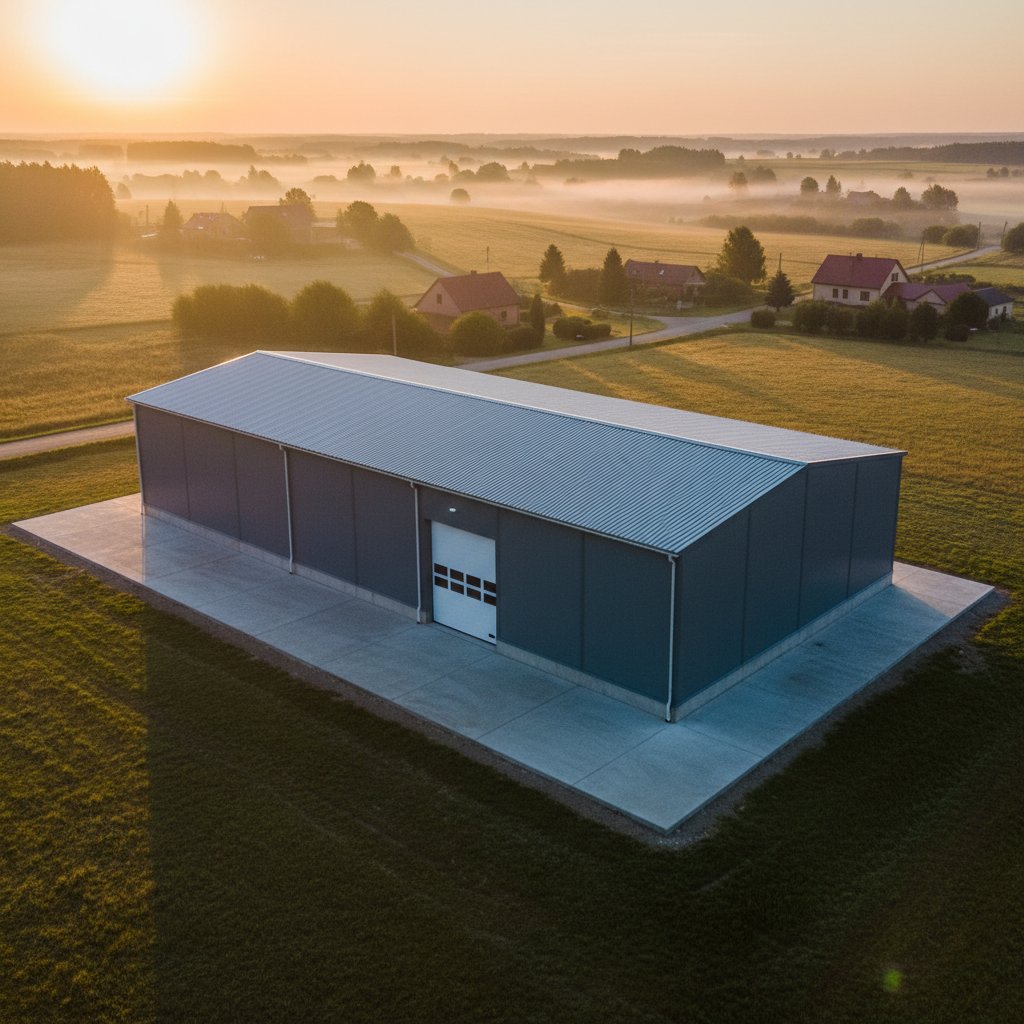
Before we dive into the financial returns, we need to clearly define the calibre of the building we are discussing. This is absolutely not a temporary, fabric-covered tent that you will have to hastily rebuild after a severe winter storm. It is a serious, precisely engineered steel building, fully adapted to handle the unpredictable and often harsh European climate. Our state-of-the-art Baltic factory in Šilutė, Lithuania, fabricates every single frame strictly adhering to the highest structural quality standards, ensuring direct-to-market efficiency without compromising on heavy-duty reliability.
Below is a comprehensive table outlining the essential technical parameters of a typical steel building from Swed-Trac.
| Parameter | Detailed Specification |
|---|---|
| Length and width | Twelve metres wide, twenty-five metres long (customisable length) |
| Total area | Three hundred square metres |
| Wall height | Four to six metres (customisable based on your specific needs) |
| Frame material | Structural steel, fully CE EN 1090-2 certified |
| Cladding (roof and walls) | Sandwich panels (PIR or EPS core) or high-quality profiled steel sheeting |
| Snow load resistance | Precisely calculated for European climate zones (up to 2.5 kN/m²) |
| Wind load resistance | Engineered to withstand severe coastal gales (vital for Normandy, Jutland, or North Holland) |
| Expected lifespan | Over fifty years (for the steel frame) |
These parameters guarantee that your standard width agricultural hangar will remain stable, secure, and virtually maintenance-free for decades. The entire structure is designed with a clear-span roof, meaning there are absolutely no internal support columns. The entire three-hundred-square-metre footprint is completely open, giving you total freedom when manoeuvring wide headers, articulated tractors, or heavy industrial equipment. While we offer a range of widths from 8m to 20m, the wide span provides the most practical and cost-effective solution for the vast majority of modern farm machinery and operational needs.
3. Full Price Breakdown: What Does a hangar Cost in Reality?
A frequent mistake buyers make is looking exclusively at the base price of a steel frame and assuming that represents the final budget. To calculate an accurate and realistic ROI, you must evaluate the complete final estimate, including cladding, doors, and labour. Transparency is a foundational value at Swed-Trac. We openly present three realistic pricing scenarios for a standard width x 25m (300 sq m) steel building based on the current 2026 European market conditions. Prices are listed in euros, excluding Value Added Tax (VAT).
| Element | Basic Setup (Cold Hangar) | Mid-Range Setup (Semi-warm, EPS) | Premium Package (Warm, PIR panels) |
|---|---|---|---|
| Steel frame and fittings | €30,450 | €30,450 | €30,450 |
| Cladding (Walls and roof) | €10,500 (Profiled steel sheets) | €19,950 (EPS sandwich panels) | €27,300 (PIR sandwich panels) |
| Gates (Industrial, overhead) | €3,750 (Single standard gate) | €7,350 (Two insulated gates) | €10,500 (Two fully automatic gates) |
| Doors, windows, skylights | €1,275 | €2,925 | €5,250 |
| Professional installation | €8,400 | €10,500 | €12,600 |
| Preliminary total sum | €54,375 | €71,175 | €86,100 |
Please note that these figures serve as a highly accurate baseline for a hangar. Metal and sandwich panel prices continuously fluctuate on global commodities exchanges, so we provide every prospective client with an individual, precise quote locked in at the time of order. However, this table perfectly illustrates the realistic budget you should anticipate when planning an infrastructure project of this scale, specifically for a standard width agricultural hangar.
4. What Is Included in the Estimate (and What Is Not)
To ensure our partnership runs smoothly from day one and to avoid any mid-project misunderstandings, we draw very clear lines of responsibility. Swed-Trac specialises deeply in manufacturing and installing premium metal structures. We are not a general building contractor that pours foundations, fits plumbing, or wires electrical panels. This strict division of labour allows us to maintain the highest possible quality and speed in our specific field, while saving you money by letting you source local tradesmen for general groundworks.
| What we guarantee in our quote | What remains your (the client's) responsibility |
|---|---|
| Detailed structural engineering design and load calculations | Ground levelling, soil preparation, and foundation pouring |
| All steel structures, high-tensile bolts, and connecting fittings | Electrical wiring, fuse boards, and interior lighting installation |
| Your chosen wall and roof cladding (sheets or insulated panels) | Heating, ventilation, and heat recovery systems |
| Gates, personnel doors, and windows (as per the agreed design) | Securing local building permits via your municipal planning office |
| Professional, safe, and rapid installation on your site | Interior finishing, dividing partitions, and industrial concrete flooring |
For the foundation work, we always provide precise load-bearing diagrams and anchor bolt plans well in advance. Your chosen local concrete contractors can seamlessly use these blueprints to pour pile, strip, or full slab foundations without any guesswork.
5. ROI and Financial Returns: How a hangar Saves You Money
Return on Investment (ROI) for a heavy-duty standard width agricultural hangar is not just a theoretical accounting term. It is highly practical mathematics, driven by avoided costs and drastically increased productivity over a five-to-ten-year horizon. When we calculate the financial returns with our clients, we evaluate three primary savings streams.
The first stream focuses on rent and facility maintenance costs. If you are a business owner currently leasing a similar-sized commercial space (e.g., 300 sq m) in a semi-urban area, in 2026 you are likely paying anywhere from twenty-two to twenty-seven thousand euros annually. By erecting a private steel building on your own land, you immediately stop bleeding that cash. Instead, you redirect those funds into increasing your own property's asset value.
The second stream involves machinery longevity and the reduction of critical downtime. Agricultural and construction equipment kept securely under a roof breaks down significantly less often. Relentless winter moisture does not corrode sensitive electronics, and deep frost does not blow out expensive hydraulic seals. When a tractor breaks down in the middle of a muddy field, transporting it to a main dealer and paying their premium labour rates costs a small fortune. Having your own dedicated, dry standard width machinery shed means you can handle most preventative maintenance in-house. By avoiding just two major, season-delaying breakdowns a year, you save between nine and fifteen thousand euros easily. This is particularly true for a standard width grain storage hangar, where proper climate control can prevent spoilage and maintain market value.
The third stream is labour productivity and employee comfort. In a fully insulated Premium package hangar, your mechanics can work comfortably and efficiently even when outside temperatures drop to minus fifteen degrees in Tyrol or Jutland. Work gets completed twice as fast, morale remains high, and the likelihood of costly human error drops dramatically when hands aren't freezing.
The underlying math is compelling. If your fully loaded Premium standard width agricultural hangar costs roughly eighty-six thousand euros, and you save roughly twenty-seven thousand euros a year through avoided rent, reduced machinery breakdowns, and higher labour output, your initial investment pays for itself in just over three years. After this short payback period, the building generates pure operational profit.
6. Competitor Comparison: Why Swed-Trac Hits the Sweet Spot
The European market is heavily populated with companies offering hangars, stables, and industrial workshops. In 2026, the main players that clients typically evaluate alongside us are Röwer & Rüb (DE), LLENTAB (SE), Ydre-Grinden (SE), Myrby (SE), and Gooiermeer (NL). Let's look at the facts and compare them directly, without the usual corporate spin.
| Criterion | Swed-Trac | LLENTAB (SE) | Röwer & Rüb (DE) | Ydre-Grinden / Myrby (SE) | Gooiermeer (NL) |
|---|---|---|---|---|---|
| Price level (300 sq. m.) | Mid-Range / Premium | Premium (High) | Ultra-Premium | Premium | Lower / Mid |
| Structural features | CE EN 1090-2 certified heavy steel frames | Fully certified, proprietary Swedish system | Highly specialised, luxury equestrian focus | Standard profiles, heavy focus on livestock/timber | Often lighter cold-rolled profiles |
| Production & installation | 4-6 weeks (direct from our Baltic factory) | 8-12 weeks (large corporate backlog) | 10-14 weeks (bespoke manufacturing) | Varies heavily via third-party dealers | Can stretch during peak agricultural seasons |
| Warranty service | Direct and rapid from our HQ | Long-term, professional corporate warranty | Excellent, but carries a premium price tag | Factory warranty handled via local intermediaries | Standard legal warranty |
| Flexibility | Extremely high (customised to the millimetre) | High | Very high (architectural bespoke designs) | Medium | Mostly standard, fixed modules |
Swed-Trac does not aim to be the absolute cheapest option on the market. If you are hunting for the lowest possible price tag just to keep the rain off, you will likely end up with a light-gauge tin shed from a discount supplier. Our goal is entirely different: we deliver the most robust, heavy-duty frame and the absolute best price-to-quality ratio available in Europe for your hangar or any other wide-span universal hangar requirement.
Unlike massive international corporations burdened with sprawling administrative overheads and layers of middle management, we operate a highly efficient, high-tech production line in Šilutė, Lithuania. We export and install directly. This streamlined approach means your money goes directly into thick structural steel and high-grade insulation, rather than paying for bloated corporate logistics or expensive regional sales directors.
7. The Process: From Inquiry to Handover
Many clients genuinely fear that undertaking a construction project will become an endless source of stress, delays, and hidden costs. With Swed-Trac, that simply does not happen. Our operational process has been refined over hundreds of builds down to the smallest detail, divided into eight transparent stages.
Stage One: Your inquiry. You contact our team by phone or email. We sit down (virtually or in person) to discuss your exact vision, the required dimensions, and the daily operational purpose of the building.
Stage Two: Preliminary estimate. Within twenty-four hours, we provide you with a crystal-clear quote featuring a detailed, line-by-line price breakdown. No hidden fees, no nasty surprises.
Stage Three: Finalising details. We confirm the exact placement of personnel doors, the clearance height of the industrial gates, and your preferred cladding colours. Once every detail aligns with your needs, you sign the contract, and we immediately lock in your production slot.
Stage Four: Engineering design. Our in-house structural engineers prepare comprehensive manufacturing blueprints. They run precise load calculations adapted specifically to the wind and snow zones of your exact geographic location, ensuring total compliance with local codes.
Stage Five: Manufacturing. Inside our state-of-the-art facility, we cut, weld, and finish the heavy steel components. This rigorous fabrication process typically takes about three weeks.
Stage Six: Foundation preparation. While we are busy manufacturing your steel frames, you or your hired local groundworks contractor pour the concrete foundations precisely according to the anchor plans we provided in Stage Four.
Stage Seven: Delivery and installation. We transport the finished structures directly to your yard on flatbed lorries. Our highly experienced, fully certified assembly crew arrives and erects the entire building in five to ten days, depending on the weather conditions and your chosen insulation package.
Stage Eight: Handover. We conduct a thorough final inspection of the finished workshop together with you. We sign the official handover protocol and hand over your long-term structural warranty documents. You are ready to move your machinery in the very same day.
8. Technical Requirements and Institutional Standards in 2026
When building a three-hundred-square-metre steel building, you must navigate a web of legal and engineering requirements, which in 2026 are strictly enforced across the European Union.
First, the foundations must be taken seriously. For a building of this scale, simply pouring a thin layer of concrete directly onto topsoil will lead to disaster. The foundations must be engineered to bear the specific dynamic loads of the heavy steel structure. This is especially critical when factoring in heavy winter snow in regions like Bavaria, or relentless coastal winds in Normandy and North Holland. You will likely need a basic geological survey of your soil to determine whether deep pile foundations or a heavily reinforced concrete raft slab is the correct engineering choice.
Second, environmental and zoning regulations cannot be ignored. Across Europe, agricultural and commercial buildings must adhere to strict environmental guidelines. If you are leveraging EU CAP funds or applying for EAFRD rural development grants, your new workshop must meet rigorous sustainability and energy efficiency criteria. The Swed-Trac Premium package, with its ultra-thick PIR panel insulation, easily satisfies these modern energy requirements, ensuring your winter heating costs remain exceptionally low and your carbon footprint is kept to an absolute minimum.
Third, veterinary and operational standards play a massive role for mixed-use farms. If your standard width agricultural hangar is located on an estate that also houses livestock, you must comply fully with EU Directive 98/58/EC regarding animal welfare and farm safety. National veterinary services-such as the Veterinäramt in Germany, the DGAL in France, or the NVWA in the Netherlands-regularly inspect farm premises. A modern, steel-framed Swed-Trac standard width machinery shed ensures you have a clean, easily sanitised environment. It keeps toxic machinery fluids, sharp spare parts, and noisy repair activities completely segregated from animal feed and housing areas. This clear, professional separation is a massive advantage during any official state inspection.
Finally, financing and insurance require certified quality. Major European banks like Deutsche Bank, Sparkasse, Crédit Agricole, ING, and BNP Paribas look highly favourably upon CE-certified steel buildings when issuing agricultural or commercial development loans. They understand that a structure certified to EN 1090-2 standards is a safe, liquid, long-term asset. Similarly, top-tier insurers such as Allianz, AXA, Agria, B
Want a quote on a hangar? Call +370 645 18595 or email sales@swedhall.se - we will prepare an individual quote within 24 hours.
FAQ: Your Questions Answered
Q: How long does it take to get a Swed-Trac hangar delivered and installed?
A: From finalising your order to the completed installation on your site, the entire process typically takes 6-8 weeks. Manufacturing takes about 3 weeks, and our professional team can erect the structure in 5-10 days, depending on the complexity and weather conditions.
Q: Can I customise the dimensions of my hangar?
A: Absolutely. While our hangar is a highly recommended universal width, all our hangars are custom-designed to your specific length, height, and even width requirements (from 8m to 20m). We provide detailed engineering plans to ensure it meets your operational needs and local regulations.
Q: What kind of maintenance does a Swed-Trac steel building require?
A: Thanks to robust steel frames and high-quality cladding materials, Swed-Trac hangars are virtually maintenance-free for decades. Occasional checks of the roof and cladding for any potential damage from extreme weather are recommended, but no regular painting or structural upkeep is needed.
Q: Is it possible to expand the hangar later if my business grows?
A: Yes, our steel structures are designed with future expansion in mind. Depending on the initial design, it is often straightforward to extend the length of your steel building by adding new bays. We can discuss potential future expansion during the initial planning phase.
Q: What are the payment terms for a Swed-Trac hangar?
A: Our standard payment terms involve an upfront deposit to secure your production slot and begin engineering, followed by progress payments during manufacturing and prior to delivery. The final payment is due upon successful handover of the completed structure. Specific terms will be outlined in your individual quote.