 Blog
Blog
The Beginning: How a Neighbour Tried to Save Cash and Paid Double
Picture a standard agricultural estate in Bavaria. Johan, managing over five hundred hectares of land, decided he urgently needed new premises to store machinery and carry out minor repairs. He found an online advert for cheap, imported fabric hangars and did not think twice. The seller assured him that "these buildings don't need any paperwork", so Johan shook hands on the deal. He thought he had saved a few thousand euros. His joy lasted exactly four months.
When the local Bauamt (building authority) inspectors arrived, the bitter reality hit hard. A two-hundred-square-metre structure, or a agricultural hangar of comparable size, requires a building permit, regardless of whether it has deep foundations or not. Worse still, the steel framework lacked any CE marking. The regional agricultural board rejected Johan’s application for EU CAP (Common Agricultural Policy) rural development funds because the building legally did not exist. Finally, after an autumn storm tore the fabric, his insurer, Allianz, refused to pay out due to the very same missing documents. Johan paid a hefty fine, tore down the illegal structure, and started from scratch.
The truth is, today Johan is one of our most loyal customers. A solid, legal, and fully insured Swed-Trac steel building now stands in his yard. Operating across Europe and manufacturing our products in Šilutė, Lithuania, we encounter dozens of similar stories every single day. In this article, I will explain the actual legal framework for agricultural hangars in 2026, with a special focus on the highly versatile agricultural hangar. We will cover building permits, certificates, insurance nuances, and liability, ensuring you never regret your investment.
Key Facts: The Versatile agricultural hangar and Other Swed-Trac Options
Before diving into the legal waters, we must clearly define the structure in question. Swed-Trac offers a range of widths to suit diverse farming needs, from smallholdings to large industrial operations. Our most popular and universally recommended option is the hangar. This width provides optimal flexibility for most agricultural tasks, comfortably accommodating modern machinery, bulk grain storage, or livestock.
Here’s a breakdown of our available widths: * 8m (Small Farms): Ideal for smaller equipment, basic storage, or as a cost-effective extension. * 10m (Medium Farms): A good step up for more machinery or feed storage. * standard width (UNIVERSAL - RECOMMENDED): The optimal choice for most farmers. This wide-span universal hangar width is perfect for grain, feed, machinery, and even livestock, offering excellent manoeuvrability and storage capacity. It's truly a standard width agricultural hangar designed for versatility. * 15m (Wider): For farms needing extra space for larger implements or more complex operations. * 18m (Large Farms): Suited for very large machinery, extensive storage, or multiple work zones. * 20m (Industrial): Our largest standard width, designed for industrial-scale operations, large-scale logistics, or significant processing facilities.
A hangar that is, for example, twenty metres long, creates exactly two hundred and forty square metres of usable floor space. This is not a small garden shed. It is a serious engineering structure subject to strict European building regulations.
| Specification | Description | Legal Significance |
|---|---|---|
| Width | standard width (UNIVERSAL) | Provides optimal space for most agricultural needs. |
| Length (example) | 20 metres | Two hundred and forty square metres of floor space means a building permit is mandatory across the EU for this size. |
| Height | Standard ridge height around 5-6 metres | Usually classified as a secondary or non-complex structure, provided it stays below standard height limits. |
| Structure | Structural steel | Mandatory CE marking under the EN 1090-2 standard. |
| Covering | 900 grams per square metre PVC fabric | Meets fire safety requirements and is easy to clean (vital for veterinary inspections). |
| Purpose | Workshop, warehouse, garage, standard width grain storage hangar, standard width machinery shed | The declared purpose dictates the health, safety, and hygiene standards you must meet. |
These specifications form the cornerstone of your negotiations with municipal architects and insurance brokers. Because we manufacture the structure in our Šilutė factory, we guarantee every steel truss will withstand local snow loads and satisfy the strictest building inspector.
Full Price Breakdown: What You Will Actually Pay for a hangar
Clients constantly ask: "What is the final bill going to look like?" Numbers never lie, so I have outlined three realistic scenarios for a hangar (e.g., standard width x 20m, offering 240 sqm of space). Prices are in euros, excluding Value Added Tax, as most of our commercial clients are VAT registered. These reflect current 2026 pan-European market rates.
| Component | Basic Scenario (EUR) | Medium Scenario (EUR) | Premium Scenario (EUR) |
|---|---|---|---|
| Base structure and fabric | 24,000 | 25,500 | 28,000 |
| Gates and doors | 1,500 (one simple gate) | 3,800 (roller door + pedestrian door) | 6,000 (two automated doors) |
| Delivery across Europe | 1,500 | 1,500 | 1,500 |
| Assembly work | 5,000 | 5,500 | 7,000 |
| Design and permits (estimate) | 3,000 | 4,000 | 5,500 (complex utility networks) |
| TOTAL (excl. VAT) | 35,000 EUR | 40,300 EUR | 48,000 EUR |
The basic scenario suits those using the standard width machinery shed as a cold garage for agricultural equipment. The medium scenario remains the most popular choice for a standard width agricultural hangar, ensuring comfortable daily operations. The premium package is entirely worth the money when the steel building becomes your company's main operational hub, demanding maximum convenience and automation.
What is Included and What is Excluded from the Standard Package
Transparency drives our business. We never claim "everything is included" when it is not. Below is a clear breakdown showing exactly what your invoice covers and what you must organise independently for your hangar.
| Included in the Swed-Trac Package | NOT Included (Client's Responsibility) |
|---|---|
| Steel frame (certified) | Ground levelling and soil compaction |
| Heavy-duty PVC fabric cover (UV resistant) | Concrete foundations or tarmac laying |
| All bolts and fixings required for assembly | Electrical wiring and installation |
| Factory technical passport and CE declaration | Securing the building permit from the local council |
| Professional consultation throughout the process | Internal lighting and heating systems |
We can recommend trusted local partners across Germany, France, and the Benelux region to handle groundworks or draft your planning application, but these services require separate contracts.
The Building Permit Process: Step by Step
A dangerous myth persists across Europe that fabric hangars bypass planning permission. This is entirely false. Whether you are in Denmark, France, or Austria, local planning laws dictate that any structure of this scale requires formal approval. Our hangar example (standard width x 20m) covers two hundred and forty square metres, making the legal route unavoidable.
Here is how the process looks in 2026:
Step one involves a topographic survey of your plot. Certified surveyors handle this. If your current survey is more than a few years old, you will need a fresh one. Step two requires hiring an architect. They will draft a simplified building project. Because the structure is relatively straightforward, architects prepare these plans faster than they would for a brick-and-mortar building. Step three is submitting the project to the local planning authority. Various departments review the plans: urban planning, environmental agencies, and sometimes the highways department if your land borders a main road. Step four covers paying the municipal fees and receiving the permit. Assuming no major hurdles, this entire process takes two to three months.
Trying to bypass the system is simply not worth the hassle. You risk heavy fines, voided insurance policies, and an eventual demolition order at your own expense.
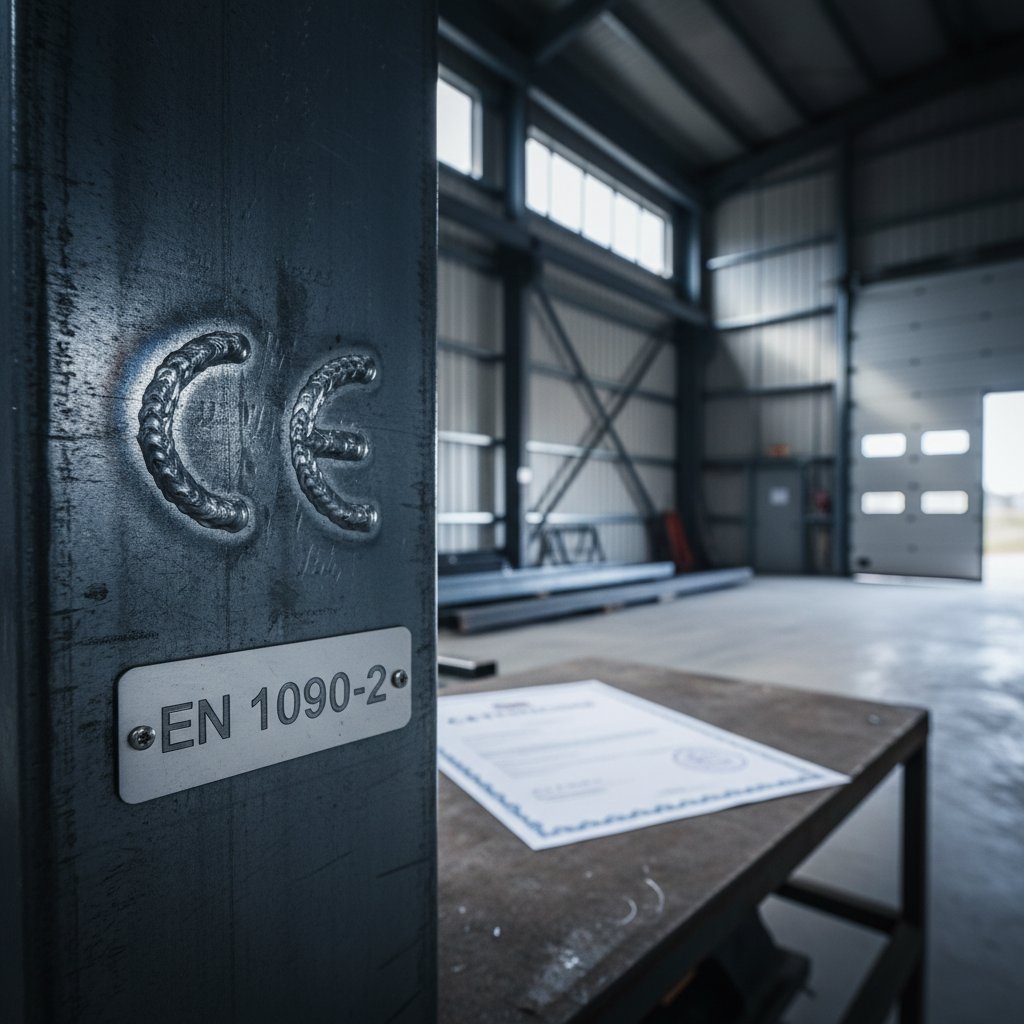
Certificates and the Law: What the CE EN 1090-2 Standard Means
The European Union enforces a strict standard for steel structures: EN 1090-2. This is not just a random string of letters and numbers. It guarantees your safety and legal compliance for any steel building.
When we manufacture steel trusses for your hangar in Šilutė, certified welders complete every single joint. The EN 1090-2 standard demands a rigorous internal factory production control system. We know exactly which batch of steel formed each component, who welded it, and the ambient temperature during the process.
If you buy a hangar from an obscure seller lacking a CE mark, the local building inspector will refuse to sign the completion certificate. You will own a building you cannot legally use. Should a disaster occur-such as a roof collapse under heavy snow-the liability falls entirely on your shoulders for erecting an uncertified structure. Swed-Trac hands over all necessary compliance documents the moment you sign the final handover protocol.
EU Directive 98/58/EC and National Veterinary Requirements
If you plan to use your standard width agricultural hangar to store grain, animal feed, or temporarily house livestock alongside your tractors, national veterinary services (like the Veterinäramt in Germany, DGAL in France, or NVWA in the Netherlands) will eventually inspect your premises. In 2026, hygiene regulations under EU Directive 98/58/EC are exceptionally strict.
The primary requirement for agricultural storage is the ability to easily clean and disinfect the space. This is where PVC fabric excels. Unlike porous concrete or untreated timber, our nine-hundred-gram fabric absorbs neither moisture nor odours. You can wash it down with a high-pressure hose, making it perfect for a standard width grain storage hangar.
Pest control represents another critical factor. The structure must remain sealed against birds and rodents. A properly assembled Swed-Trac hangar, bolted flush to a level concrete base, delivers the necessary seal. Inspectors will also check your ventilation. We always recommend installing extra ventilation vents in the ridge to prevent condensation buildup.
Insurance Policy Aspects: How to Protect Your Asset
Insuring a two-hundred-and-forty-square-metre fabric hangar differs vastly from insuring a brick house. Major European insurers like Allianz, AXA, and Generali carefully assess the risks associated with wind and snow loads for a steel building.
To secure favourable insurance terms, you must present three documents: First, the building completion certificate (proving the structure is legal). Second, the manufacturer's certificates (the CE EN 1090-2 we discussed). Third, the building's technical passport, detailing the maximum permissible loads.
Insurance contracts often include a clause requiring you to clear snow if it exceeds a specific depth. Our structures handle harsh European winters with ease, but as the owner, you must perform basic maintenance. If a storm hits and the assessor discovers the fabric was loose and you failed to tension it according to the manual, the insurer can reduce the payout, citing improper maintenance.
Competitor Comparison: Swed-Trac vs. The Rest of the Market
The European market moves fast, and we track our competitors closely. When choosing a hangar, you must compare the final price against the actual value delivered. Below is an objective assessment of the 2026 market landscape for a comparable standard width x 20m (240 sqm) structure.
| Criteria | Swed-Trac | LLENTAB SE | Röwer & Rüb DE | Gooiermeer NL |
|---|---|---|---|---|
| Base Price (12x20 m) | ~25,500 EUR | ~34,000 EUR | ~30,500 EUR | ~23,000 EUR |
| Manufacturing Base | Lithuania (Šilutė) | Sweden | Germany | Netherlands (Imported) |
| CE EN 1090-2 Certificate | Yes, strictly applied | Yes, top tier | Yes, excellent | Basic / Varies by batch |
| Warranty Support | Fast, EU-wide response | Good, but slow in peak season | Excellent, but pricey post-warranty | Difficult communication |
| Covering Quality | 900 g/m² PVC (Premium) | Steel cladding (not fabric) | 800-900 g/m² PVC | 650-800 g/m² PVC (Budget) |
We do not aim to be the cheapest on the market. Cheap usually means thinner steel or weaker fabric. Our goal is to deliver a durable product backed by flawless legal documentation and responsive support. Unlike companies that merely import and resell budget kits, we take responsibility for every single bolt of your steel building.
The Process from Enquiry to Handover
How does this work in reality? We operate a clear, ten-step process that keeps clients informed and relaxed when investing in a new standard width agricultural hangar.
Step one is your initial enquiry by phone or email. We discuss your needs and site conditions. Step two is providing an initial estimate. You see exactly what the structure costs and the price of any optional extras. Step three involves signing the contract and transferring the deposit. We immediately reserve production capacity in Šilutė. Step four is handing the technical drawings to your architect to start the planning permission process. Step five is production. Cutting, welding, and finishing the steel, and welding the PVC fabric takes four to six weeks. Step six is ground preparation. While we manufacture, you pour the concrete foundations or prepare the tarmac. Step seven is delivering the structure to your site anywhere in Europe. Step eight is assembly. Our professional team completes the build in three to five days. Step nine is the final handover, passing all CE certificates and the technical passport directly to you. Step ten marks the start of your warranty and our long-term partnership.
Technical Requirements and Engineering Solutions
A hangar needs solid engineering to stand for decades. Good paperwork is not enough. Here's the thing: a two-hundred-and-forty-square-metre roof acts as a massive sail catching the wind, and a huge platform collecting snow.
Our engineers in Šilutė calculate loads based on specific European climate zones. Wind loads on the coast of Normandy or Jutland are vastly higher than in central Austria. We adapt the truss spacing accordingly to ensure absolute stability for your steel building.
Foundations remain critical. You could theoretically anchor a fabric hangar into compacted gravel using long steel pins. However, we strongly recommend pouring concrete pad foundations for the columns. This guarantees stability, prevents the structure from settling after the spring thaw, and makes operating large roller doors much smoother. A solid base is the only way to perfectly tension the fabric so it does not flap in the wind and wear against the steel frame.
Real Customer Cases: Three Different European Experiences
Nothing speaks louder than real results. Here are three distinct stories from different corners of Europe, where a hangar or similar Swed-Trac structure made a significant difference.
Johan the Farmer in Bavaria, Germany Johan needed space for expensive agricultural machinery and winter maintenance. He already had a tarmac yard. He chose a Swed-Trac standard width machinery shed (standard width x 20m) and secured his building permits within three months, successfully applying for EAFRD (European Agricultural Fund for Rural Development) support. Because our products carry full CE certification, the agricultural funding inspectors approved the grant immediately. Johan saved roughly forty percent compared to building a brick barn, and his machinery now stays perfectly dry.
Marcel the Mechanic in Normandy, France Marcel wanted to expand his independent garage. He needed enough space to fit three vehicle lifts. Light and insulation were his main concerns. We provided a tailored solution: a steel building with a double-layer roof fabric with an air gap for thermal insulation, using a translucent material to let natural light in. Marcel secured a commercial building permit, and his investment paid for itself in under two years as he doubled his daily customer capacity.
A Logistics Firm in North Holland, Netherlands A fast-growing logistics company needed a rapid solution for cross-docking goods. They required a clear-span building with no internal pillars so forklifts could move freely. Our wide-span universal hangar (standard width wide) fit the bill perfectly. They initially looked at cheaper imported alternatives, but their financing partner, ING, and their insurer, AXA, demanded strict compliance declarations. The importers could not provide them. We handed over the full EN 1090-2 documentation, and the company easily secured both financing and comprehensive insurance for the building and the goods inside.
Decision Tree: Which Hangar to Choose
If you are still debating which hangar width fits your needs, run through this simple decision tree:
First, does your planned footprint exceed fifty to eighty square metres? If yes, accept the fact that a building permit is mandatory in your country. Second, consider your primary use: * Small equipment or basic storage (8m or 10m wide): For smaller farms or specific storage needs. * Universal agricultural use (standard width wide): This is our PRIMARY RECOMMENDATION. A hangar is ideal for most farmers, offering ample space for modern machinery, a standard width grain storage hangar, or a versatile standard width machinery shed. * Large-scale operations (15m, 18m, or 20m wide): For very large machinery, extensive storage, or industrial applications. Third, will people work inside daily, or is it purely for storage? If it involves daily work, opt for the medium or premium package with good lighting and insulation options. A basic model serves perfectly for pure storage. Fourth, do you plan to apply for EU CAP funding? If yes, you must choose a certified manufacturer. Ignore adverts lacking proper company details-you will lose the grant and waste your time. Fifth, is your ground stable? If you are building on soft, peaty soil, invest in deeper pile foundations. Solid clay requires simpler groundwork.
General Advice and Warnings for New Owners
Even the finest steel building requires a little care. As a senior Swed-Trac expert, I want to share a few practical tips to extend your hangar's lifespan.
Set up a maintenance calendar. Walk around the building twice a year (before and after winter) to check the fabric tension. If the fabric feels loose, the wind will rub it against the metal frame, causing micro-tears over the years. Monitor snow buildup during winter. Our PVC fabric is slick, allowing most snow to slide off naturally. However, heavy snowfall followed by a sudden freeze can create a stubborn crust of ice. Clear this carefully to avoid exceeding the design loads. Keep naked flames and welding sparks away from the walls. The fabric resists fire, but direct contact with molten metal will burn a hole straight through it. Use protective welding screens if you do heavy fabrication work inside your standard width machinery shed. Finally, guard your paperwork. Treat the technical passport, CE certificate, and building permit like your passport. You will need them if you ever sell the building or file an insurance claim ten years down the line.
Want a quote on a hangar? Call +370 645 18595 or email sales@swedhall.se - we will prepare an individual quote within 24 hours.
Frequently Asked Questions (FAQ)
Do standard width wide agricultural hangars always need a building permit?
Yes, without exception. Any standard width agricultural hangar exceeding fifty to eighty square metres (depending on local regulations) will exceed the permitted development limits everywhere in Europe, making formal approval mandatory.
How long does it take to get a building permit for a hangar?
The process usually takes two to three months, depending on how busy your local planning authority is and how quickly your architect works.
Can I build the hangar myself?
Theoretically, yes. We can supply a materials-only package. However, self-assembly means you assume full liability for the structural integrity, which usually limits your warranty.
What is the lifespan of the PVC fabric on a steel building?
With proper tensioning and routine maintenance, our 900 g/m² PVC fabric lasts between fifteen and twenty years.
Can I extend the hangar later?
Yes, this is a major advantage of fabric structures. The frame is modular, allowing you to add extra bays in the future. You will, of course, need an updated building permit.
How does this hangar handle European winters?
We engineer the structures for specific climate zones. The steep ridge angle and slick fabric ensure the vast majority of snow slides off naturally, even in a standard width grain storage hangar .
Will veterinary authorities approve these premises for food or feed storage?
Yes, provided you implement proper rodent control and ventilation. The PVC material is easy to wash and disinfect, meeting strict hygiene standards for a standard width agricultural hangar .
What happens if the fabric accidentally tears?
Repairs are fast and cheap. We use a special hot-air welding tool to apply a patch, rendering the cover completely waterproof again.
Do I need special foundations for a steel building?
We highly recommend concrete pad foundations or a continuous concrete ring beam. This delivers maximum stability during severe storms.
Do insurance companies cover fabric hangars?
Yes, but they demand a legal building completion certificate and CE compliance documents. We provide all of these for your hangar .
Can I get EU CAP funding for this structure?
Absolutely. Many of our agricultural clients successfully utilise European Union rural development funds because our buildings meet all official criteria.
How much does delivery cost for a hangar?
Delivery across mainland Europe typically costs around 1,500 EUR, though the final price depends on your exact location.
Does condensation form inside the building?
A single-layer fabric roof can produce condensation in autumn and spring. The solution is proper ventilation or upgrading to a double-layer roof with an air gap.
Where does the steel for the frame come from?
We source high-quality, certified European steel, which we cut, process, and weld in our own factory in Šilutė, Lithuania.
How fast can you manufacture the hangar?
From signing the contract to the start of assembly, the process takes about four to six weeks, depending on seasonal demand at the factory. Decision-making in commercial construction is rarely easy, especially in a market full of misinformation. By understanding the legal requirements, recognising the value of CE standards, and partnering with a reliable manufacturer, the process becomes clear and predictable. Do not let bureaucracy or the fear of making a mistake halt your business expansion.