 Blog
Blog
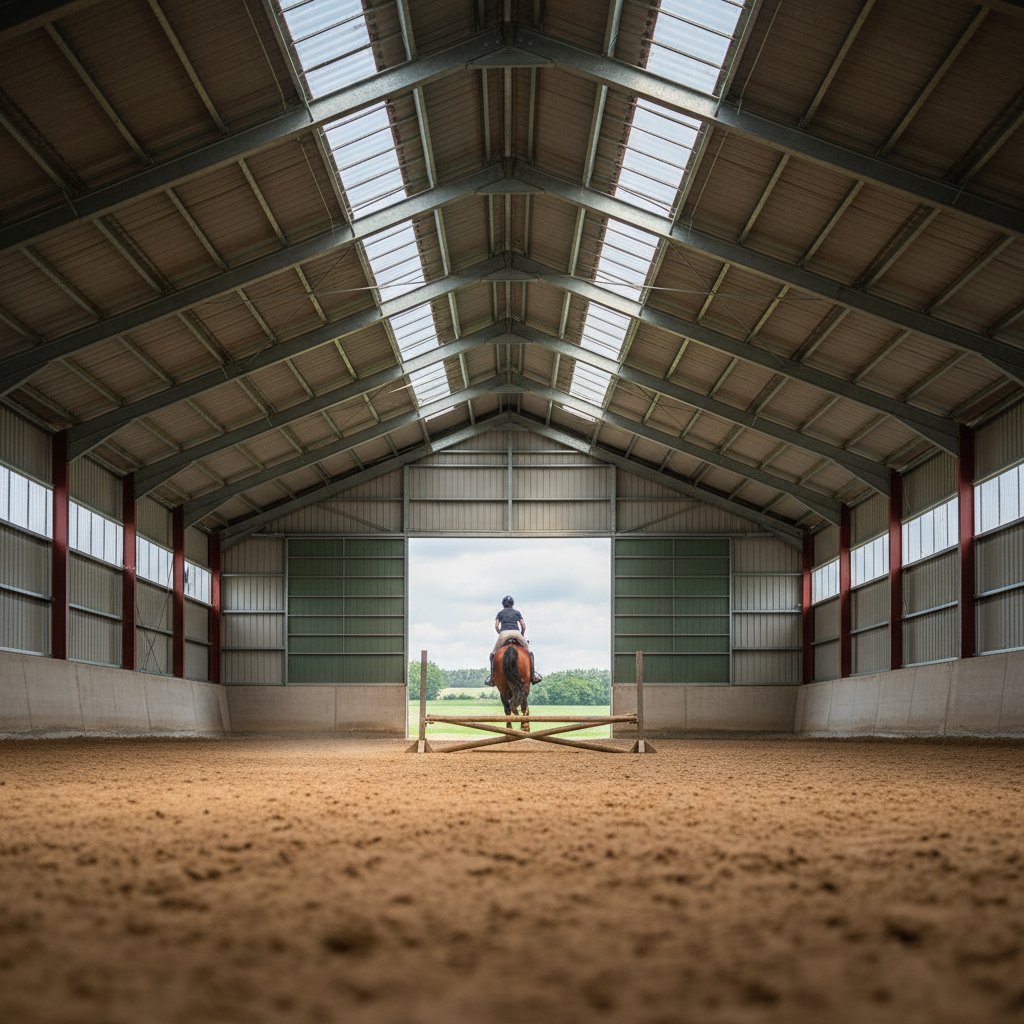
When you’re planning a new indoor riding arena, it's easy to get caught up in the dimensions of the riding surface itself: 20x40 metres for dressage, maybe 20x60m for a long court, or a generous 30x60m+ for jumping. But here's the thing: while the length and width dictate your riding space, the ceiling height often dictates its true utility, safety, and long-term value. It’s not just about keeping the rain off; it's about creating an environment where horses and riders can thrive.
Consider Hans, a professional show jumper and trainer from North Holland. He was planning a new 20x60m indoor arena for his equestrian centre. His initial thought was to go with a standard 4.5-metre ceiling clearance, which seemed perfectly adequate for daily training. He'd even received a quote for the steel structure around €80,000 from a local Dutch supplier, but it lacked comprehensive CE certification and felt a bit overpriced for the specifications.
However, Hans started thinking about the future. He wanted to host small regional jumping competitions and attract high-level clients. He also knew his top horses, some standing over 170cm, needed plenty of air above them for powerful take-offs. The FEI (Fédération Équestre Internationale) standards for international jumping competitions stipulate a 5-metre ceiling clearance. While his regional shows wouldn't be international, aiming for that standard would set his facility apart. The dilemma was clear: invest a bit more upfront for a higher ceiling or save a few thousand euros now and potentially limit his future opportunities. He knew that compromising on safety or functionality was not worth the hassle.
Beyond Clearance: Why Ceiling Height Truly Matters
The height of your arena ceiling isn't just a number on a blueprint; it’s a fundamental design choice that impacts everything from air quality and light to rider safety and the versatility of your facility. A well-designed arena fosters a healthy, productive environment for both horses and riders. Skimping on height can lead to a cramped, poorly ventilated space that quickly feels outdated and limits your potential.
For jumpers, insufficient height is an obvious safety hazard. A horse clearing a 1.40m fence needs significant vertical space above the obstacle, especially if they add a metre or more to their jump. But even for dressage, a low ceiling can feel oppressive, affecting the horse's natural elevation in movements and making the entire space feel less inviting. The truth is, optimal height contributes to the psychological comfort of both horse and rider.
Navigating the Technical Standards
When it comes to arena ceiling height, there are industry standards and best practices that guide optimal design. These aren't just arbitrary numbers; they are based on safety, animal welfare, and functional requirements.
FEI Arena Ceiling Clearance Guidelines:
| Discipline | Minimum Ceiling Clearance | Recommended Ceiling Clearance | International Competition |
|---|---|---|---|
| Dressage | 4.0 metres | 4.5 metres | 4.5 metres |
| Show Jumping | 4.5 metres | 5.0 metres | 5.0 metres |
| Driving/Eventing | 4.0 metres | 4.5 metres | 4.5 metres |
| General Training | 4.0 metres | 4.5 metres | N/A |
While these are guidelines, smart builders and owners aim for the recommended or international competition heights, especially for jumping. A 5-metre clearance for a jumping arena allows for comfortable jumps up to 1.50m and beyond, providing a margin of safety and the feeling of openness that riders appreciate.
Ventilation: The Silent Contributor to Horse Health
A critical, often overlooked, aspect of ceiling height is its role in ventilation. Horses produce a significant amount of heat, moisture, and ammonia. Without proper air exchange, these can accumulate, leading to respiratory issues and an uncomfortable environment. Higher ceilings allow for a larger volume of air, which helps dilute airborne pollutants and manage temperature fluctuations.
According to technical norms, a stable environment requires a minimum of 150-200 m³/hour/horse ventilation, aiming for 10 times air exchange per hour. While mechanical ventilation systems play a vital role, a generous ceiling height enhances natural convection, allowing warmer, stale air to rise and exit, while cooler, fresh air enters at lower levels. It’s an integral part of maintaining the air quality that regulators like Germany's Veterinäramt, France's DGAL, or the Netherlands' NVWA might scrutinise.
Lighting and Insulation: Making Every Metre Count
Beyond air, ceiling height profoundly affects natural light and thermal performance. Taller walls and a higher roof allow for larger windows or translucent roof panels, bringing in more natural light. This reduces the reliance on artificial lighting, saving energy costs and creating a more pleasant, natural environment for horses, which in turn can positively impact their well-being.
When it comes to insulation, a higher ceiling means a larger volume of air to heat or cool. This isn't necessarily a bad thing if the structure is well-insulated. An insulated arena structure, with a U-value of 0.25-0.35 W/m²K, will maintain a more stable internal temperature regardless of height, preventing condensation and reducing heating costs in winter. For uninsulated structures (U-value 5-6 W/m²K), a higher ceiling can mitigate some of the extreme temperature swings by offering a larger thermal buffer. This is where quality construction, like our CE-certified steel structures, truly shines.
The Cost Equation: Investment vs. Value
Here's where many project managers and stable owners get caught in a bind. A higher ceiling requires more steel, more cladding, and potentially more complex engineering for the structure. This naturally increases the upfront cost. However, viewing this solely as an expense misses the bigger picture of long-term value.
Let's look at Hans's situation again. He was considering a 20x60m arena. A standard 4.5-metre clearance might cost less initially. But upgrading to 5 metres, or even 5.5 metres for serious jumping, adds significant value.
Estimated Turnkey Arena Costs (2026, Structure Only, excluding groundworks/footings/surface):
| Arena Size | Ceiling Height | Premium Western (e.g., LLENTAB) | Swed-Trac (30-40% less) | Value Difference |
|---|---|---|---|---|
| 20x40m (Dressage) | 4.0m | €70,000 - €95,000 | €49,000 - €66,500 | €21,000 - €28,500 |
| 20x40m (Dressage) | 4.5m | €75,000 - €100,000 | €52,500 - €70,000 | €22,500 - €30,000 |
| 20x60m (Long Court) | 4.5m | €95,000 - €130,000 | €66,500 - €91,000 | €28,500 - €39,000 |
| 20x60m (Long Court) | 5.0m | €105,000 - €145,000 | €73,500 - €101,500 | €31,500 - €43,500 |
| 30x60m (Jumping) | 5.0m | €130,000 - €180,000 | €91,000 - €126,000 | €39,000 - €54,000 |
| 30x60m (Jumping) | 5.5m+ | €140,000 - €195,000 | €98,000 - €136,500 | €42,000 - €58,500 |
Note: Prices are estimates for the steel structure and cladding, excluding groundworks, specific footing, and full turnkey installation, which can push total project costs for a 20x40m arena to €65,000-€110,000 and a 30x60m+ arena much higher.
As you can see, the jump from 4.5m to 5.0m for a 20x60m arena might add €7,000-€10,000 to Swed-Trac’s price, but it adds significantly more value and future potential. This is often worth the money in the long run. Swed-Trac offers a compelling proposition: our steel structures, certified CE per EN 1090-2 (execution class EXC2, EXC3 on request), are 30-50% cheaper than Western premium brands like LLENTAB, Röwer & Rüb, or Gooiermeer, yet deliver full EU-standard quality. This allows you to invest in optimal height without breaking the bank.
Regulatory and Structural Considerations
When building any equestrian facility in Europe, you're operating within a framework of regulations designed to ensure animal welfare and structural safety. EU Directive 98/58/EC sets overarching standards, which are then reinforced by national bodies like Germany's Veterinäramt, France's DGAL, or the Netherlands' NVWA. While these bodies don't typically specify arena ceiling height, they focus on overall welfare, ventilation, and safety, all of which are positively impacted by appropriate height.
From a structural perspective, a taller building requires careful engineering. Our CE certification per EN 1090-2, execution class EXC2 (and EXC3 on request), means our structures meet stringent EU safety and quality standards, independently verified by notified body 1487 (Lithuanian Standardization Department).
For taller structures, the foundation becomes even more critical. While central European regions might have a frost line at 0.8m, colder climates like Lithuania or Sweden require concrete foundations to be 1.2m deep. Our engineering team accounts for these factors, ensuring your taller arena is not just aesthetically pleasing but also structurally sound and built to last, backed by a 2-year structural warranty.
Future-Proofing Your Investment
Hans ultimately decided to go with a 5.0-metre ceiling for his 20x60m arena. He reasoned that the slight increase in initial cost from Swed-Trac's competitive pricing was a small price to pay for the versatility and higher resale value it would bring. He recognised that a premium facility, even if built more affordably, would attract better clients, enable him to host more diverse events, and stand out in the competitive Dutch equestrian market.
Grants from programmes like the EU CAP (Common Agricultural Policy) or rural development funds (EAFRD) are often available for agricultural investments, including equestrian facilities. A well-planned, high-quality structure that meets or exceeds welfare and safety standards might even strengthen your application for such funding, especially if it enhances rural tourism or economic activity. Banks like Deutsche Bank, Sparkasse, Crédit Agricole, ING, BNP Paribas, Danske, or Nordea are often more willing to finance projects that demonstrate robust planning and long-term viability.
A thoughtful investment in ceiling height today isn't just about the immediate cost; it's about safeguarding your reputation, ensuring the well-being of your horses, and maximising the value of your equestrian business for years to come.
FAQ
What is the minimum ceiling height for a dressage arena?
The minimum recommended ceiling clearance for a dressage arena is 4.0 metres, though 4.5 metres is generally preferred for comfort and versatility.
Does ceiling height affect ventilation in a riding arena?
Yes, a higher ceiling allows for a larger volume of air, which significantly improves natural ventilation, helping to dilute airborne pollutants and manage temperature more effectively.
How does arena ceiling height impact construction cost?
A higher ceiling requires more steel and cladding materials, leading to an increase in the overall construction cost of the structure. However, this added cost is often offset by increased functionality and value.
Is a higher arena ceiling always better?
While a higher ceiling offers benefits like improved ventilation, light, and versatility, there's a point of diminishing returns in terms of cost and practical benefits. Optimal height balances these factors based on the arena's primary use.
What are the regulatory requirements for arena height in Europe?
EU Directive 98/58/EC and national bodies like Veterinäramt (Germany) or NVWA (Netherlands) don't typically specify exact arena ceiling heights, but they focus on overall animal welfare, ventilation, and safety, which are all positively impacted by adequate height.
Can Swed-Trac build custom ceiling heights for an arena?
Absolutely. As a manufacturer of CE-certified steel structures, Swed-Trac can engineer and build arenas with custom ceiling heights to meet specific client requirements, adhering to all safety and quality standards.
What warranty does Swed-Trac offer on its arena structures?
Swed-Trac provides a 2-year structural warranty and a 2-year interior warranty, ensuring peace of mind for your investment.
Do grants cover the additional cost of a higher arena ceiling?
Grants from programs like EU CAP or EAFRD focus on agricultural and rural development. While not specific to ceiling height, a higher-quality, well-planned facility that enhances welfare and functionality might strengthen your grant application.
Investing in the right arena ceiling height is a decision that pays dividends in safety, performance, and the long-term value of your equestrian facility. Don't compromise on a crucial element that impacts everything from horse health to your business's potential.
Ready to discuss the ideal arena design for your needs? Contact Swed-Trac today for a consultation and a competitive quote on a CE-certified steel structure that balances quality and cost.
📞 +370 645 18595