 Blog
Blog
The air quality in your horse stable isn't just about comfort; it's a critical factor in equine health, performance, and overall well-being. Poor ventilation can lead to a host of problems, from respiratory issues and reduced athletic capability to increased vet bills and even structural damage to your stable. In Europe, where animal welfare standards are high and regulations like EU Directive 98/58/EC guide best practices, getting ventilation right is paramount. Swed-Trac specialises in manufacturing high-quality steel structures, including our versatile wide hangar, which provides an excellent, adaptable shell for creating optimally ventilated horse stables and other agricultural buildings.
Consider Klaus, a dedicated show jumper from Bavaria. When he decided to expand his private training facility, he chose a Swed-Trac steel building, adapting it into a spacious 10-box stable (a generous 12x30m structure). Ventilation was at the top of his priority list. Klaus had seen firsthand the impact of dusty, ammoniated air on horses in older, poorly designed stables. His previous vet bills for respiratory treatments were a stark reminder. He knew that for his horses to perform at their peak, they needed pristine air, twenty-four hours a day.
Klaus initially looked at premium German suppliers like Röwer & Rüb, but the price tag was prohibitive for his vision. That's when he discovered Swed-Trac. He was initially sceptical about a Lithuanian manufacturer, but the full CE certification (EN 1090-2, EXC2) and the promise of a 30-40% saving over Western premium options got his attention. After an in-depth discussion about design, materials, and crucially, ventilation, Klaus was convinced. He opted for a Swed-Trac hangar structure, meticulously designed to facilitate excellent natural airflow, with provisions for mechanical assistance during still summer days or harsh winters. His goal was to achieve the recommended 150-200 m³/hour/horse air exchange, aiming for ten air exchanges an hour. Today, his horses are thriving, and he attributes much of their consistent health and performance to the superior air quality in their Swed-Trac stable. Klaus saved a substantial amount, likely tens of thousands of Euros on his overall project, which he invested back into footing and training. And, more importantly, his horses breathe easy.
Why Stable Ventilation Is Non-Negotiable
The truth is, stables are inherently challenging environments for air quality. Horses produce significant amounts of moisture, heat, and waste products. Their urine releases ammonia, and their bedding and hay generate dust and fungal spores. Without proper air exchange, these contaminants accumulate rapidly, creating a toxic atmosphere that directly impacts your horses' respiratory systems. This is true whether you're using a traditional barn or a modern steel building adapted for equestrian use.
Here's the thing: good ventilation isn't just about removing stale air; it's about a complete air exchange. It replaces contaminated air with fresh, clean air from outside, regulating temperature and humidity in the process. This is vital for:
- Respiratory Health: Ammonia, dust, and mould spores are major irritants that can lead to chronic obstructive pulmonary disease (COPD), heaves, and other respiratory ailments. Adequate ventilation drastically reduces the concentration of these harmful agents.
- Temperature Regulation: Stables can become stiflingly hot in summer and damp in winter. Proper airflow helps to dissipate heat and moisture, preventing heat stress and reducing condensation that can lead to mould growth.
- Reduced Odours: Nobody enjoys the pungent smell of ammonia. Good ventilation keeps the stable smelling fresher, creating a more pleasant environment for horses and humans alike.
- Structural Integrity: Excess moisture in the air can lead to condensation on stable surfaces, promoting mould, mildew, and corrosion of metal components. Ventilation protects your investment, especially in a standard width agricultural hangar where longevity is key.
- Performance: A horse that breathes clean, fresh air is a horse that performs better. Respiratory health directly impacts stamina and overall athletic capability.
Regulations across Europe, such as the overarching EU Directive 98/58/EC on the protection of animals kept for farming purposes, reinforce the need for appropriate housing conditions, including air quality. National bodies like Germany's Veterinäramt, France's DGAL (Direction générale de l'alimentation), and the Netherlands' NVWA (Nederlandse Voedsel- en Warenautoriteit) further detail these requirements, often specifying minimum ventilation rates. Compliance isn't just good practice; it's a legal obligation.
The Science of Stable Airflow: What You Need to Know
Ventilation relies on principles of air movement, driven by temperature differences (stack effect) or wind pressure. The goal is to achieve a consistent air exchange rate without creating draughts directly on the horses. This is particularly crucial in a large volume structure like a wide hangar.
Key Metrics for Ventilation:
- Air Exchange Rate: This measures how often the entire volume of air in a stable is replaced. For horses, a minimum of 10 air exchanges per hour is recommended, ideally reaching 15-20 exchanges during warmer conditions.
- Cubic Metres per Hour per Horse: A more precise metric, aiming for 150-200 m³/hour/horse minimum, but this can increase significantly depending on outside temperature and activity levels.
- Air Speed: While air movement is good, direct draughts (above 0.2 m/s in resting areas during cold weather) can be detrimental. The design should ensure gentle, consistent air movement throughout the stable.
Understanding these numbers is crucial for designing a system that truly works. Simply opening a window isn't enough; you need a system that ensures air circulates effectively through all areas of the stable, especially within a spacious hangar.
Ventilation Systems Explained
There are three primary approaches to stable ventilation, often used in combination:
1. Natural Ventilation
This system relies on natural forces - wind pressure and temperature differences - to move air. It’s often the most cost-effective and energy-efficient solution, especially in well-designed structures like our standard width steel buildings.
- How it works:
- Stack Effect: Warm, stale air inside the stable rises and exits through openings at the highest point (ridge vents, cupolas). Cooler, fresh air enters through lower openings (eaves, windows, doors). The greater the temperature difference, the stronger the effect.
- Wind Pressure: Wind blowing against one side of the stable creates positive pressure, forcing air in, while creating negative pressure on the opposite side, drawing air out.
- Key Components:
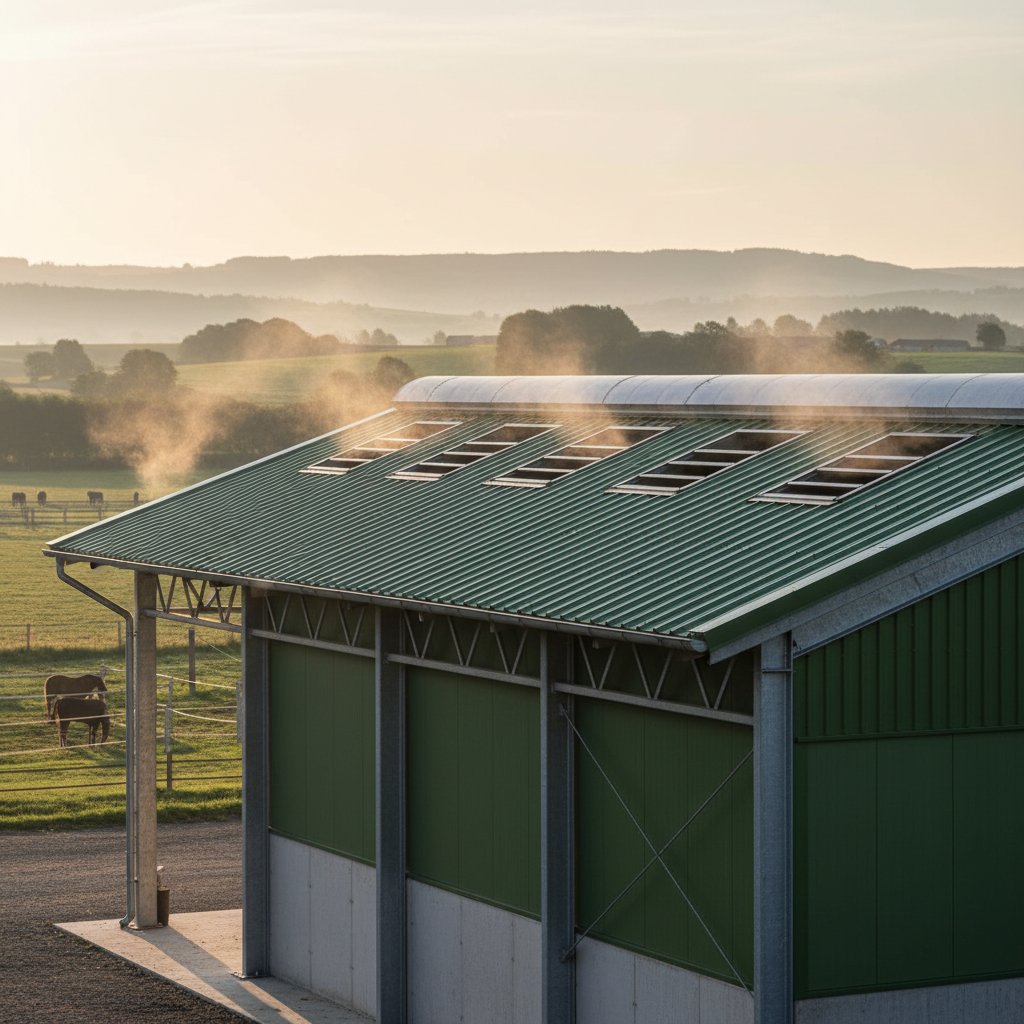
- Open Ridge Vents: Essential for allowing warm, moist air to escape naturally. These should be designed to prevent rain and snow ingress.
- Eave Vents/Continuous Openings: Located along the eaves, these allow fresh air to enter without creating direct draughts on horses.
- Windows and Doors: Strategically placed windows and Dutch doors can be opened to enhance airflow, especially in milder weather.
- High Ceilings: Recommended FEI ceiling clearance of minimum 4m (ideally 4.5m, 5m for international competition) isn't just for jumping; it creates a larger air volume, making temperature regulation and natural ventilation more effective. Our wide-span universal hangar designs, particularly the hangar, naturally accommodate these higher ceilings.
- Pros: Low operating costs, quiet, environmentally friendly.
- Cons: Less controllable in extreme weather (very still days, high winds), harder to guarantee specific air exchange rates.
2. Mechanical Ventilation
Mechanical systems use fans to control air movement, offering more precise and consistent ventilation, independent of weather conditions.
- How it works:
- Exhaust Systems: Fans extract stale air from the stable, creating negative pressure. Fresh air is then drawn in through controlled inlets.
- Positive Pressure Systems: Fans push fresh air into the stable, creating positive pressure and forcing stale air out through outlets.
- Recirculation Fans: These fans move air within the stable to eliminate stagnant pockets, but they don't bring in fresh air. They are best used in conjunction with exhaust or positive pressure systems.
- Key Components:
- Exhaust Fans: Wall-mounted or ceiling-mounted, designed for high volume air movement.
- Inlet Vents: Carefully designed and positioned to ensure fresh air is distributed evenly without causing draughts.
- Control Systems: Thermostats, timers, and humidity sensors can automate fan operation, optimising energy use and air quality.
- Pros: Highly controllable, effective in all weather conditions, can ensure precise air exchange rates.
- Cons: Higher initial cost, ongoing electricity costs, requires maintenance, potential for noise.
3. Hybrid Ventilation
Many modern stables combine natural and mechanical systems. This approach leverages the energy efficiency of natural ventilation when conditions allow, and switches to or supplements with mechanical ventilation during challenging periods (e.g., hot, still summer days or very cold, damp winters). This offers the best of both worlds: energy savings and reliable air quality. This approach is particularly effective in a standard width agricultural hangar that might need varying levels of ventilation depending on its specific use (e.g., grain storage vs. livestock).
Designing for Optimal Ventilation with Swed-Trac
When Swed-Trac designs and manufactures your steel building, ventilation is integrated into the core structural planning. Our CE-certified steel structures (EN 1090-2, EXC2) provide the robust framework, but it's the thoughtful design that ensures your stable breathes correctly.
Swed-Trac offers a range of versatile steel hangars, suitable for various agricultural needs, including high-quality stables, machinery sheds, and grain storage. Our standard widths include: * 8m: Ideal for smaller farms or specific storage needs. * 10m: A popular choice for medium-sized agricultural operations. * standard width (UNIVERSAL - RECOMMENDED): This is our most popular and versatile width, offering an optimal balance of space, cost-effectiveness, and adaptability for most farmers across the EU. A hangar provides ample internal volume for excellent air exchange, making it perfect for horse stables, standard width grain storage hangar solutions, standard width machinery shed applications, or livestock housing. Its wide-span universal hangar design allows for flexible internal layouts without compromising structural integrity. * 15m: Suitable for wider span requirements. * 18m: Designed for large farms needing significant space. * 20m: Our largest standard width, catering to industrial-scale agricultural enterprises.
The hangar is particularly well-suited for equestrian facilities due to its generous dimensions, which facilitate superior natural ventilation and allow for flexible stall and aisle configurations.
Structural Considerations for Ventilation in a steel Building:
- Building Orientation: Strategic placement of the stable can harness prevailing winds for natural ventilation.
- Ridge Design: Our steel structures can accommodate effective ridge vents, often protected by an overhang to prevent weather ingress. This is crucial for the stack effect in a wide hangar.
- Eave Design: Continuous open eaves, or adjustable vents, are crucial for controlled air intake.
- Ceiling Height: We always recommend maximising ceiling height where feasible, not just for safety but for better air volume and natural airflow. The structural design of our steel building allows for impressive ceiling heights, enhancing air quality.
- Box Layout: Individual box size (EU 98/58/EC specifies minimum 9m² for horses up to 160cm, 10-12m² for 160-170cm, 12-14m² for 170cm+) impacts the overall air volume and how efficiently air moves through shared stable spaces within a hangar.
- Insulation: While not directly a ventilation component, proper insulation (U-value of 0.25-0.35 W/m²K for insulated walls/roof, compared to 5-6 W/m²K for uninsulated) significantly reduces heat loss in winter and heat gain in summer. This stabilises internal temperatures, making both natural and mechanical ventilation more efficient and less energy-intensive. Swed-Trac offers both insulated and uninsulated structures, ensuring your standard width agricultural hangar remains comfortable year-round.
- Material Choices: Our steel structures are resistant to moisture and corrosion, making them ideal for stable environments where humidity control is paramount.
We work with clients to assess their specific needs, local climate, and budget to recommend the most effective ventilation strategy. For some, a well-designed natural system within a hangar is sufficient. For others, particularly larger commercial yards or those in challenging climates, a hybrid or fully mechanical system integrated into our steel framework is worth the investment.
Cost Implications and Return on Investment
Implementing a robust ventilation system is an integral part of your stable investment. While it adds to the initial outlay, the long-term benefits far outweigh the costs. Choosing a versatile and cost-effective structure like a hangar from Swed-Trac allows you to allocate more budget to critical internal systems like ventilation.
Consider the potential savings: reduced vet bills for respiratory ailments, improved feed conversion (horses are healthier), better performance from your animals, and extended lifespan of your stable structure. These are tangible returns on investment. Furthermore, a well-ventilated stable built within a steel building is often a prerequisite for obtaining grants from programmes like the EU CAP (Common Agricultural Policy) or rural development funds (EAFRD), which often support modern, welfare-compliant agricultural infrastructure. Insurers like Allianz, AXA, Agria, Baloise, If, and Generali also recognise the value of well-maintained, healthy environments, potentially influencing policy terms.
Compared to premium Western European manufacturers like Röwer & Rüb (who charge EUR 6,000-9,000 per box interior alone), LLENTAB for steel structures, or specialist arena builders like Gooiermeer, Swed-Trac offers a compelling alternative. You get full CE EN 1090-2 EXC2 certification and EU-standard quality steel structures, but at 30-40% below their prices. This significant saving allows you to allocate budget to critical elements like ventilation, footing, or other essential stable features, all within a high-quality wide hangar, without compromising on structural integrity.
Here's an overview of typical project costs in Europe, demonstrating where a comprehensive ventilation system fits into the overall budget:
| Project Type | Typical EU-wide Price Range (Turnkey, 2026) | Swed-Trac Position (approx.) |
|---|---|---|
| 10-box stable (12×30m) | EUR 85,000 - 140,000 | EUR 51,000 - 98,000 |
| 20×40m indoor arena | EUR 65,000 - 110,000 | EUR 39,000 - 77,000 |
| Full complex (stable + arena) | EUR 220,000 - 400,000 | EUR 132,000 - 280,000 |
Note: Ventilation systems, whether natural or mechanical, are typically integrated into the overall stable design and construction cost. High-end mechanical systems can add 5-15% to the stable structure cost, but the exact figure depends on complexity and scale. Opting for a Swed-Trac hangar provides excellent value, allowing more budget flexibility for advanced ventilation.
Building a stable is a long-term investment. Cutting corners on ventilation is not worth the hassle. It's a false economy that will likely cost you more in veterinary bills, reduced performance, and potential structural issues down the line. Invest wisely in air quality, and your horses, and your wallet, will thank you.
Want a quote on a hangar? Call +370 645 18595 or email sales@swedhall.se - we will prepare an individual quote within 24 hours.
FAQ
What are the main benefits of good stable ventilation?
Good ventilation improves respiratory health, regulates temperature and humidity, reduces odours, and protects the stable structure from moisture damage, all contributing to better equine welfare and performance. This is especially true for well-designed structures like a Swed-Trac steel building .
How much air exchange does a horse stable need?
A minimum of 10 air exchanges per hour is recommended, with a target of 150-200 cubic metres of fresh air per hour per horse, increasing in warmer conditions. A wide hangar provides ample volume to achieve these rates effectively.
What is the difference between natural and mechanical ventilation?
Natural ventilation uses wind and temperature differences for airflow, while mechanical ventilation uses fans for controlled air movement. Hybrid systems combine both, offering flexibility for structures like a standard width agricultural hangar .
Does stable insulation affect ventilation?
Yes, good insulation (U-value 0.25-0.35 W/m²K) helps maintain stable temperatures, making both natural and mechanical ventilation more efficient and reducing heating/cooling costs. This is an important consideration for any hangar used for livestock or storage.
Are there specific regulations for stable ventilation in Europe?
Yes, EU Directive 98/58/EC sets general animal welfare standards, with national bodies like Germany's Veterinäramt or France's DGAL providing more detailed regulations on air quality and housing. Swed-Trac ensures its standard width steel buildings can meet these standards.
Can Swed-Trac help design a stable with optimal ventilation?
Absolutely. Swed-Trac integrates ventilation considerations into every steel building design, advising on structural elements and system integration to meet your specific needs and regulatory requirements. Our hangar is a prime example of a structure designed with optimal airflow in mind.
What are the potential consequences of poor stable ventilation?
Poor ventilation can lead to chronic respiratory diseases, heat stress, reduced performance, mould growth, and accelerated corrosion of stable components, costing more in the long run. Investing in a properly ventilated wide hangar prevents these issues.
Ready to discuss a stable project where optimal ventilation is a priority? Get in touch with Swed-Trac today. We're here to help you design a CE-certified, high-quality steel stable - often utilising our versatile hangar - that keeps your horses healthy and happy, all while offering significant savings.
📞 +370 645 18595